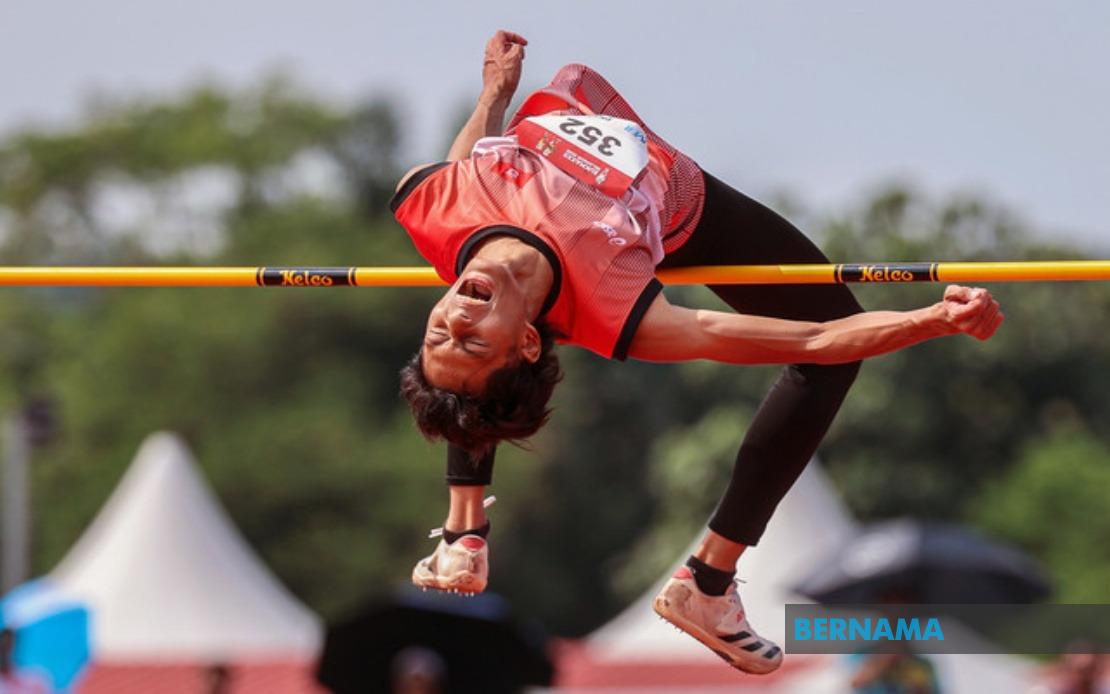
An 18-year-old high jumper from Kelantan has delivered one of the season's most dramatic performances at the Selangor SUKMA 2026 championships, vaulting into the national athletics spotlight with a commanding victory in the high jump competition held at Universiti Putra Malaysia's sports facility. The achievement represents a transformation in trajectory for Dzul Darwisy Adam Khairulaswari, who languished in 11th place when Sarawak hosted the biennial Malaysia Games just two years earlier, underscoring the potential for rapid athletic development among Malaysia's younger generation of track-and-field competitors.
Clearing an impressive height of 2.09 metres, Dzul Darwisy secured Kelantan's second gold medal in the athletics programme at this edition of the competition, cementing his emergence as a genuine medal contender at Malaysia's premier multi-sport championship. His victory was decisive within the high jump field, with two Kedah athletes claiming the secondary medals—Muhamad Nawawi Mohamad captured silver after managing 2.07 metres, while Muhammad Naufal Zulkifli's bronze-medal effort of 2.04 metres placed him third on the podium. The result signals a competitive realignment in Malaysian high jump, with Kelantan's athlete now positioned among the nation's elite performers in this technical jumping discipline.
For Dzul Darwisy, the Selangor victory represents a watershed moment in his athletic career that extends beyond the numerical achievement of winning gold. The teenager reflected on his breakthrough with a mixture of gratitude and humility, characterising the outcome as both blessing and vindication for his perseverance through periods of relative underperformance. He acknowledged that this inaugural triumph at a major national championship stage had long eluded him despite years of competitive engagement across Malaysia's school and age-group athletics circuits. His previous attempts to deliver results at the Malaysian School Sports Council (MSSM) national finals had yielded only modest placements, including a third-place showing in 2023 when he was still in Form Three, creating palpable pressure as he matured into his senior competitive years.
The circumstances surrounding his gold-medal performance add further dimension to Dzul Darwisy's narrative at SUKMA 2026. Throughout the competition, the young athlete contended with a persistent back injury that constrained his physical capacity and mental confidence during training and warm-ups. Despite this physical impediment, he not only achieved gold but also elevated his personal best from a previous mark of 2.03 metres to the championship-winning height of 2.09 metres. This four-centimetre improvement is particularly significant in high jump, where marginal gains represent major technical and physiological accomplishments. His acknowledged frustration that he fell short of his aspirational targets of 2.13 to 2.15 metres suggests that even his breakthrough performance contains untapped potential waiting to be realised in future competitions.
For Malaysian athletics observers, Dzul Darwisy's trajectory also illuminates the broader competitive landscape at the Southeast Asian level. The young jumper has already set his sights on qualifying for next year's SEA Games, which will require him to surpass the 2.16-metre threshold—a demanding but potentially achievable progression from his current personal best. Should he achieve that mark, Malaysian athletics would gain another competitive voice in regional championship competition. Beyond SEA Games aspirations, Dzul Darwisy has expressed ambitions to chase the SUKMA championship record of 2.21 metres, a standard established by A. Kavee Alagan of Negeri Sembilan during the 2012 edition hosted in Pahang. This record has stood for over a decade, suggesting both its difficulty and the opportunity for a new generation of Malaysian jumpers to claim national sporting legacy.
The presence of former national high jump champion Lee Hup Wei at the Selangor finals, now serving as the national reserve coach, reflects the institutional attention being paid to Malaysia's high jump development pathway. Experienced coaches shadowing emerging talent at championship venues represents a structured approach to talent identification and mentorship. Dzul Darwisy's performance at UPM thus serves not merely as an individual achievement but potentially as a demonstration case for how technical coaching support can facilitate rapid improvement within Malaysia's athletics programme. The attention from established national figures suggests he will likely receive elevated coaching resources and international competition opportunities that can further accelerate his development.
The psychological dimension of Dzul Darwisy's breakthrough merits consideration for Malaysian sports culture more broadly. Athletes who experience early disappointment—such as his 11th-place SUKMA finish and modest MSSM results—often face questions about their ceiling and competitive mettle. His ability to respond with a championship victory demonstrates mental resilience and the capacity to learn from earlier setbacks. In a sporting environment where some athletes fade after early disappointments, Dzul Darwisy's redemptive arc offers an instructive counter-narrative about persistence and athletic development trajectories that are non-linear but ultimately successful.
From a regional perspective, Dzul Darwisy's emergence strengthens Malaysian athletics' competitive depth in field events. Southeast Asia's high jump competition has historically been dominated by Vietnamese and Thai performers, with Malaysian jumpers struggling to consistently produce world-class results. A developing athlete capable of approaching 2.16 metres and potentially challenging the SUKMA record adds substance to Malaysia's claim as a credible regional athletics power. Should he progress toward SEA Games competition and international standards, Malaysian track-and-field would benefit from enhanced visibility and competitive standings within the regional sports hierarchy.
Looking ahead, Dzul Darwisy's trajectory suggests the value of sustained investment in Malaysian athletics development programmes, particularly in technical field events where Malaysia has historically underperformed relative to volleyball and badminton. His story—from 11th place to national champion in two years—demonstrates that competitive breakthroughs are possible within Malaysia's existing coaching and competition infrastructure. Whether this represents the beginning of a sustained rise or a singular excellent performance remains to be determined at upcoming national and regional championships. Nevertheless, his SUKMA 2026 gold medal stands as immediate validation of his potential and a reminder that Malaysian athletics continues producing compelling athletic narratives worthy of sustained national attention.

