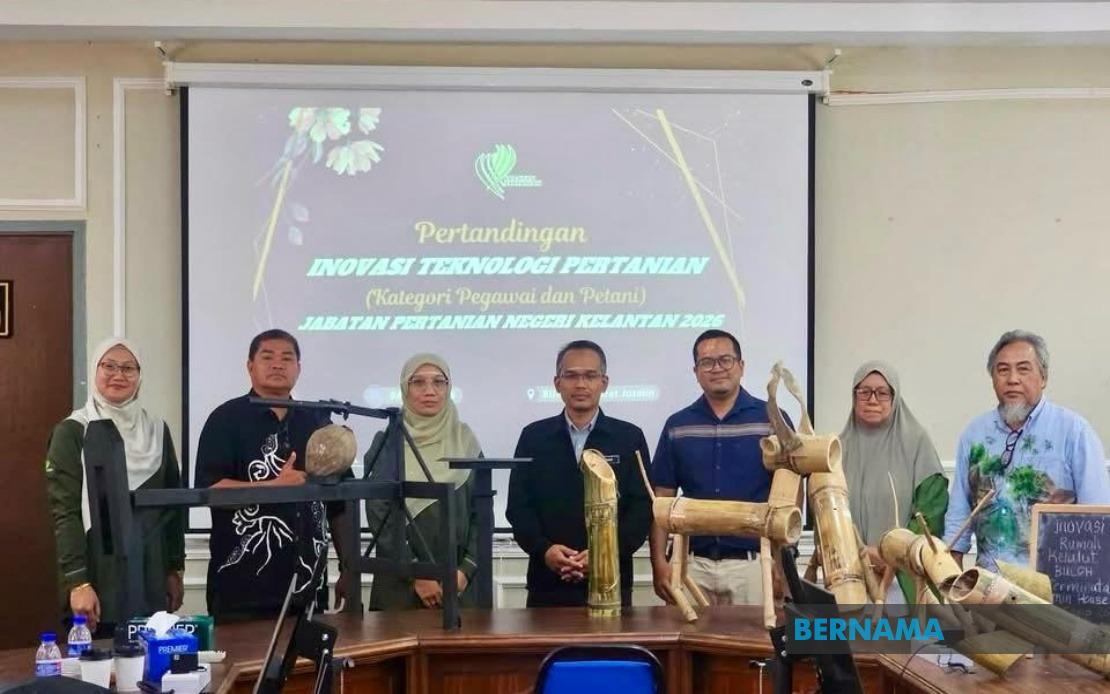
An agricultural innovation emerging from Kelantan's farming heartland is attracting interest far beyond coconut plantations. Che Adnan Che Kadir, a 56-year-old plantation entrepreneur, has secured a four-star rating for his coconut dehusking device at the Kelantan Department of Agriculture's 2026 Agricultural Technology Innovation Competition, with judges now proposing the technology be adapted for processing durians—a crop that presents distinctly different operational challenges but shares the core problem of labour-intensive handling and injury risk.
The recognition places Che Adnan's invention at a potential inflection point between grassroots farm innovation and commercial application. Judges from the Kelantan Department of Agriculture, the Malaysian Agricultural Research and Development Institute (MARDI), and local polytechnics evaluated the device and identified durian processing as the most promising avenue for expansion. The suggestion reflects broader thinking within Malaysia's agricultural sector about mechanising tasks that traditionally depend on skilled manual labour and expose workers to repetitive strain and cutting injuries.
Che Adnan's achievement carries personal significance beyond the award itself. Developed in 2024 to address the practical frustrations of managing a six-hectare farm in Kampung Chetok, Pasir Mas, the portable 3.5-kilogramme device emerged from genuine operational need rather than theoretical engineering. Traditional coconut dehusking consumes two to three minutes per fruit when done by hand; the device reduces this to approximately one minute, with experienced operators achieving results in 40 to 45 seconds. This efficiency gain directly translates to labour savings and reduced physical strain for plantation workers—considerations that resonate throughout Southeast Asia's agricultural sector, which faces persistent labour shortages and safety concerns.
The farmer's reaction to the judges' proposal for durian adaptation reveals the collaborative spirit increasingly characterising Malaysia's innovation ecosystem. Che Adnan expressed surprise that a farm-level solution had garnered interest for wider commercialisation, underscoring how domestic agricultural challenges often reflect shared regional problems. Durians present particular mechanical difficulties that differ from coconuts. The spiky exterior, irregular shape, and requirement to preserve the fruit's integrity demand sophisticated design thinking. Malaysian durian farmers and exporters have long grappled with processing bottlenecks, particularly as international demand grows and supply chains demand faster throughput without compromising quality.
The state-level award positions Che Adnan as a candidate to represent Kelantan at National Innovation Week in Putrajaya in late September, an opportunity that would expose his invention to a national audience of policymakers, investors, and industry stakeholders. This platform carries implications beyond personal recognition; successful innovations often attract funding, licensing opportunities, and partnerships that accelerate commercialisation. The visibility matters particularly for agricultural technology, where adoption hinges not only on technical merit but on awareness among scattered farmer networks and agricultural organisations across the country.
Transforming prototype into product, however, demands resources currently beyond Che Adnan's reach. He has identified a RM10,000 national innovation grant as essential for refining the design based on judges' feedback and conducting the engineering work necessary for durian adaptation. The grant would enable stress-testing under commercial conditions, material refinement to handle durian-specific demands, and development of production-ready specifications. Without such support, the innovation risks remaining a promising local solution rather than achieving the broader agricultural impact that both judges and the entrepreneur envision.
The trajectory of this invention illustrates how Southeast Asian agricultural innovation often emerges bottom-up rather than through institutional research programmes. Smallholder and medium-scale farmers frequently identify mechanical solutions to immediate problems before formal agricultural research institutions address them. When such innovations reach evaluation bodies like MARDI or state agricultural departments, they gain credibility and access to networks that can drive scaling. The complementary roles of farmer-inventors and institutional support structures remain critical to Malaysia's agricultural modernisation agenda, particularly as the sector confronts demographic pressures and the need to improve productivity per worker.
Durian processing presents a strategic opportunity for technology adaptation. Malaysia's durian industry generated approximately RM3.87 billion in revenue in 2022 and continues expanding, with exports concentrated in Asian markets where demand consistently outpaces domestic Malaysian consumption. Processing innovations that maintain fruit quality while accelerating throughput could substantially improve export competitiveness and farmer profitability. A dehusking device adapted for durians would address not only small-scale farm operations but also medium and large-scale producers operating near ports and processing facilities.
The broader implications extend to Malaysia's positioning in Southeast Asia's agricultural technology landscape. Countries including Thailand, Indonesia, and Vietnam have invested heavily in agricultural mechanisation as rural labour becomes scarcer and younger generations migrate to urban employment. Malaysian innovations that prove effective at modest cost could establish export markets for the technology itself, transforming successful domestic solutions into intellectual property with regional reach. Che Adnan's potential path from Pasir Mas to national recognition to possible commercialisation mirrors the development trajectory that policymakers increasingly hope to encourage.
Looking forward, the farmer's stated intention to refine his design based on judges' recommendations and secure funding reflects realistic understanding of innovation's commercial phase. Moving from award-winning prototype to market-ready product requires investment in manufacturing processes, regulatory compliance, and demonstration programmes that convince sceptical farmers of reliability and cost-effectiveness. The agricultural sector historically shows reluctance toward new mechanisation solutions until they prove themselves through extended field trials and clear return-on-investment calculations.
For Malaysian agriculture broadly, innovations like Che Adnan's device represent incremental progress toward a more efficient, safer, and worker-friendly sector. The recognition by MARDI and the Department of Agriculture signals institutional commitment to identifying and nurturing such developments. As Southeast Asia's agricultural workforce continues aging and rural-to-urban migration accelerates, innovations that extend productivity per worker become increasingly vital to maintaining competitive food production and export industries. Che Adnan's journey from farm problem-solver to state award winner to potential national representative encapsulates the potential—and the modest resources currently allocated—to transforming agricultural innovation into commercial reality across Malaysia's farming communities.

