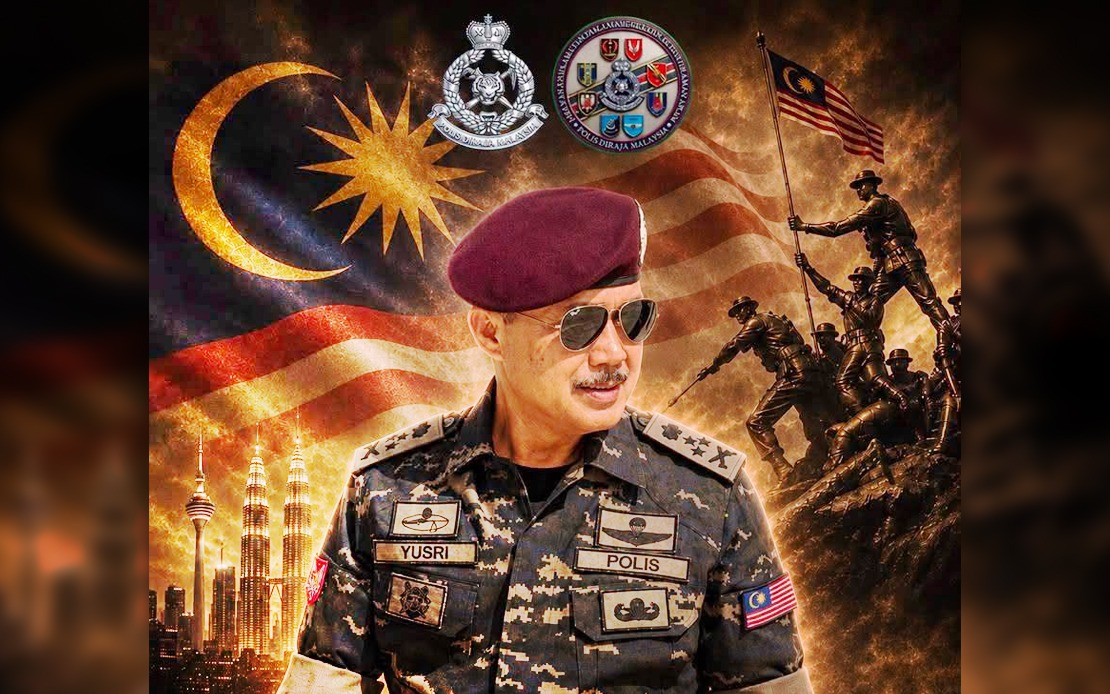
Datuk Seri Mohd Yusri Hassan Basri will exchange his motorcycle for horseback this year, trading the roar of a BMW R 1250 RT for the clip-clop of hooves as he leads the Royal Malaysia Police contingent at the 69th National Day Parade in Putrajaya on August 31. As director of the Department of Internal Security and Public Order (KDNKA), Yusri will command nearly 600 officers and personnel from atop Al-Sakb, a white horse, marking a symbolic shift in how the police force presents itself at the nation's most significant annual celebration.
The transition from motorcycle to mounted cavalry represents more than mere ceremonial theatre. The Federal Reserve Unit's Mounted Unit, comprising 20 trained officers and personnel along with 20 horses, will spearhead the entire PDRM contingent, establishing a visual anchor for the massive procession that will traverse Dataran Putrajaya. This restoration of equestrian elements to the parade reflects deliberate choices about how security forces wish to project authority and tradition—the horse carries historical weight in Malaysian ceremonial contexts, bridging modern policing with classical symbols of power.
For Yusri, the change presents both opportunity and challenge. His previous role leading the Traffic Investigation and Enforcement Department parade featured the contemporary roar of high-performance motorcycles, embodying technological modernity. Now, as KDNKA director overseeing internal security and public order, he must master an entirely different performance medium. The shift acknowledges that public security encompasses broader dimensions than traffic management, and the equestrian presentation signals KDNKA's diverse operational responsibilities across multiple domains.
Preparation for this ceremonial role has consumed more than a month of intensive training. Yusri underwent systematic instruction to ensure that not only his individual horsemanship meets parade standards, but that the entire Mounted Unit operates with synchronized precision. The training emphasises that ceremonial movements must appear effortless while requiring meticulous coordination—every turn, every halt, every advance down Dataran Putrajaya's thoroughfare demands months of preparation to execute flawlessly before the assembled crowds and national broadcast audience.
Beyond the mounted contingent, KDNKA's parade presence will showcase the full spectrum of contemporary police capabilities. The General Operations Force (GOF) and Air Operations Force will both feature prominently, demonstrating to Malaysian public that modern security operations extend far beyond traditional ground-level constabulary. This layered approach to presentation allows the force to communicate its operational reach and technological sophistication without resorting to military-style displays that might alienate civilian viewers.
Technological innovation will receive particular emphasis through recently acquired All Terrain Tactical Assault E-Bikes (ATEB), electric motorcycles supplied to the GOF for specialized operations including high-risk interventions, border patrol duties, and conflict management. These vehicles represent the intersection of environmental consciousness and tactical effectiveness—electric-powered platforms capable of silent approach and rapid deployment. For Malaysian audiences, such equipment signals that police modernization prioritizes both capability and sustainability.
The parade will also feature an AW139 helicopter flypast operated by PDRM's Air Operations Force, creating a dramatic vertical element that captures attention and demonstrates the force's three-dimensional operational capacity. Combined with the Mounted Unit at ground level and mid-tier GOF displays, the parade constructs a narrative of comprehensive security presence spanning terrestrial, tactical, and aerial domains.
Animal elements beyond horses will feature the K9 Unit's 16 elite working dogs, animals that embody the partnership between humans and trained creatures in law enforcement. These dogs represent real operational assets, not merely ceremonial accessories—they perform genuine security functions at borders, in searches, and during special operations. Their parade presence legitimizes police capability while acknowledging the living, breathing components that make enforcement effective.
Yusri has emphasized that flawless execution serves PDRM and KDNKA's institutional image, with smooth choreography and synchronized movements communicating competence and professionalism to Malaysia's viewing public. This perspective understands that parades function as political communication—citizens watching such displays form impressions about whether security institutions operate with discipline, purpose, and coordination. Every misstep or confusion would subtly undermine confidence in institutional capability.
The transition from JSPT leadership to KDNKA directorship naturally occasioned the shift from traffic-focused parade representation to broader internal security showcasing. KDNKA's portfolio encompasses public order maintenance, security operations, and internal stability—functions demanding presentation of diverse capabilities rather than single-purpose specialization. The mounted cavalry leadership visually anchors this expanded mandate, suggesting traditional stability and enduring authority rather than mere technical expertise.
Parade preparations have achieved optimal readiness according to Yusri, though weather conditions remain a variable beyond planners' control. His appeal for public attendance with families reflects institutional awareness that national celebrations require civilian participation to achieve full symbolic power. August 31 will test whether his training translates successfully to actual performance, whether Al-Sakb responds appropriately amid crowd noise and unfamiliar environments, and whether the synchronized Mounted Unit maintains formation integrity throughout the route.
For Malaysian viewers, the pageantry carries significance beyond immediate spectacle. How security institutions present themselves shapes public perception of state capacity, legitimacy, and capability. The decision to feature horses, modern tactical motorcycles, helicopters, and working dogs in coordinated sequence communicates that contemporary Malaysia maintains security through layered approaches combining tradition, technology, and trained personnel. Whether audiences focus on ceremonial elegance or operational substance, the parade succeeds in articulating how PDRM and KDNKA understand their evolving role in national life.

