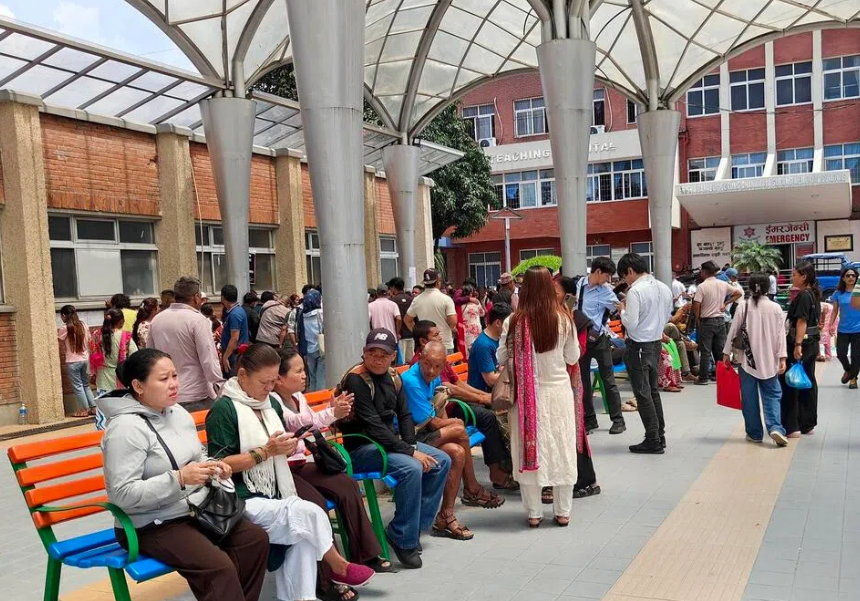
The gates of Tribhuvan University Teaching Hospital in Kathmandu have become a grim gallery of grief. For the past two days, photographs of deceased flood victims have lined the hospital entrance, a desperate measure to aid identification as Nepal grapples with the aftermath of a catastrophic flash flood that devastated the country's border region on August 26. The scale of the calamity has already claimed more than 500 lives in northern Nepal, with hundreds more still unaccounted for and search operations ongoing across the treacherous Bhotekoshi river system and its downstream areas.
The flood struck with sudden ferocity in one of the Himalayan nation's most remote and economically vital corridors. Rasuwa district, which sits along the crucial trade route to Tibet, bore the brunt of the devastation. Many of those missing were commercial drivers and traders ferrying goods between the Chinese border and Nepal's interior, while others were pilgrims returning from the sacred Kailash-Mansarovar pilgrimage route that passes through the affected region. This mix of local workers and international travellers has transformed what might otherwise be a largely domestic tragedy into an emergency drawing international attention and responses.
Outside the hospital gate, the human cost becomes visceral. Dolma Tamang, aged 36, has spent three days running between medical facilities searching for her sister and brother-in-law, both of whom were transporting goods through Rasuwa district when their phones went silent on the morning of August 26. She methodically examines each photograph displayed on the gate, her desperation mounting with each passing hour. "It has been very difficult; my tears have run dry," she told international media, capturing the emotional exhaustion that has gripped families across Kathmandu. Similar scenes repeat themselves daily, with hundreds of relatives circulating through hospitals carrying printed photographs and images stored on their phones, hoping against diminishing odds to locate their loved ones.
The psychological toll of this search is compounded by the hospital's grim working conditions. Bikesh Shrestha, searching for his cousin Rakesh, found himself unable to bear looking at the displayed photographs of mangled corpses. He physically turned away, hugging himself to prevent an emotional collapse, acknowledging the terrible possibilities while still hoping for a miraculous survival. Sushila Shrestha, merely 23 years old, searches for her 21-year-old brother Bir Bahadur, a driver heading toward the Chinese border when the flood struck. Her coping mechanism differs markedly—she clings to the absence of news as evidence of survival, reasoning that if his body had been found and identified, she would have heard by now. This psychological splitting between hope and reality characterizes the experience of thousands of families navigating what may be the most agonizing uncertainty imaginable.
The operational challenges facing Kathmandu's medical infrastructure reveal the scale of the disaster's impact. Tribhuvan University Teaching Hospital, one of only two major public facilities handling both casualties and the deceased, reported the missing persons list reaching more than 1,500 by the afternoon of August 28. Downstream in Chitwan district, a region famous for its national park and elephant sanctuaries, the situation has grown critical. By late August 28, 186 bodies had been recovered in Chitwan alone, but the district's hospitals can collectively accommodate only 30 to 50 cadavers in their existing morgues. Hospital administrators have begun reporting that facilities are running out of storage capacity across multiple districts, creating logistical nightmares even as rescue operations continue.
The rescue operation itself has mobilized enormous personnel and resources. More than 4,400 police officers have been deployed for search and rescue efforts, supplemented by units from the Nepali Army and Armed Police Force. Initial rescue operations on August 28 were halted briefly when authorities feared a barrier lake formed by debris might breach and unleash another catastrophic flood. By evening, officials declared the immediate danger had passed, though they acknowledged the situation remained fluid and unpredictable. The combination of mountainous terrain, ongoing aftershocks, and extensive debris makes search operations extraordinarily hazardous and time-consuming, limiting the pace at which missing persons can be located and processed.
International dimensions of the disaster have added complexity to what is already an overwhelmed response system. Nine Singaporeans remain missing, while the Nepal Tourism Board reported rescuing 121 foreign nationals by August 28, including 85 Indians and 16 Chinese nationals. More significantly, approximately 288 Indian nationals were reported missing, many of them pilgrims who had been at or near the Gyirong border crossing between Nepal and Tibet when the flood struck. That crossing was devastated, with viral video footage showing the border checkpoint being obliterated by mudslides and floodwaters that have become iconic images of the disaster's horrifying scale. Family members from India and the United Kingdom have begun flying into Kathmandu to search for their relatives, including a group from Tamil Nadu who arrived on the morning of August 28 to locate members of their travel group returning from the Mount Kailash pilgrimage.
Prime Minister Balen Shah's approach to international assistance reflects lessons learned from Nepal's 2015 earthquake experience. Despite offers from China, India and other nations to deploy search and rescue teams, the government has declined, citing coordination difficulties that arose when multiple international rescue operations competed for resources and access in the previous disaster. Instead, Nepal is requesting financial assistance channelled through a unified governmental mechanism that will be announced shortly. This strategy prioritizes reconstruction and rehabilitation assistance from international agencies and donor countries, effectively asking the international community to support Nepal's own response infrastructure rather than deploying parallel systems that could create confusion.
India's humanitarian response has nevertheless been substantial. New Delhi initially dispatched 47 tonnes of assistance through military transport aircraft, including temporary shelters, blankets, hygiene kits, solar lamps, medicines and food packets—the kinds of immediate support that can mean survival in the critical days following catastrophe. The Indian government has also offered prefabricated truss bridges to replace the dozens of small and large bridges destroyed across Nepal's border regions, recognizing that infrastructure restoration is essential both for recovery and for preventing future isolation of affected communities during natural disasters.
The Gyirong border area, which was severely damaged in the flash flood, has emerged as a particular focal point of international concern. The crossing serves as a crucial junction for pilgrims and traders, making its destruction especially significant. The popular Kailash-Mansarovar pilgrimage route, which attracts devotees from across South Asia and beyond, passes through Rasuwa district directly along this corridor. Many of the missing Indian nationals were either embarking on this sacred pilgrimage or returning from it when they became trapped in the flooding. The disruption of this important spiritual and commercial route carries implications far beyond immediate casualty figures, affecting the livelihoods of local communities and the religious practices of pilgrims from multiple nations.
As rescue and recovery operations continue, the full extent of the tragedy remains unknown. The missing persons lists grow by hours rather than days as more bodies are discovered and more families file reports. Kathmandu's hospitals remain overwhelmed, their corridors crowded with anguished relatives, their morgues taxed to capacity. The photographs on the hospital gates serve as unwilling monuments to Nepal's vulnerability to natural disaster, reminders that in a country where mountains define both identity and destiny, those same mountains can become conduits for catastrophe. For the families still searching, each photograph represents both the possibility of closure and the fear that answers may come in the worst form imaginable.

