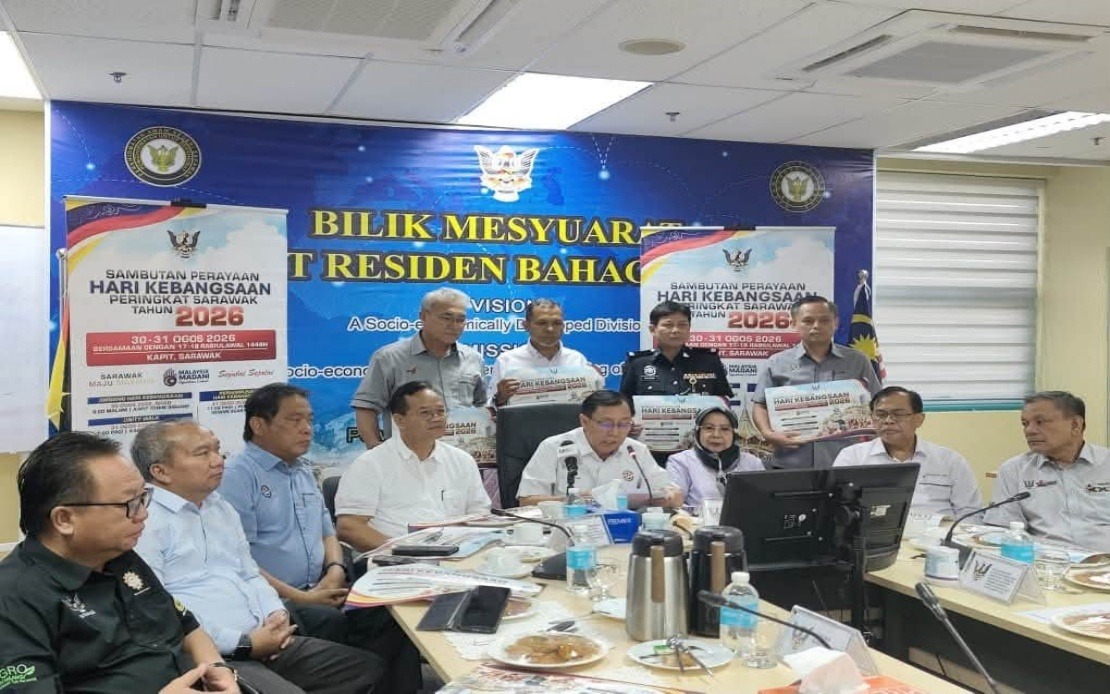
Kapit, a town in the heart of Sarawak's interior, will become the focal point of the state's National Day observance this year when Sarawak hosts its official celebration on August 30 and 31. The two-day programme represents a significant recognition for the division and demonstrates the state government's commitment to taking the commemoration across different regions rather than confining it to urban centres. The events have been deliberately structured to blend ceremonial significance with grassroots participation, creating opportunities for residents from Kapit Division and neighbouring areas to engage in the festivities.
Datak Seri Dr Stephen Rundi Utom, who holds the portfolios of Sarawak Food Industry, Commodity and Regional Development Minister and chairs the National Day celebration committee, outlined the underlying philosophy behind the initiative. He emphasised that the gathering transcends mere commemorative formality, instead serving as a carefully orchestrated platform to reinvigorate collective consciousness around shared national values. The focus extends beyond honouring the nation's founding moment to encompassing recognition of historical leadership and contemporary acknowledgement of the diverse populations that comprise Sarawak.
Senior state leadership has committed to attending portions of the celebration, underscoring its importance within the political calendar. Sarawak Governor Tun Dr Wan Junaidi Tuanku Jaafar and Sarawak Premier Tan Sri Abang Johari Tun Openg are both scheduled to participate, with the Governor slated to attend both the early morning Unity Walk commencing at 7 am on August 31 and the formal gathering at midday, while the Premier will focus on the main assembly event. Their attendance signals the state government's elevation of this occasion above routine administrative ceremonies.
The celebration framework comprises three sequential components, each designed to build momentum and deepen community involvement. On the evening of August 30, Kapit Town Square will transform into a gathering venue for the National Day Eve celebration, setting an informal tone that encourages public participation before the more structured events of the following day. This scheduling approach reflects modern event management principles that recognise the value of creating accessible entry points for broader audiences before progressing to formal state ceremonies.
The Unity Walk at dawn on August 31 carries particular symbolic weight in the contemporary Malaysian context. Early morning communal exercises involving government leaders and ordinary citizens represent tangible expressions of cohesion, moving beyond rhetorical affirmations of unity to create shared physical experiences. The choice of a 7 am start time, whilst demanding early participation, traditionally signals the seriousness with which organisers view the event and attracts committed participants genuinely invested in the commemoration rather than casual attendees.
Following the Unity Walk, proceedings will shift to the grounds surrounding Dewan Suarah Kapit for the formal National Day Gathering at 11 am. This venue selection anchors the celebration within Kapit's civic infrastructure, using the state assembly building as a focal point that carries institutional weight. The timing allows participants who completed the morning walk to refresh before gathering for speeches, official ceremonies, and whatever entertainment or cultural programming the organisers have arranged.
For those unable to journey to Kapit physically, the state government has ensured accessibility through broadcast mechanisms. TVS, the Sarawak television service, will carry live coverage of the proceedings, whilst the Sarawak Public Communications Unit (UKAS) will simultaneously stream events through official social media channels. This technological accommodation acknowledges the realities of interior Sarawak's geography, where distances and transportation constraints create genuine hardship for some potential participants. The dual-platform approach also reflects evolving expectations around government transparency and public engagement through digital channels.
The invitation issued by Rundi explicitly prioritises residents of Kapit Division and adjoining areas, suggesting that whilst the celebration carries state-level significance and attracts top officials, the organisers view local participation as central to the occasion's purpose. This emphasis on regional representation distinguishes it from purely ceremonial state occasions confined to capital cities and reflects a deliberate policy choice to distribute marquee events across Sarawak's geography.
From a Malaysian perspective, the decision to host this celebration in Kapit carries subtle but meaningful implications. Kapit represents interior Sarawak, an area often positioned at the periphery of national and even state-level media attention, despite being home to significant populations of Indigenous groups and longtime Malaysian residents. Bringing a state-level commemoration to such a location acknowledges the need for inclusive national observances that reach beyond urban corridors. For Malaysian newspaper readers and policymakers monitoring Sarawak affairs, this demonstrates how state governments approach the delicate balance between centralised authority and distributed recognition of diverse regions and communities.
The thematic emphasis on patriotism, unity and love for country reflects standard messaging around National Day commemorations, yet the specific location invokes additional dimensions. Interior Sarawak has historically maintained distinctive economic relationships and governance patterns compared to coastal areas. Drawing Sarawak's attention to Kapit during a major national holiday subtly reinforces narratives of inclusive development and acknowledgement of all Sarawakians' contributions to both state and national projects.
The preparation and execution of such celebrations involve complex coordination between state agencies, local authorities, police and security services, and volunteer organisers. For Malaysian readers interested in state administration, the logistics of moving high-level officials to interior towns, coordinating broadcast infrastructure, and managing public gatherings across extended geography illustrate ongoing challenges faced by Malaysian state governments in serving geographically dispersed populations.
Looking forward, the success or challenges encountered during Kapit's hosting of this celebration may influence how Sarawak structures future commemorative events. If the two-day programme generates positive public response and achieves its stated objectives around strengthening unity and fostering patriotism, it could establish a precedent for rotating state-level celebrations across different divisions. Conversely, logistical difficulties or lower-than-anticipated participation might prompt reconsideration of such decentralised approaches. Either outcome will offer relevant lessons for other Malaysian states navigating similar questions about how to conduct state-level ceremonies in ways that genuinely engage diverse populations across varying geographies and economic circumstances.

