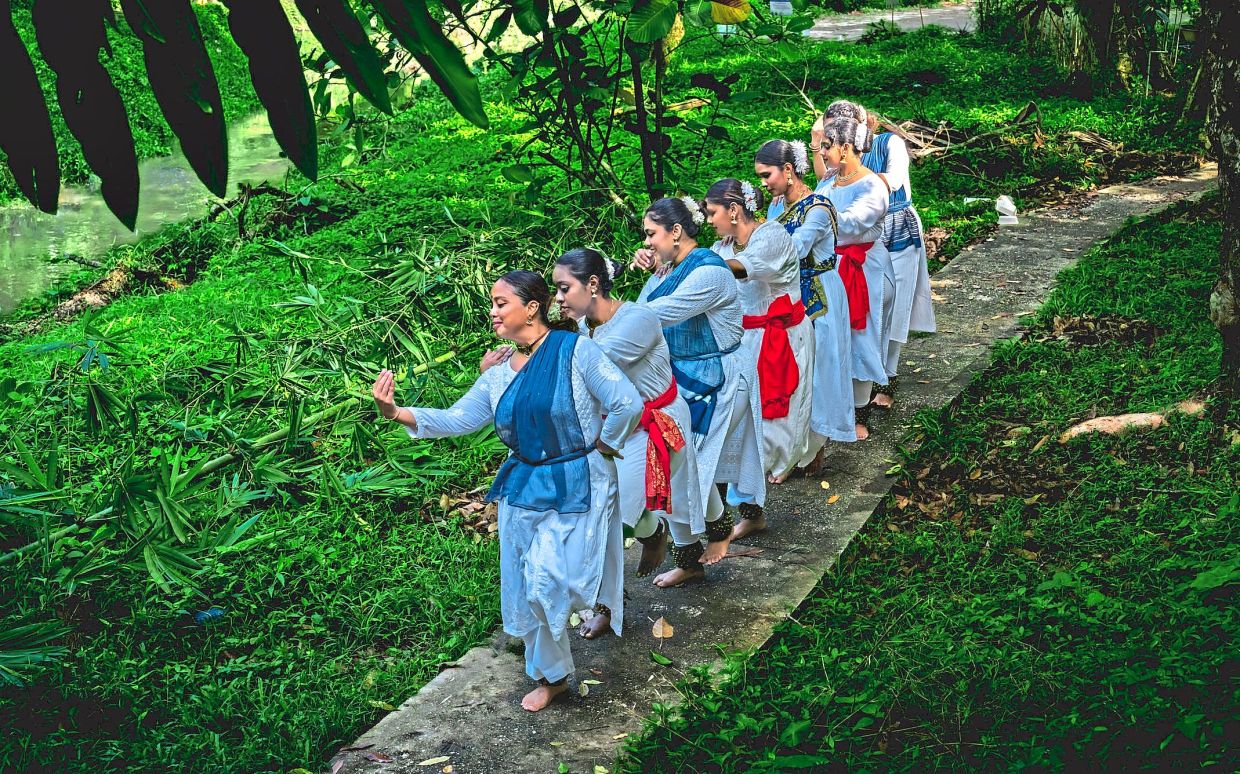
Kalpana Dance Theatre (KDT), the Kuala Lumpur-based institution now marking its 30th anniversary, exemplifies how cultural organisations can endure in an industry marked by financial precarity and unpredictable conditions. Like the rivers that inspire its latest production, KDT has navigated countless obstacles—administrative, financial and creative—to establish itself as a significant force in Malaysia's performing arts landscape. Founder-director Shangita Namasivayam attributes this longevity to a philosophy of perpetual reimagination, refusing to treat tradition as static or immutable, instead allowing it to respond dynamically to contemporary concerns.
The anniversary production takes the form of a bharatanatyam concert conceptually anchored to two pivotal Indian waterways: the Ganga in north India and the Kaveri in south India. These are not arbitrary choices. The Ganga holds immense spiritual and cultural weight within Hindu civilisation, revered as a purifying force in religious practice and mythology. The Kaveri, venerated as the southern counterpart—the "Ganga of the South"—sustains agricultural systems, generates hydroelectric power, and binds together communities across Karnataka and Tamil Nadu. Both rivers function simultaneously as economic arteries and cultural repositories, having inspired dance, music and oral traditions across centuries. In selecting these waterways as thematic anchors, Shangita deliberately positions classical Indian dance as a medium for addressing ecological crises affecting contemporary life.
The artistic vision emerged through sustained collaboration with established figures in Indian classical arts. Choreographer PT Narendran, musician OS Arun and scriptwriter Dr Va Ve Subramanian brought complementary expertise developed over decades of creative partnership with Shangita. Rather than imposing a concept from above, the team engaged in extended dialogues that allowed individual perspectives to crystallise into a unified production philosophy. This methodology reflects a broader understanding that contemporary dance theatre requires intellectual rigour alongside technical virtuosity—that artistic credibility demands thematic coherence and philosophical depth.
What distinguishes this production from conventional cultural commemoration is its deliberate integration of environmental activism into the creative process. Since January, the 54 dancers—ranging in age from six to 62 and including performers with disabilities—have participated in ground-level conservation work alongside The Alliance of River Three (ART!), a volunteer-driven environmental organisation founded in 2018 to rehabilitate the Klang River. The dancers have been directly involved in cleaning Taman Melawati River Three SDG Park and the Mid Valley River Three SDG Park as part of restoration initiatives scheduled for completion by 2030. This experiential learning transforms environmental awareness from abstract concept into embodied knowledge.
Shangita articulates the pedagogical rationale underpinning this approach: water represents humanity's most critical resource, yet rivers and oceans face accelerating contamination and degradation. By exposing young dancers to the material reality of environmental degradation—literally removing pollutants from waterways—the company inculcates responsibility that transcends performance. The extended exposure serves as counterweight to what Shangita identifies as a generational disconnection from physical labour and environmental stewardship. For dancers accustomed to studio training in climate-controlled environments, direct participation in river restoration constitutes a formative disruption, forcing confrontation with ecological realities that artistic expression alone cannot convey.
The production's structural approach emphasises collective rather than individual excellence. The 90-minute presentation features no soloists or featured performers; instead, all 54 dancers carry substantive roles, ensuring equitable participation across the ensemble. This democratic structure challenges the soloist-centric model historically dominant in bharatanatyam concert presentation. The accompanying musical ensemble comprises 30 artistes; pragmatic logistics meant that not all could travel to Malaysia, necessitating recruitment of local musicians to work alongside the core Chennai-based team. This compositional necessity created unexpected benefits: young Malaysian dancers gained exposure to internationally respected practitioners, facilitating knowledge transfer and technical refinement that extends beyond choreography into philosophical understanding of bharatanatyam's evolving possibilities.
The narrative framework combines Tamil text with English narration, deliberately crafting accessibility for audiences beyond Tamil-speaking communities while maintaining linguistic specificity. Shangita's scriptwriting collaborators developed language that aspires to both poetic resonance and philosophical substance, weaving mythology, environmental ethics and emotional resonance into a cohesive whole. The two rivers function metaphorically and materially: the Ganga as "the shore of compassion" and the Kaveri as "the mother of prosperity" encapsulate theological frameworks while simultaneously signalling the material stakes of water scarcity and pollution affecting millions across South Asia and Southeast Asia.
For Malaysian audiences and particularly the broader Southeast Asian cultural sphere, this production addresses recurrent tensions within immigrant communities regarding cultural transmission. Shangita's struggles to secure funding for each production cycle reflect systemic challenges facing minority arts organisations dependent on limited public investment. Yet her refusal to abandon live performance—despite its financial burden—rests on a conviction that cultural transmission demands embodied experience. Classical Indian dance cannot be adequately transmitted through video archives or theoretical instruction; it requires the convergence of living bodies, acoustic sound, and shared physical space. This argument carries particular weight within Malaysia's context, where multiple diasporic communities navigate questions of cultural preservation amid competing pressures toward homogenisation.
The partnership with ART! signals broader possibilities for arts organisations to function as platforms for social mobilisation. Rather than treating environmental advocacy as supplementary to artistic practice, KDT has integrated ecological awareness into its fundamental creative process. This approach resonates within contemporary discourse on arts' social responsibility, particularly urgent in Southeast Asia where rapid urbanisation and developmental pressures have degraded river ecosystems throughout the region. The Klang River, like many urban waterways in Malaysia and across the region, has suffered decades of industrial and municipal pollution; rehabilitation efforts require sustained commitment and community participation that cultural organisations can help catalyse.
The performance takes place on August 8 at the Shantanand Auditorium, Temple of Fine Arts in Kuala Lumpur, representing a milestone moment for institutional longevity within Malaysia's performing arts landscape. Shangita's three-decade trajectory illustrates how individual artistic commitment, combined with strategic vision and collaborative openness, enables cultural institutions to remain relevant despite systemic constraints. The anniversary production demonstrates that classical art forms need not retreat into nostalgic preservation; instead, they can serve as vital resources for addressing contemporary challenges—environmental, social and spiritual—that demand urgent collective attention and creative reimagination across the region.

