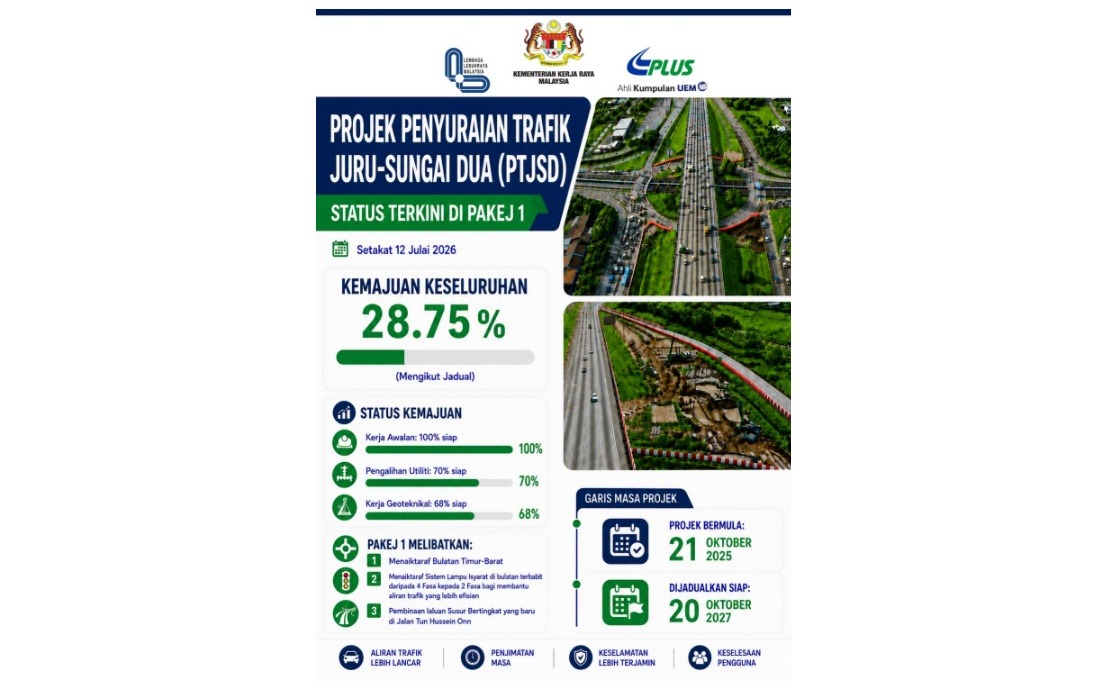
The Juru-Sungai Dua Traffic Dispersal Project (PTJSD) is tracking favourably through its first major construction phase, with PLUS Malaysia Berhad confirming that Package 1 has now achieved 28.75 per cent overall progress as of July 12. The announcement comes as the project maintains its targeted timeline for completion in October 2027, signalling steady advancement despite the scale and complexity of the undertaking across Penang's congested transport corridors.
Work on preliminary activities has now concluded in full, representing a critical foundation stone for subsequent construction stages. Utility relocation efforts—a notoriously time-consuming aspect of large infrastructure projects in built-up areas—have advanced to 70 per cent completion. Geotechnical investigations and ground preparation works have similarly progressed to 68 per cent, reflecting the technical rigour required before major structural elements can proceed. These parallel workstreams demonstrate a coordinated approach to managing multiple dependencies that characterise a project of this magnitude.
Package 1 encompasses three interconnected improvements designed to untangle traffic bottlenecks at one of Penang's most problematic junctions. The East-West Roundabout will undergo comprehensive upgrading, while the traffic management system controlling flow through that intersection receives technology enhancements to improve real-time responsiveness. The construction of a new elevated slip road along Jalan Tun Hussein Onn represents the most visible infrastructure addition, creating an alternative routing option that bypasses traditional ground-level congestion points.
The project spans a 17.3-kilometre corridor bisecting three administrative zones within Seberang Perai—the South, Central, and North districts—positioning it as a regional rather than merely local initiative. An estimated 200,000 vehicle movements traverse this route daily, underlining the enormous demand pressure that current infrastructure cannot adequately accommodate. For Malaysian highway users accustomed to dealing with severe congestion on major trunk routes, particularly those connecting Penang Island and the southern Peninsula to Thailand and northern states, this project addresses one of the country's persistently problematic chokepoints.
With a total cost projection of RM3 billion, the PTJSD represents a substantial infrastructure investment justified by traffic modelling that anticipates significant redistribution of flows once the new direct Juru-Sungai Dua route becomes operational. The analysis suggests that approximately 30 per cent of current traffic could shift to this alternative corridor, fundamentally altering travel patterns during peak periods. The most striking benefit cited involves journey times, with projections indicating that the current one-hour traverse during congested conditions could compress to merely 20 minutes—a reduction that, if realised, would dramatically improve both productivity and quality of life for regular commuters and commercial operators.
Implementation involves collaborative governance arrangements between the Ministry of Works and the Malaysian Highways Authority, reflecting the multi-jurisdictional nature of major trunk route development in Malaysia. This coordination structure, while sometimes cumbersome in practice, enables pooling of technical expertise and regulatory authority necessary to deliver projects that transcend typical federal or state boundaries. The Juru-Sungai Dua corridor's particular significance stems from its function as the primary land connection between Penang and the broader northern Peninsula, making traffic efficiency in this zone a matter of broader regional concern rather than a purely local issue.
The underlying problem that PTJSD addresses—chronic congestion strangling the Juru-Sungai Dua corridor—has persisted for years despite incremental improvements. The route's critical role as a commercial and commuter artery means that bottlenecks here generate cascading delays throughout the broader transport network. Industrial activities in the Kulim-Bandar Baharu and Bukit Kayu Hitam zones further upstream depend upon efficient southbound connectivity, making traffic fluidity directly consequential to regional economic performance. Congestion-induced delays impose invisible but measurable costs on business operations, from elevated logistics expenses to missed delivery windows.
When the PTJSD reaches completion in October 2027, the anticipated improvements extend beyond mere travel time reduction. Enhanced traffic flow should lower accident rates by reducing the stressful stop-start conditions that characterise severely congested corridors and increase driver error risks. Safety infrastructure improvements form an integral component of the overall design philosophy. Additionally, more predictable journey times benefit both individual commuters and professional drivers whose schedules depend upon reliable transit duration estimates, ultimately fostering greater economic certainty for businesses reliant upon this corridor.
The project's trajectory will be scrutinised closely by transport planners across Southeast Asia, particularly in rapidly urbanising regions where similar infrastructure bottlenecks are emerging. Malaysia's experience managing large-scale traffic dispersal schemes amid ongoing economic activity offers valuable lessons for comparable schemes elsewhere in the region. The PTJSD demonstrates the feasibility of major infrastructure intervention in already-developed corridors, provided that project management maintains rigorous schedule discipline—a challenge that has historically compromised comparable undertakings.
For Malaysian commuters and businesses dependent upon Penang's connectivity, the PTJSD represents an investment in future operational efficiency that should eventually validate the substantial capital outlay. Progress metrics indicating sustained schedule adherence suggest competent project delivery, though the remaining 71 per cent of work encompasses the most technically demanding phases. Monitoring the transition from preliminary works and utility relocation into full-scale construction will reveal whether this project becomes a textbook example of successful major infrastructure delivery or faces the delays and cost overruns that have sometimes characterised Malaysian infrastructure schemes.

