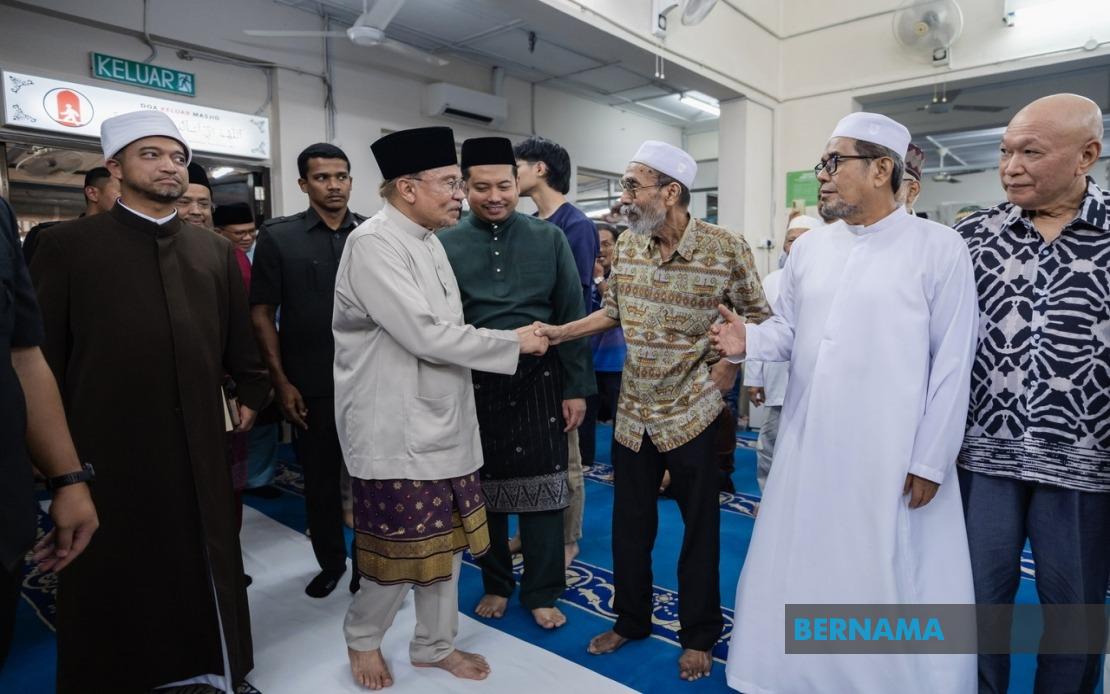
Prime Minister Datuk Seri Anwar Ibrahim has assured stakeholders that the Johor-Singapore Special Economic Zone remains on course for development, whilst cautioning political figures against weaponising the initiative for partisan advantage. Speaking after Friday prayers at Masjid As-Sodiqin in Taman Kobena on July 3, Anwar stressed that the zone represents a coordinated effort between Putrajaya and Singapore's leadership, with progress tracking according to established timelines.
The Prime Minister's remarks came as a measured response to recent calls from Johor Menteri Besar Datuk Onn Hafiz Ghazi, who had publicly requested acceleration of the master plan announcement to sustain the state's economic momentum. Rather than committing to expedited timelines, Anwar framed the JS-SEZ as fundamentally a federal initiative executed in partnership with Johor's state apparatus. This distinction carries significance for understanding governance structures in Malaysia's federal-state relations, where major economic projects typically require coordination between both tiers yet ultimately fall under federal purview.
The bilateral nature of the JS-SEZ means that critical announcements and formal signing ceremonies involve the heads of government from both nations—a protocol that cannot be accelerated by state-level pressure alone. Anwar's emphasis on this procedural reality suggests that while Johor's leadership has legitimate interests in the zone's development, the timing of public disclosure remains subject to diplomatic timelines between Malaysia and Singapore. For investors and businesses monitoring the initiative, this clarification provides needed certainty that progress follows bilateral agreement rather than unilateral state demands.
Malaysia-Singapore economic partnerships carry particular weight within Southeast Asia's broader integration framework. The JS-SEZ represents an attempt to deepen the two nations' already significant trade and investment relationship, creating a shared prosperity mechanism along the Johor-Singapore border. Such initiatives typically generate spillover benefits throughout the region, attracting multinational corporations seeking to leverage both nations' complementary advantages. Johor's geographic position and labour markets combined with Singapore's financial sophistication and global connectivity create conditions for substantive economic collaboration.
Anwar's warning against politicisation addresses a recurring tension in Malaysian governance: the tendency for state leaders to leverage federal projects for electoral or factional advantage. By explicitly discouraging this behaviour, the Prime Minister signals commitment to keeping the JS-SEZ insulated from domestic political competition. This stance carries credibility given Malaysia's track record of project delays and cancellations stemming from political disputes between federal and state governments. The relative stability of JS-SEZ planning reflects conscious effort to prevent such outcomes.
The Ministry of Economy has apparently fielded and addressed various concerns regarding the zone, suggesting that substantive clarifications have already entered public discourse. This implies that some of the pressure from Johor's leadership may stem from communication gaps rather than genuine delays. By noting that the ministry has already clarified outstanding issues, Anwar redirects the conversation toward existing information rather than promising new announcements. This approach encourages political figures to engage with factual detail before demanding acceleration.
For Malaysian businesses and international investors, the JS-SEZ represents a significant strategic development. Access to Singapore's global networks combined with Malaysian labour costs and land availability creates compelling economics. However, project credibility depends heavily on political stability and consistent governmental commitment. Anwar's reassurance that the initiative progresses according to plan—and his insistence that leaders refrain from politicisation—addresses investor anxiety about potential disruption from factional disputes. The zone's success fundamentally relies on sustained cooperation between Putrajaya and Johor Baru across electoral cycles.
The timing of this intervention reflects broader questions about Malaysia's capacity for long-term economic planning amidst political fragmentation. The JS-SEZ cannot deliver its full potential if announcements and milestones become hostage to state-level political competition. Anwar's public stance therefore serves a dual purpose: reassuring Singapore of Malaysian stability whilst sending a message to domestic political actors that such behaviour carries reputational costs. Singapore's investors and policymakers will interpret the Prime Minister's intervention as evidence of federal commitment to the project despite local political pressures.
Regional observers monitoring Malaysia-Singapore ties will note the subtle power dynamics evident in this exchange. Johor's Menteri Besar, whilst wielding significant state-level authority, cannot unilaterally accelerate a bilateral initiative. The federal government retains ultimate discretion over timing and public communication. This hierarchy reflects Malaysia's constitutional structure yet inevitably generates tension when state leaders operate under electoral pressures that federal timelines may not accommodate. The JS-SEZ thus becomes a case study in navigating federal-state relations within Malaysia's complex political architecture.
Looking forward, the JS-SEZ's trajectory will depend on continued political discipline from Malaysian leaders across all levels. Anwar's intervention appears calibrated to establish clear expectations: the project will advance according to bilateral timelines rather than state political calendars. Whether Johor's political establishment accepts this framework—or whether pressure for acceleration continues—will illuminate the extent to which Malaysia's governing structures can subordinate factional interests to cross-border economic cooperation.

