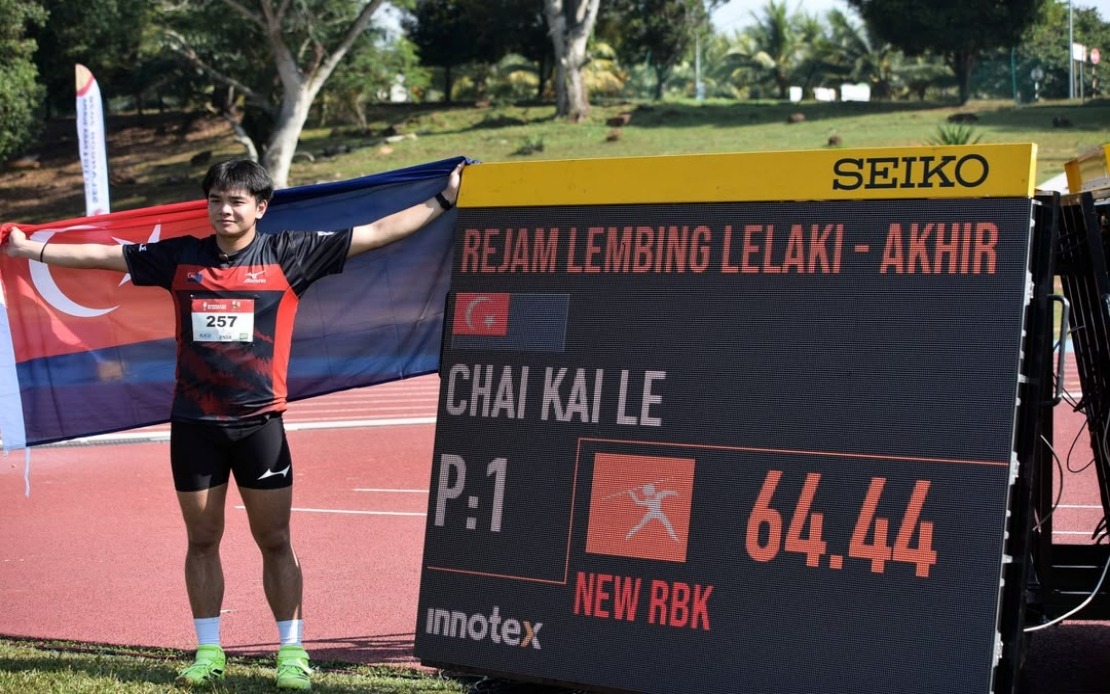
The Selangor edition of the Malaysia Games witnessed a historic athletics performance today as Johor's rising talent Chai Kai Le claimed the men's javelin gold medal with a powerful 64.44-metre throw at the Universiti Putra Malaysia Sports Centre in Serdang. The 18-year-old's achievement eclipsed a record that had stood for over two decades, demonstrating the emergence of a new generation of Malaysian athletes capable of competing at increasingly demanding standards.
Le's second-attempt throw surpassed the previous Games benchmark of 62.33 metres, which had been set by Sarawak's Kho Mei Kuan at the 2000 Penang edition. The margin of improvement—more than two metres—underscores both the advancement in training methodologies and the physical capacity of contemporary Malaysian athletes. Penang's Tan Chun Wei captured the silver medal with a 60.43-metre performance, while Le's Johor teammate Mohd Noor Iman Norman rounded out the podium with a bronze-medal effort of 59.04 metres, reflecting the strength of Johor's athletics programme in this particular event.
In remarks to the media following his victory, the teenage athlete indicated that breaking the Games record represented a tangible objective within a carefully structured preparation plan spanning two years. Le expressed satisfaction with his performance, noting that the outcome aligned with his pre-competition expectations given the intensive training regimen he had undertaken leading up to SUKMA 2026. His strategic approach to athlete development highlights how contemporary Malaysian sports preparation incorporates long-term planning rather than ad-hoc competition participation.
However, Le acknowledged that his performance contained elements of physical compromise. Following his record-breaking second throw, he sustained a technical error in his throwing motion that precipitated lower back discomfort and fatigue. This injury prompted him to adopt a conservative management strategy for his remaining attempts, prioritising the prevention of acute injury over pursuing additional distance improvements. Such candour regarding physical limitations reflects a mature approach to athletic longevity, particularly for a young competitor with substantial career prospects ahead.
Interestingly, Le's performance gains context when compared against his personal records. The 18-year-old holds a national under-20 record of 65.65 metres, suggesting that his SUKMA-winning throw of 64.44 metres, while record-breaking at the Games level, represents a slightly conservative performance relative to his capabilities. This gap indicates that with continued development and injury-free preparation, Le possesses the technical foundation and physical attributes to produce performances exceeding even his current personal bests, positioning him as a potential long-term asset for Malaysian athletics on the continental stage.
Elsewhere on the track at the same venue, Penang's Mohammad Aiman Haikal Sahrudin demonstrated similar championship credentials by claiming gold in the men's 10,000-metre race walk, a discipline requiring exceptional aerobic capacity and technical proficiency in the prescribed walking gait. Sahrudin's winning time of 47 minutes 28.84 seconds proved sufficient to secure victory ahead of Kelantan's Ahmad Farish Irfan Ahmad Fahmi, whose silver-medal performance was clocked at 47 minutes 37.17 seconds. The Federal Territories' Khor Jing Hong secured the bronze medal in 47 minutes 49.27 seconds, completing a competitive field that showcased Malaysia's developing depth in this technical endurance event.
Mohammad Aiman's victory marked a significant improvement on his previous Games appearance, where he had settled for a silver medal in the identical event at the preceding SUKMA edition held in Sarawak. This progression from runner-up to champion status demonstrates the benefits of consistent training cycles between major Games competitions and the athlete's capacity for meaningful performance enhancement over relatively short timeframes. For a race walker competing at age eighteen, such improvement trajectories suggest substantial room for continued development throughout his athletic career.
Looking beyond SUKMA, Mohammad Aiman articulated strategic ambitions aligned with Malaysia's broader athletics objectives. The Penang competitor identified national squad selection and qualification for the 2027 Southeast Asian Games as his immediate targets, indicating an understanding of the progression pathways available to regional athletes. Notably, he acknowledged that race walking's competitive structure at the SEA Games differs from SUKMA programmes, with the 10,000-metre event absent from the continental championship but the 20,000-metre distance featuring prominently. His intention to compete in the longer race walk distance at SUKMA 2026 suggests a deliberate preparation strategy for future SEA Games participation.
Mohammad Aiman hails from Kampung Tanah Liat in Penang, representing a state that has historically produced competitive race walkers and distance runners. The regional concentration of success in particular athletic disciplines often reflects established coaching infrastructure, community participation patterns, and the cultural prioritisation of specific sports within particular states. Penang's continued representation on the SUKMA medals table in walking events reinforces the state's competitive advantage in this technically demanding discipline.
These performances at SUKMA 2026 carry implications extending beyond immediate medal counts and record books. The emergence of athletes like Chai Kai Le and Mohammad Aiman Haikal Sahrudin, alongside their demonstrated capacity to break existing benchmarks and progressively improve their performances, suggests that Malaysian athletics is cultivating a cohort of competitors capable of representing the nation with increasing credibility at regional competitions. The technical proficiency displayed by race walkers and throwers competing at SUKMA 2026 indicates that national training programmes are delivering athletes with genuine competitive potential.
For Malaysian sports development more broadly, these achievements underscore the value of sustained investment in athletics infrastructure, coaching expertise, and talent identification systems. Young athletes achieving record-breaking performances while still in their late teens signal that the foundational work undertaken through school sports systems and state-level athletics federations is producing tangible results. The competitiveness demonstrated across multiple events at SUKMA 2026 suggests that the interval between consecutive Games editions—typically three years—provides a sufficient window for meaningful athlete development and programme refinement.
The road ahead for emerging athletes like Chai Kai Le will test whether SUKMA success translates into sustained competitive performance at increasingly demanding international competitions. The SEA Games, scheduled for 2027, will provide the next significant benchmark for measuring whether Malaysia's rising generation of track and field athletes possesses the consistency, resilience, and technical sophistication required to succeed beyond the regional Games environment. For now, the record-breaking performances on display at SUKMA 2026 offer encouraging signals regarding the trajectory of Malaysian athletics development.

