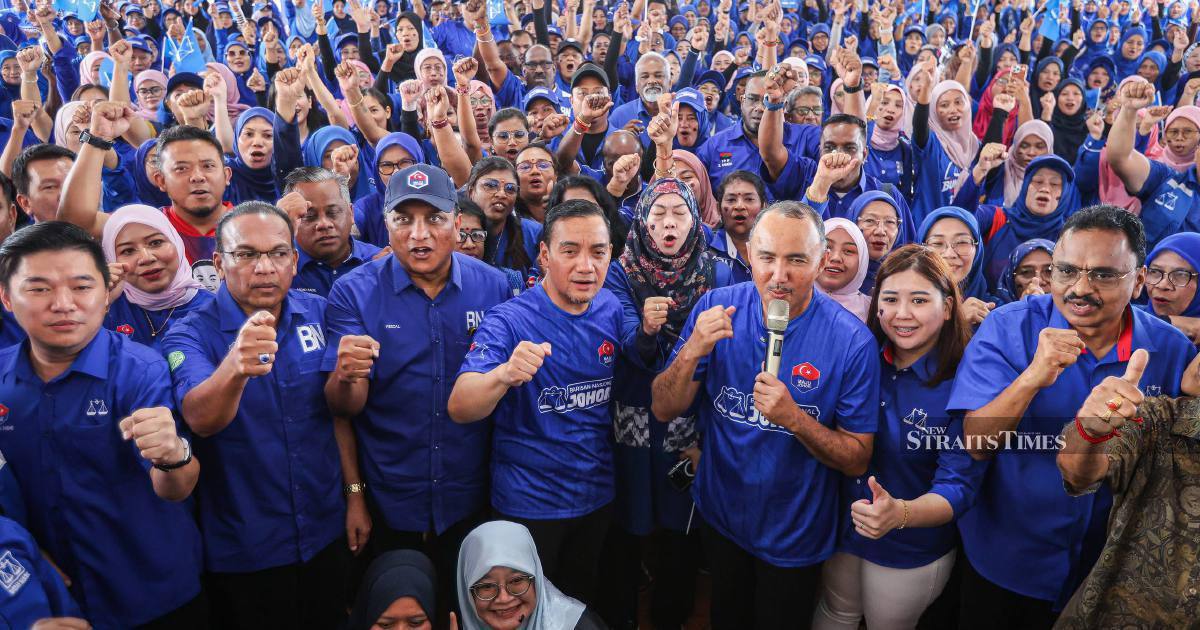
Caretaker Menteri Besar Datuk Onn Hafiz Ghazi has launched a direct appeal to Johor voters during the concluding phase of the state election campaign, urging them to exercise caution against what his administration characterises as divisive tactics employed by opposition parties seeking electoral gains. Speaking at a gathering in Kluang, the outgoing chief minister framed the choice facing Johor's electorate as a fundamental decision between substantive governance and what he portrayed as inflammatory political messaging designed to distract from the state's developmental agenda.
The campaign trail in Johor has intensified as election day approaches, with political parties mobilising their ground operations across the state's diverse constituencies. Onn Hafiz's intervention highlights the intensifying battle for narrative control, as competing visions for the state's future take centre stage in what has been a closely contested electoral cycle. His remarks reflect growing concern within the ruling coalition about opposition momentum in certain areas, prompting more assertive messaging during the critical final campaign period.
The caretaker leader's emphasis on rejecting what he terms empty promises speaks to a broader pattern in Malaysian electoral contests, where competing parties make vastly different projections about what they can deliver to constituents. Onn Hafiz appears to be positioning his government as the pragmatic choice, implicitly suggesting that opposition pledges lack grounding in fiscal reality or administrative feasibility. This approach—distinguishing between promises rooted in governance capability versus those offered without clear implementation pathways—represents a familiar but contentious battleground in contemporary Malaysian politics.
For Malaysian voters, particularly those in Johor, the distinction between campaign rhetoric and deliverable policy outcomes remains perpetually fraught. The state has historically served as a significant political bellwether within Southeast Asia's broader regional context, with its electoral results often signalling shifts in national political sentiment. The caretaker menteri besar's public warnings suggest that the race remains sufficiently competitive to warrant direct appeals to voter scepticism about opposition claims.
Johor's electorate encompasses urban, semi-urban, and rural constituencies with distinct economic priorities and service expectations. In metropolitan areas like Johor Baru, voters increasingly evaluate candidates based on infrastructure investment, economic opportunity creation, and service delivery efficiency. Rural and semi-urban communities often prioritise agricultural support, healthcare accessibility, and educational opportunities. Opposition parties attempting to secure electoral gains must craft messaging that resonates across these disparate constituencies, a challenge that Onn Hafiz is attempting to exploit by suggesting their platforms lack specificity and realism.
The invocation of slander and provocation points to the heated nature of Johor's campaign environment. Malaysian election campaigns frequently involve aggressive rhetorical exchanges, and Johor has been no exception in this cycle. The caretaker menteri besar's characterisation of opposition tactics as provocative suggests that both major political coalitions are engaged in confrontational campaigning, with each side questioning the integrity and feasibility of the other's platform.
From a broader Southeast Asian perspective, Johor's election reflects wider democratic patterns across the region, where elections serve as crucial mechanisms for accountability and political contestation. The state's significance extends beyond its borders; as Malaysia's largest economy by gross domestic product, Johor's political direction influences regional economic stability and development trajectories. An unstable or ineffective government would reverberate through supply chains and business investment across Southeast Asia.
Onn Hafiz's position as caretaker menteri besar places him in an unusual position—leading government operations while simultaneously campaigning for electoral validation. This dual role requires calibrating messaging between government stewardship and partisan advocacy, a balance that campaigns in the final week become increasingly difficult to maintain. His public statements must function simultaneously as warnings to voters and reassurances about his administration's continuity should his coalition prevail.
The final week of campaigning typically involves candidates and party officials saturating their respective constituencies with direct appeals, focusing on swing voters who remain genuinely undecided. Onn Hafiz's address in Kluang represents part of this intensive push, targeting communities where marginal gains could prove decisive in determining electoral outcomes. His emphasis on rejecting opposition rhetoric suggests internal polling data indicates that voters in certain areas remain persuadable, particularly if doubts about opposition feasibility can be effectively communicated.
Moving forward, the election's outcome will reveal whether voters accept the caretaker leader's characterisation of opposition proposals as unrealistic or whether they embrace alternative visions despite uncertainties about implementation. The choice Johor voters make will also influence how Malaysian political parties approach campaign messaging in future electoral contests, potentially establishing precedents about which rhetorical strategies prove effective in persuading contemporary electorates.

