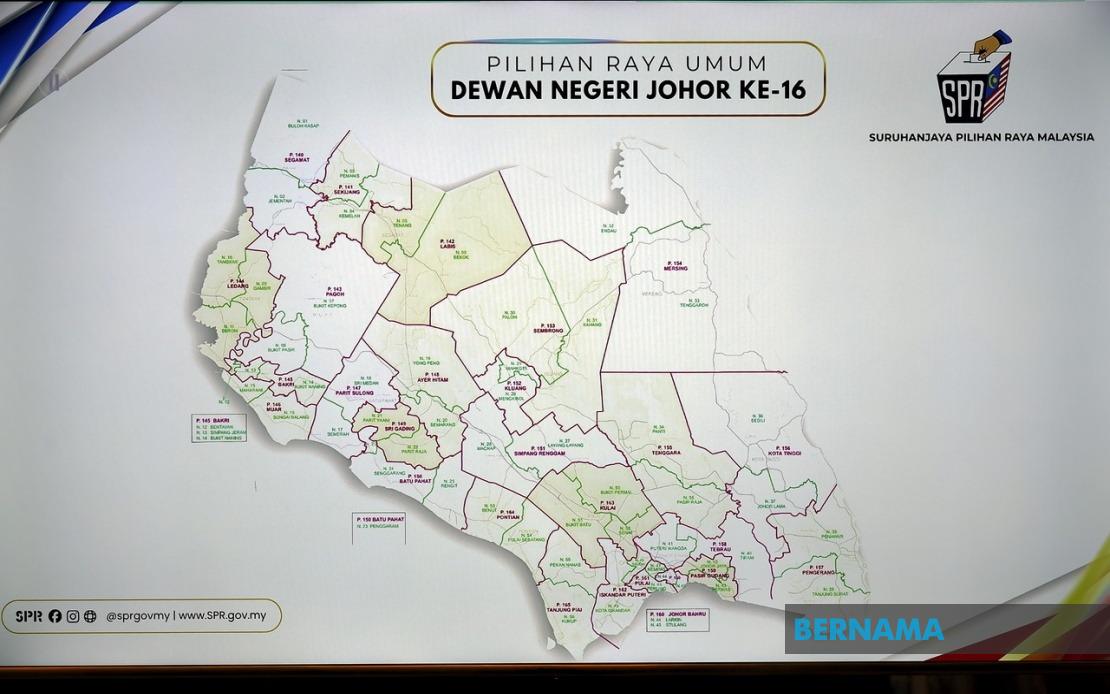
Johor enters a decisive political moment on June 27 as nomination day formally commences the 16th state election, setting in motion a competitive race across all 56 state assembly constituencies. The Election Commission (EC) has structured the candidate registration window tightly, allowing aspirants just one hour—from 9 am to 10 am—to lodge their nomination papers at designated centres throughout the state. Once election officials complete their vetting procedures, the full roster of contenders will be made public, providing voters and analysts with a comprehensive picture of who is contesting each seat. This streamlined process establishes a clear starting line for what many political observers expect to become one of peninsular Malaysia's most hotly contested state-level battles.
The electoral landscape encompasses a voter base of 2,727,926 eligible participants, a figure that underscores Johor's significance as Malaysia's third most populous state by registered electorate. This electorate comprises over 2.7 million ordinary voters, complemented by 12,041 military personnel and their spouses, plus 12,710 police officers and their families. The geographic spread of these voters across urban, semi-urban and rural constituencies ensures that campaign messaging must address diverse concerns—from industrial development and urban congestion in areas like Johor Bahru to agricultural livelihoods and infrastructure in more distant districts. The election schedule concentrates the campaigning period into a relatively compact timeframe, with early voting designated for July 7 and general polling set for July 11, compressing the traditional weeks-long contest into just two weeks of formal nomination-to-polling activity.
Pakatan Harapan (PH) has committed to fielding the full complement of 56 candidates, signalling an all-or-nothing approach to recapturing lost ground in a state it once controlled decisively. The coalition divvies up seats according to its component parties' established strengths: Parti Keadilan Rakyat (PKR) fields 20 candidates, Amanah contributes 19, while the Democratic Action Party (DAP) rounds out the slate with 17 contenders. This distribution reflects PKR's historical dominance within the Johor wing of Pakatan and Amanah's concentrated presence in certain divisions. For Johor voters accustomed to PH governance between 2018 and 2022, this full-slate approach represents a direct challenge to the incumbent Barisan Nasional (BN), essentially betting that recent years' political shifts have weakened BN's traditional hold on the state.
Barisan Nasional, retaining state power since March 2023, counters with an equally comprehensive roster spanning all 56 seats, principally anchored by the United Malays National Organisation (UMNO) with 36 nominees. The Malaysian Chinese Association (MCA) contributes 16 candidates, while the Malaysian Indian Congress (MIC) rounds out the coalition's Johor campaign with four contenders. This composition maintains the longstanding BN structure where UMNO dominates numerically but depends upon the smaller communal parties for specific constituencies, particularly those with substantial Chinese or Indian voting populations. BN's dominance in the 2022 election—when it secured 40 of 56 seats—established it as the formidable incumbent, and this full slate indicates confidence in defending that position despite any intervening political turbulence.
Perikatan Nasional (PN) injects a third major force into the contest, fielding candidates across substantially fewer seats but maintaining meaningful presence in specific regions. The Pan-Malaysian Islamic Party (PAS) contests 11 seats, primarily clustered in constituencies where it has cultivated voter bases or where its Islamic messaging resonates with particular demographics. Bersatu, the faction-ridden Malay-majority party formerly helmed by former Prime Minister Mahathir Mohamad, fields 16 candidates, while the Malaysian Indian People's Party (MIPP) fields five nominees. PN's strategy appears to target swing constituencies and areas where it believes messaging around governance alternatives and Islamic governance can gain traction, rather than attempting comprehensive geographic coverage.
Several smaller parties and newly emergent coalitions round out the candidate field, adding unpredictable elements to seat calculations. The Malaysian United Democratic Alliance (MUDA), which achieved its sole Johor seat in 2022 through a lone independent-turned-MUDA victory, contests four constituencies this cycle, potentially drawing younger, reform-minded voters dissatisfied with establishment parties. The Socialist Party of Malaysia (PSM) fields one candidate, while Parti Bersama Malaysia (Bersama) makes its electoral debut in Johor by fielding 15 candidates—a substantial showing for a new entrant suggesting either strategic partnership arrangements with specific communities or confidence in particular constituencies. These smaller parties often function as pressure valves for voter sentiment unaddressed by major coalitions.
Amongst the candidate profiles across all parties, observers note a deliberate mix of political strategies. Seasoned incumbents seek to retain their bases through accumulated local service records and established networks. Fresh faces signal renewal and generational transition, particularly important for younger constituencies and areas experiencing demographic shifts. Returning candidates who lost in 2022 represent attempted comebacks, often reflecting internal party politics and efforts to rectify previous losses. Each nomination carries implications beyond the individual candidate—it signals which constituencies each party considers winnable, which it may be conceding, and which it views as genuine battlegrounds where resources merit concentration.
The Election Commission has issued procedural reminders intended to prevent nomination-day chaos, urging candidates to pre-screen their nomination forms at either the Returning Officer's Office or State Election Office. This early checking mechanism helps identify document deficiencies before the submission deadline, avoiding last-minute disqualifications. Similarly, the EC emphasises settling deposit payments—typically in the range of several thousand ringgit per candidate—early in the process, with receipts serving as crucial proof of payment during nomination submission. These administrative requirements, while seemingly routine, occasionally disqualify candidates and their parties, inadvertently reshaping constituency contests.
Anti-corruption oversight carries particular weight in this election cycle. The Malaysian Anti-Corruption Commission (MACC) has issued explicit warnings to all candidates and party officials regarding prohibited conduct under the MACC Act 2009 and the Election Offences Act 1954 (Amendment 2012). The commission has activated five dedicated 24-hour operations rooms strategically positioned across Tampoi, Batu Pahat, Kluang, Segamat and Mersing—covering geographically dispersed regions of the state—to receive corruption allegations and abuse-of-power complaints from the public. This enforcement infrastructure sends a clear message that the MACC intends active monitoring throughout the campaign and polling periods, potentially chilling certain practices while creating channels for rival campaigns to lodge complaints about each other.
The 2022 Johor election provides the immediate historical backdrop against which this contest unfolds. That election saw BN capture 40 seats, providing a substantial mandate but falling short of the 47-seat supermajority some had anticipated. Pakatan Harapan secured 12 seats, primarily in urban constituencies where Chinese and Indian voters concentrate. Perikatan Nasional managed just three seats despite fielding candidates, while MUDA's single seat represented an anomalous breakthrough for the fledgling party. The two-year interim period has witnessed BN consolidation of state power, various cross-party defections that altered seat mathematics, and shifting voter sentiment regarding inflation, employment, and development priorities. Whether those 2022 results reflected a genuine endorsement of BN or merely represented rejection of the chaos preceding it remains contested.
ForJohor voters and Malaysian political observers, this election functions as a significant bellwether for peninsular politics more broadly. Johor's substantial economy, diverse demography, and historical importance as either a BN or opposition stronghold at different periods make its outcome consequential for national coalition mathematics. A decisive BN victory would reinforce the governing coalition's post-2023 political dominance and validate the strategy of consolidation undertaken during the previous parliament. Conversely, significant PKR-Amanah-DAP gains would suggest voter willingness to reconsider alternatives and potentially embolden opposition repositioning ahead of the next federal election. The concentration of PN candidates in specific constituencies suggests a strategy less about displacing BN than about fragmenting opposition support, potentially benefiting BN if vote-splitting occurs.
As candidates prepare nomination documents and campaign strategies crystallise, the true battleground emerges in constituencies where multiple parties view victory as achievable. Urban seats with mixed electorates, areas experiencing economic transition, and constituencies with narrow 2022 margins will likely absorb disproportionate campaign attention and resources. The two-week campaign window provides limited time for the kind of grassroots organising that traditionally characterised Malaysian electoral contests, potentially advantage parties with pre-existing organisational infrastructure and incumbent advantage. Nomination day formally initiates this carefully orchestrated electoral process, but the real contest for voter preference begins in earnest as candidates fan out into their constituencies with their messages.

