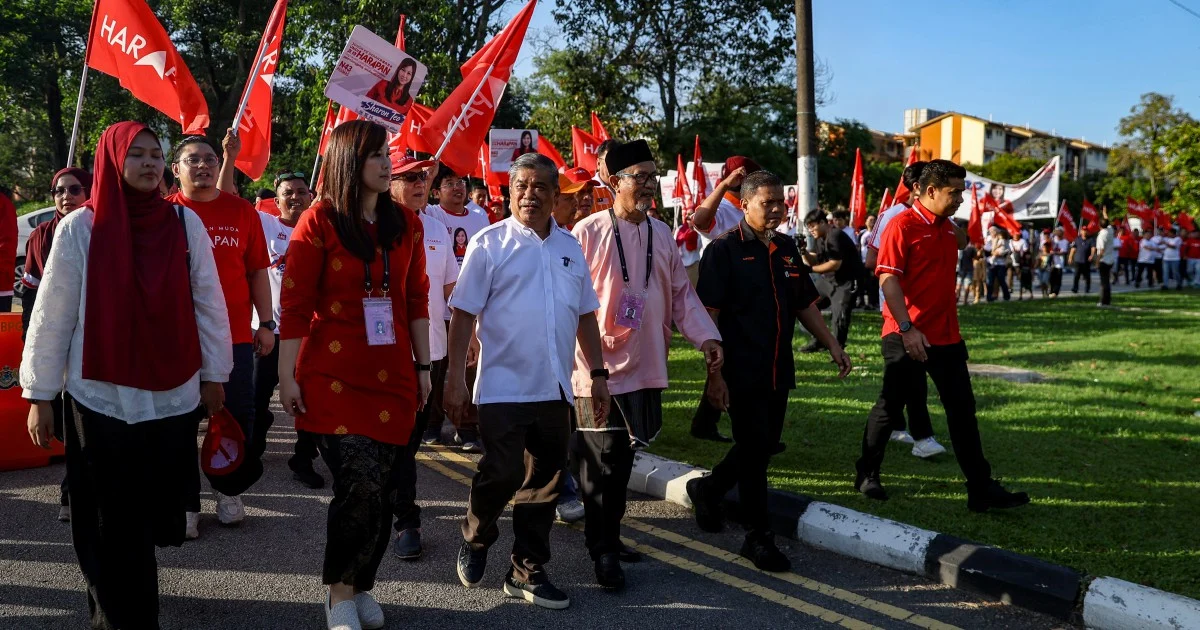
Sharon Teo's arrival at the nomination centre for Johor's Permas state constituency drew animated support from coalition backers in Pasir Gudang, with vocal demonstrations of backing for Pakatan Harapan marking a significant show of grassroots enthusiasm for the opposition alliance's campaign in the state. The scene at Dewan Muafakat Taman Mawar underscored the coalition's push to consolidate voter backing in a jurisdiction that has become increasingly contested in recent electoral cycles.
The Permas constituency represents a meaningful battleground within Johor's political landscape, a state historically dominated by Barisan Nasional but where Pakatan Harapan has worked to expand its footprint. Johor remains a crucial electoral prize for any coalition seeking to alter Malaysia's political trajectory, given its substantial parliamentary representation and the traditionally high voter turnout rates that characterise the state. Sharon Teo's candidacy reflects the coalition's broader strategy to field competitive candidates capable of engaging voters across demographic lines.
The vocal support witnessed at Teo's nomination filing suggests energised coalition supporters willing to participate actively in the campaign process. For Pakatan Harapan, translating such grassroots enthusiasm into ballot box gains has proven challenging in Johor, where incumbent Barisan structures retain considerable organisational advantages and community networks. The coalition has nonetheless maintained that Johor represents achievable terrain for gains, particularly in urban and semi-urban areas where dissatisfaction with governance and economic pressures have created openings.
Permas itself encompasses parts of Pasir Gudang, an industrial and residential zone in the eastern corridor of Johor. The constituency contains a demographically diverse population mixing established residential communities with newer development areas, creating voters with varying priorities ranging from economic opportunities to infrastructure development and community services. This heterogeneity makes Permas a competitive seat where constituency-level campaigning and candidate credibility potentially carry substantial weight.
The scale and tenor of supporter mobilisation witnessed at Teo's nomination reflects broader dynamics within Pakatan Harapan's campaign machinery in Johor. The coalition has invested significantly in organisational rebuilding following setbacks in previous elections, focusing on volunteer networks and grassroots engagement strategies intended to overcome the structural advantages traditionally enjoyed by ruling coalition machinery. Such displays of supporter engagement, while not determinative of electoral outcomes, indicate campaign momentum that party strategists view as foundational to converting interest into votes.
For Malaysian political observers, Johor's electoral trajectory carries implications extending well beyond the state itself. As the federation's second-largest state by population and a region with substantial Malay-Muslim voter majorities, Johor outcomes significantly influence calculations regarding national political feasibility. Opposition coalitions unable to establish credible presence in states like Johor face inherent difficulties assembling parliamentary majorities, making each contested Johor seat a proxy for broader national political viability.
Sharon Teo's background and campaign positioning reflect Pakatan Harapan's broader efforts to present candidates perceived as competent, approachable alternatives capable of addressing voter concerns without ideological rigidity. The coalition has prioritised nominating individuals with demonstrated community engagement or professional credentials intended to shift voter perceptions beyond traditional partisan narratives. This approach carries particular significance in constituencies like Permas where swing voters potentially hold decisive influence.
The nomination process itself carries procedural and symbolic importance within Malaysian electoral contests. Successful nomination filing represents the formal registration of candidacy and triggers transition toward the active campaigning phase. For Pakatan Harapan, each successfully filed nomination represents incremental progress toward presenting a comprehensive alternative governance proposition to voters, though nomination filing and electoral success remain substantially different undertakings.
Johor's political dynamics have shifted noticeably over recent years, with Pakatan Harapan gradually increasing its parliamentary representation through by-election gains and incremental seat additions. Whether these trends represent durable realignment or cyclical fluctuation remains contested among political analysts. The pattern of supporter engagement visible at Teo's nomination filing suggests at minimum that coalition campaigning maintains capacity to mobilise voter interest in constituencies previously considered uncompetitive terrain.
The electoral outcome in Permas and across Johor will substantially influence calculations regarding Malaysia's broader political direction and the viability of opposition coalitions achieving competitive parity with ruling structures. Success in marginal constituencies like Permas could accumulate across multiple seats to produce meaningful parliamentary shifts, while failure to convert grassroots enthusiasm into electoral gains would reinforce assessments that structural barriers remain formidable obstacles to coalition advancement. The vocal backing demonstrated for Sharon Teo represents a necessary but insufficient foundation upon which sustained campaign momentum must be constructed.

