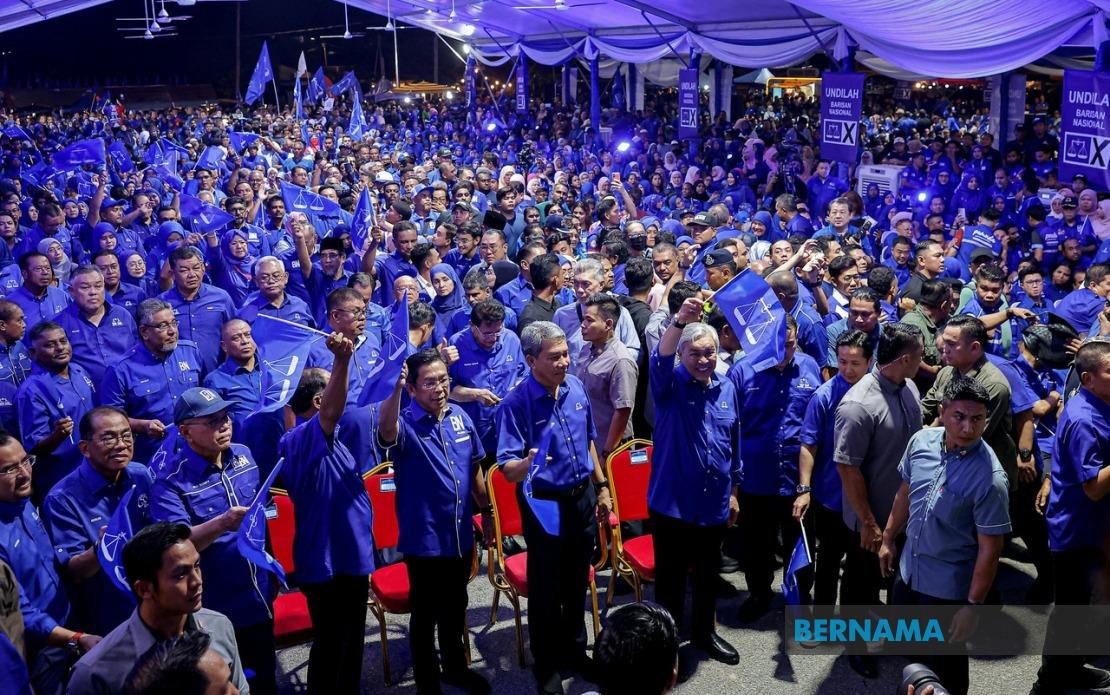
Barisan Nasional's leadership has issued a clarion call to party machinery to build momentum from its emphatic Johor victory and translate that success into triumph in the Negeri Sembilan state election. Speaking at the formal launch of BN's campaign apparatus in Seremban on July 15, coalition chairman Datuk Seri Dr Ahmad Zahid Hamidi framed the Johor result—in which BN captured 48 of 56 state seats and secured nearly 60 per cent of the popular vote—as a decisive endorsement of the coalition's capacity to deliver political stability and economic progress. The Johor outcome, described as the coalition's finest performance in the state's electoral history, now serves as the template and psychological springboard for the broader contest ahead.
The Deputy Prime Minister's remarks, delivered at Tuanku Abdul Rahman Stadium in Paroi and attended by BN deputy chairman Datuk Seri Mohamad Hasan and other senior coalition figures, underscored a central theme: the Johor model of internal cohesion and disciplined execution must be replicated in Negeri Sembilan's competitive political landscape. Ahmad Zahid emphasized that Johor's triumph reflected the electorate's confidence in a coalition capable of steering the state toward sustainable development and institutional effectiveness. This framing positions BN's campaign not merely as a contest for seats but as a referendum on governance capacity—a narrative strategy that seeks to elevate the election beyond local grievances toward broader competence arguments.
Central to Ahmad Zahid's message was a call for internal solidarity and the subordination of individual advancement to collective electoral objectives. Party members were explicitly cautioned against allowing candidate selection controversies to fragment coalition discipline or distract ground operatives from voter engagement work. The UMNO president acknowledged that candidacy negotiations routinely generate tension within multi-party coalitions, but insisted that such internal disputes must not undermine the machinery's cohesion or messaging discipline. His framing presented unity as both a moral imperative and a strategic necessity—the claim being that voters respond positively to coalitions displaying organizational discipline and shared purpose, while those visibly fractured by internal conflict suffer credibility deficits.
The timing of the Negeri Sembilan election carries distinct significance within Malaysia's broader electoral calendar. Following BN's 2023 setback in the state, where the coalition secured only 14 seats, the upcoming contest represents a crucial opportunity for BN to demonstrate renewed electoral capacity. The swing from 14 seats to a competitive position reflects the shifting political environment, where BN has recovered ground nationally through effective governance performance and coalition management. Negeri Sembilan thus becomes a test case for whether BN's Johor momentum translates into gains elsewhere, or whether state-specific dynamics constrain broader national trends.
Ahmad Zahid's emphasis on grassroots mobilization reflects the contemporary reality of Malaysian electoral politics, where sophisticated analytics and micro-targeted messaging increasingly coexist with traditional door-to-door canvassing. His instruction for party machinery to intensify direct voter contact operates on the assumption that personal engagement remains decisive in swaying undecided voters and consolidating supporter commitment. This approach particularly matters in Negeri Sembilan, where suburban and semi-rural constituencies often respond to traditional relationship-building between elected representatives and constituents. The exhortation to mobilize immediately following the Seremban launch signals BN's determination to capitalize on Johor's momentum before media attention shifts elsewhere.
The broader context for Negeri Sembilan's election involves Malaysia's complex multi-party landscape and the delicate equilibrium BN must maintain across its coalition partners. While UMNO remains the dominant BN component, the coalition includes Malaysian Chinese Association (MCA), Malaysian Indian Congress (MIC), and state-specific partners. Each coalition member brings distinct voter bases and territorial interests, creating potential friction points around candidate allocation and campaign messaging. Ahmad Zahid's emphasis on collective responsibility and mutual trust implicitly acknowledges these tensions while attempting to reframe them as manageable through disciplined coalition management.
The electoral calendar established by the Election Commission—with nomination day scheduled for July 22, early voting on July 28, and polling on August 1—compresses the campaign period into a two-week sprint. This compressed timeline rewards the coalition with superior organizational resources and established voter databases, advantages BN possess. However, it simultaneously increases the vulnerability to messaging errors or organizational breakdowns, as there exists limited time for recovery or course correction. Ahmad Zahid's immediate call for ground mobilization reflects awareness that every day of the abbreviated campaign carries disproportionate significance.
From a regional perspective, the Negeri Sembilan election demonstrates the continued vitality of electoral competition within Malaysia's democratic system and the electorate's capacity to impose accountability through the ballot. It also reflects the complex relationship between national political trends—such as BN's recovery—and state-level dynamics, where local governance performance, personality factors, and communal considerations often outweigh national narratives. Observers across Southeast Asia monitoring Malaysian politics often cite such state elections as indicators of broader democratic health and coalition management competence.
The implicit comparison Ahmad Zahid drew between Johor's success template and Negeri Sembilan's requirements suggests BN strategists view the state election as winnable but not inevitable. The coalition's confidence derives from national momentum and organizational capacity, yet the cautionary rhetoric about internal discipline and focus indicates awareness that complacency or internal division could squander Johor's psychological advantage. This balanced assessment—confidence without overconfidence—characterizes mature electoral operations.
Looking beyond the immediate electoral contest, the Negeri Sembilan outcome will carry implications for Malaysian political positioning heading toward the next general election. If BN performs strongly, it reinforces the narrative of coalition revitalization under current leadership. A disappointing result would raise questions about whether Johor represented a genuine realignment or merely a localized phenomenon. Ahmad Zahid's present mobilization therefore operates simultaneously at tactical, state-level considerations and strategic, national-level calculations about BN's broader electoral trajectory and the coalition's capacity to recapture ground lost in recent electoral cycles.

