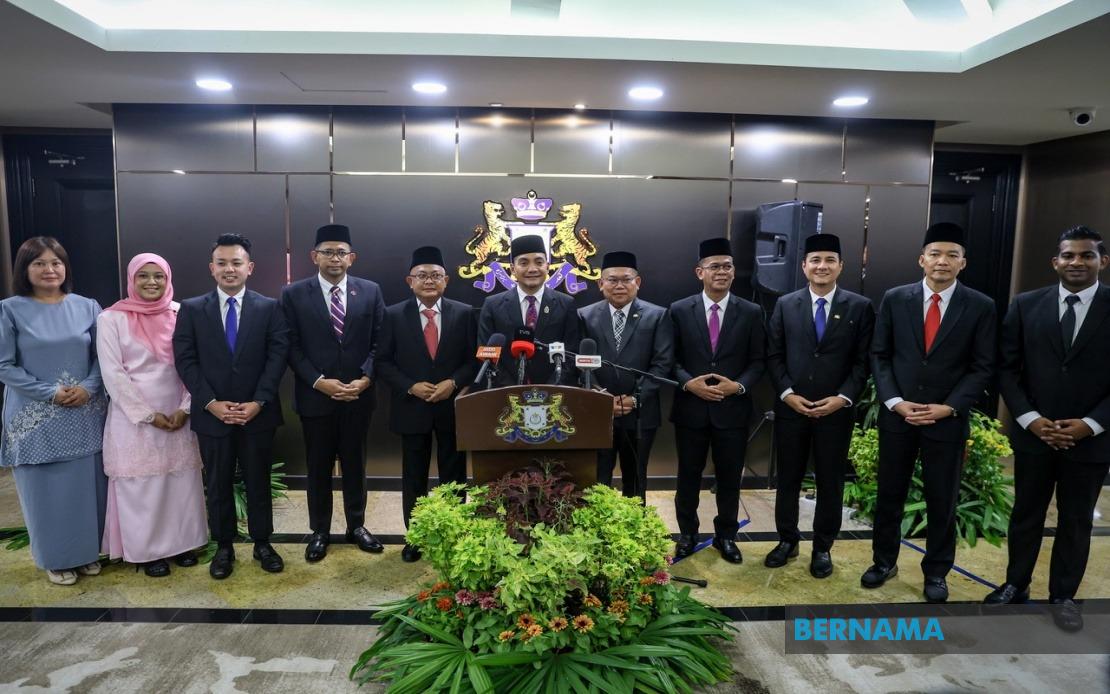
Johor's state administration has taken a significant organisational step by appointing ten deputy committee chairmen to the State Executive Council, a move designed to bolster the state government's capacity to manage increasingly complex governance challenges. Menteri Besar Datuk Onn Hafiz Ghazi announced the appointments at a special press conference held in Iskandar Puteri, emphasising that the restructuring reflects the growing demands placed on Johor's administration as the state pursues ambitious development targets.
The decision carries the endorsement of Tunku Mahkota Ismail, the Regent of Johor, underscoring the constitutional importance of the appointments. This dual approval—from both the executive chief minister and the royal institution—signals the formal nature of the expansion and its alignment with the state's governance framework. For Malaysian states seeking to demonstrate effective administration, such arrangements are critical, as they demonstrate institutional coherence between executive and constitutional authority.
Onn Hafiz characterised the appointments as part of a broader response to accelerating state development. As Johor's agenda becomes increasingly demanding, the government recognised that its existing committee structure risked becoming a bottleneck in policy implementation and public service delivery. By introducing deputy positions, the administration aims to distribute workload more evenly across leadership teams, allowing for faster decision-making and more responsive governance at the grassroots level.
The appointments directly support two flagship initiatives: the Maju Johor 2030 framework and the Johor Economic Transformation Plan (JETP). Both programmes represent long-term strategic visions designed to elevate Johor's development status and competitive position within Malaysia and Southeast Asia. The Maju Johor 2030 framework specifically targets the state's transformation into a developed entity within the next six years, while the JETP focuses on economic restructuring and sectoral growth. These ambitious goals require administrative infrastructure capable of executing multiple workstreams simultaneously without sacrificing quality or equity.
A central rationale for the restructuring centres on ensuring that development policies reach all districts equitably and inclusively. Johor, as one of Malaysia's largest states by population and geography, faces inherent challenges in translating centralised policy directives into localised outcomes. Deputy committee chairmen are expected to serve as intermediaries between state-level strategy and district-level implementation, monitoring projects in real time and identifying bottlenecks before they escalate into public grievances.
The operational framework expected of these newly appointed officials involves close coordination with existing committee chairmen, relevant government departments, and implementing agencies. This trilateral coordination structure—between committee leadership, the deputy layer, and operational departments—creates a more granular system of oversight. Field operations benefit from having dedicated supervisory personnel whose primary role is ensuring that initiatives penetrate to grassroots communities rather than remaining confined to headquarters-level planning.
Onn Hafiz's comments underscore a philosophy of leadership that emphasises trust and shared responsibility. Rather than concentrating executive authority in a small circle of senior figures, the expansion distributes accountability across a broader cohort of appointed officials. This decentralisation can accelerate problem-solving, as officers closer to implementation challenges may recognise solutions more readily than distant executives. Simultaneously, it creates redundancy in decision-making capacity—if one chair or deputy faces unexpected absence or incapacity, the administration need not grind to a halt.
For Malaysian observers and regional counterparts, Johor's restructuring offers instructive lessons about scaling governance capacity. Many Southeast Asian states and Malaysian states face similar pressures: ambitious development timelines, large geographic footprints, diverse constituency demands, and limited administrative bandwidth. Johor's approach—introducing intermediate supervisory layers rather than dramatically expanding the top executive circle—represents a pragmatic, cost-effective method of enhancing administrative throughput without creating an unwieldy bureaucracy.
The emphasis on service delivery improvement reflects broader governance trends across Malaysia, where state governments increasingly face public expectations for rapid service provision and transparent project execution. The appointment of deputy chairs signals commitment to those expectations by visibly investing in infrastructure dedicated to service quality rather than merely announcing policies. Public perception of government effectiveness often depends less on the announced ambitions and more on the visible machinery deployed to achieve them; these appointments constitute such visible machinery.
Looking forward, the success of this restructuring will likely depend on how effectively the new deputy chairs integrate with existing committees and whether their appointment meaningfully accelerates project timelines and complaint resolution. Initial indicators will include reductions in project implementation delays, improved public satisfaction metrics, and visible progress toward Maju Johor 2030 and JETP milestones. Should the appointments prove effective, the model may attract replication among other Malaysian states seeking to enhance administrative capacity without wholesale structural overhaul.
The timing of the announcement—as Johor navigates post-pandemic economic recovery and intensifying regional competition for investment and talent—suggests that state leadership views administrative efficiency as a competitive advantage. By demonstrating streamlined, responsive governance, Johor positions itself as an attractive destination for domestic and foreign investment, particularly in sectors requiring predictable permitting processes and efficient local government interaction. The deputy committee appointments thus extend beyond internal reorganisation into the realm of economic strategy and regional positioning.

