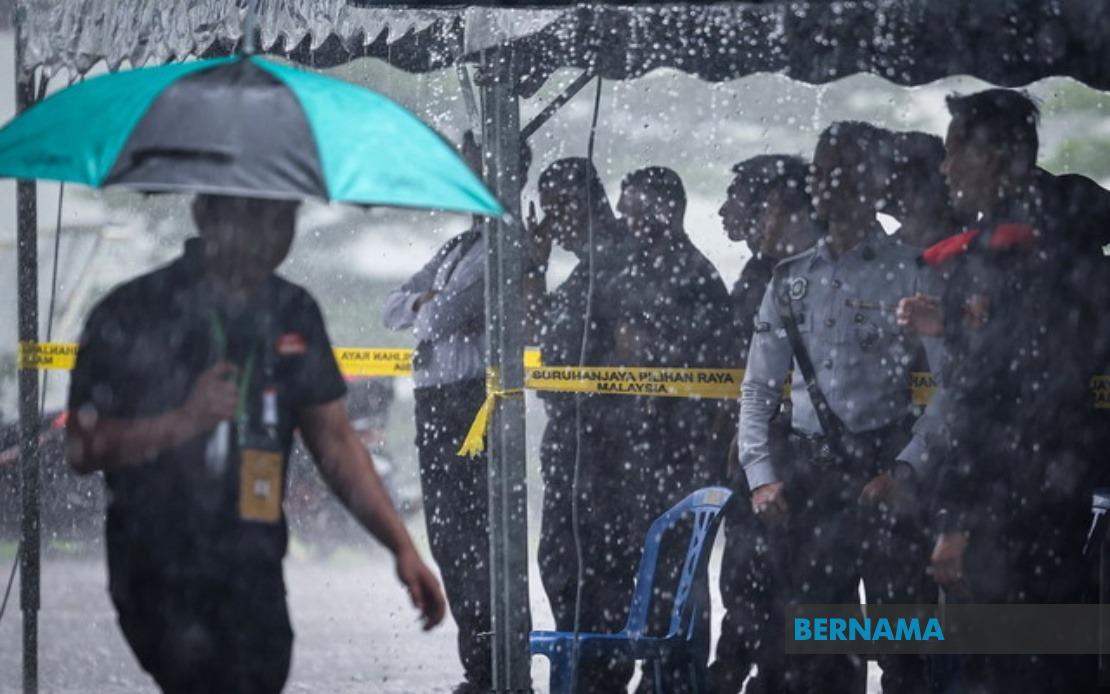
The 16th Johor state election's early voting phase unfolded without significant incident at the State Police Contingent Headquarters in Johor Bahru on July 7, even as tropical weather threatened to complicate proceedings. A substantial downpour struck the area around 9.40 am, yet the election management framework held firm, with voting operations continuing at their established rhythm. The weather, while inconvenient for voters and observers alike, proved insufficient to derail what has become a routine logistical exercise for managing participation among security force personnel and their families.
Police officers and staff members appeared undeterred by the rainfall, moving quickly through entrances to reach polling stations where election officials waited to process their votes. The scene captured the familiar tension between weather's minor disruptions and the determined progression of democratic process. Media representatives covering the election's early voting phase adapted by establishing shelter under tent structures, a standard precaution during Malaysia's monsoon season. Such contingencies reflect the institutional experience accumulated across numerous electoral cycles.
The participation figures paint a picture of substantial engagement within the police force ahead of the broader election day. A total of 12,067 police personnel and their spouses participated in person at various designated polling centres throughout Johor on the early voting date. This represented a significant block of the security apparatus exercising the franchise before the general public went to the polls. Additionally, 643 members had opted for postal voting, reflecting the geographic distribution of police postings across the state and the flexibility built into Malaysia's electoral system to accommodate personnel who cannot be physically present at their assigned polling stations.
The 16th Johor state election represents a substantial electoral undertaking for the southern state, one of Malaysia's most politically significant jurisdictions. A total of 172 candidates have registered to contest the 56 state seats available, indicating competitive races across most constituencies and reflecting the political intensity that characterises Johor politics. The state has historically served as a political barometer for national trends, making its electoral outcomes relevant far beyond its own borders. The diversity of candidatures suggests that voters will encounter meaningful choices across the spectrum of party affiliation and political philosophy.
The broader electorate extends well beyond the police contingent, with more than 2.7 million ordinary voters scheduled to cast ballots on Saturday, July 9. This massive voter roll underscores Johor's demographic significance within Malaysia's electoral landscape. Managing such numbers requires meticulous coordination across numerous polling centres, election commission staff, and administrative resources. The decision to permit early voting for security personnel and their families acknowledges the operational demands that prevent such individuals from participating during standard polling hours.
The early voting arrangement for police and military personnel has become standardised practice in Malaysian elections, reflecting both logistical necessity and recognition of the unique circumstances facing security force members. By concentrating such voting on a designated date before the general poll, election management can allocate appropriate resources and staffing to ensure smooth processing without disrupting regular polling day operations. The successful completion of police early voting in Johor suggests the underlying systems remain adequately robust to handle the compression of voting into a shorter timeframe.
Weather patterns during Malaysia's wet season regularly challenge election day operations, yet the accumulated experience of the Election Commission has produced protocols and contingency measures that typically suffice to maintain the integrity and continuity of voting. The rain in Johor on July 7 exemplified the kind of routine weather challenge that election systems must accommodate. Temporary sheltering solutions, alert staff, and voter patience combine to keep the process moving forward despite climatic inconveniences. For observers, such incidents demonstrate the resilience of the electoral machinery.
Johor's political importance transcends state-level considerations, given its substantial population and economic influence within the Malaysian federation. Electoral outcomes in the state have frequently foreshadowed shifts in national political sentiment and sentiment among particular voter demographics. This reality ensures that national political actors maintain close attention to Johor polling results, and the conduct of voting in the state receives scrutiny from observers concerned with broader questions about election administration and political participation.
The steady stream of voters arriving throughout the morning at the police headquarters polling centre indicated sustained interest in early voting among eligible personnel. No significant bottlenecks or processing delays emerged despite the compression of large numbers into a single facility. The election commission's ability to process voters efficiently reflected adequate preparation and staffing for the anticipated volume. Such operational competence, while perhaps invisible to casual observers, underpins public confidence in the electoral system's capacity to accommodate millions of voters.
With police early voting successfully concluded and general polling scheduled for Saturday, Johor enters the final phase of its electoral cycle. The participation of security force personnel in the process reinforces the principle that public sector employees and their families retain voting rights despite their operational commitments. This inclusion, even if managed through separate early voting arrangements, affirms that Malaysia's electoral democracy extends across the full spectrum of society including those occupying sensitive positions within state institutions. The smooth passage of police voting despite adverse weather conditions provided a positive note heading toward the election's climactic Saturday poll.

