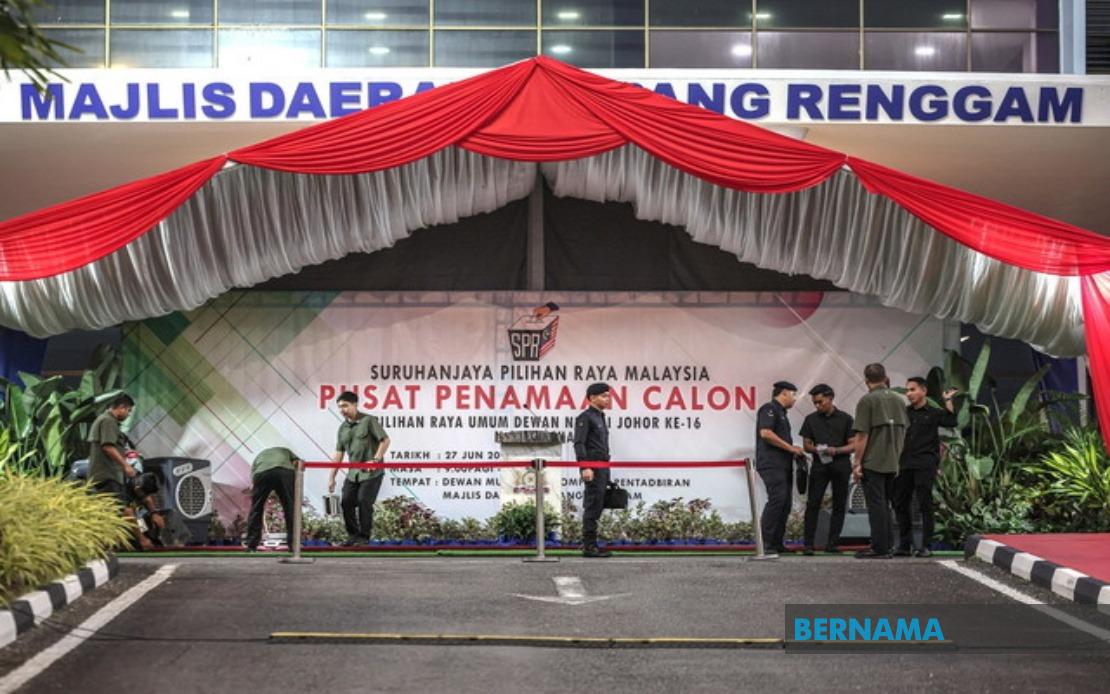
The 16th Johor State Election moved into its official nomination phase on June 27 when all 56 nomination centres across the state simultaneously began accepting candidate registration at 9am. The single-hour submission window, closing at 10am, represented a crucial first step in what promises to be a closely watched electoral contest in the nation's southern heartland. Returning officers stationed at each centre stood ready to process nomination papers while supporters of various political parties gathered from the early hours to demonstrate backing for their chosen candidates.
The nomination submission process itself operates on straightforward but strict procedural lines. Candidates must present their nomination forms directly to the returning officer, though they need not appear alone—proposers and seconders may accompany them, or any combination of two or all three may submit the papers together. This flexibility acknowledges the practical realities of political campaigns while maintaining the institutional framework that ensures proper documentation and verification. Once all nominations have been received and verified for compliance with electoral regulations, the Election Commission will announce the official candidate list, clearing the way for campaign activities to commence.
Following verification, the Election Commission has mandated a 14-day campaign period beginning immediately and running through 11.59pm on July 10. This timeframe gives political parties and independent candidates sufficient opportunity to canvas voters, hold rallies, and present their manifestos across the 28 state seats contested in this election. The compressed campaign schedule reflects the EC's careful planning to balance adequate preparation time with efficient electoral administration, a consideration particularly relevant in Johor's diverse political landscape where multiple parties maintain significant ground presence.
Early voting has been scheduled for July 7, allowing eligible voters including military personnel and their spouses as well as police personnel and their spouses to cast ballots before the general polling day. The main election will be held on July 11. These arrangements accommodate the needs of uniformed personnel who may face deployment or operational commitments that could prevent standard voting on election day, reflecting an administrative approach that seeks to maximise voter participation across all segments of the electorate.
Johor's electoral register comprises a substantial constituency. According to Election Commission data released ahead of nominations, 2,727,926 voters are eligible to participate in this election. The registered electorate breaks down into 2,703,175 ordinary voters forming the bulk of the franchise, supplemented by 12,041 military personnel and their spouses and 12,710 police personnel and their spouses. This size positions Johor as one of the nation's most significant state electoral contests, with results carrying implications beyond the state level for Malaysia's broader political dynamics.
Weather considerations added a variable to the nomination day proceedings. The Malaysian Meteorological Department had forecast rainfall in several districts including Johor Bahru, Muar, Batu Pahat, Kota Tinggi, Pontian, Tangkak and Kulai during the morning hours, while Segamat, Kluang and Mersing were expected to remain clear. Afternoon thunderstorms were predicted across most districts, potentially affecting the movement of candidates, supporters and election officials throughout the nomination period. Such weather forecasts, while seemingly minor operational details, can influence voter turnout and the logistics of campaign preparation during the subsequent fortnight.
Security arrangements reflected the Election Commission's determination to maintain order and prevent disturbances during the nomination process. Police forces working alongside personnel from the People's Volunteer Corps implemented strict security protocols and traffic management around all nomination centres. These precautions aimed to create an environment where candidates could complete their registration without interference while ensuring the safety of election officials, party representatives and the general public who gathered to observe or participate in the proceedings.
The nomination phase carries particular significance in Malaysian state elections as it formally defines the competitive landscape. Parties must have finalised candidate selections beforehand, and individuals aspiring to elected office must navigate submission procedures correctly to ensure their eligibility. Rejected nominations, whether due to procedural errors or substantive disqualifications, can reshape political calculations and force last-minute adjustments to party strategies. The hour-long submission window thus concentrates a flurry of political activity and administrative verification into a narrow timeframe that demands precision and coordination from all participants.
Johor's political history indicates this election will likely feature intense competition across multiple fronts. The state has traditionally been a Barisan Nasional stronghold, but recent electoral cycles have demonstrated growing opposition party traction, particularly in urban constituencies. The composition of candidates nominated across the 56 centres will provide the first indication of how major parties have adjusted their strategies and where they have concentrated recruitment efforts. Independent candidates also frequently contest Johor elections, sometimes achieving surprising victories in specific constituencies.
The transition from nomination day to the campaign period represents a shift from administrative mechanics to substantive political messaging. With candidate lists finalised and the 14-day campaign window open, parties will deploy resources into grassroots organising, media outreach, and direct voter engagement. Johor's geographic spread—stretching from Johor Bahru's urban environment to the rural districts of Segamat, Mersing and Kluang—requires campaigns to adapt messaging and tactics to diverse local concerns while maintaining coherent statewide narratives.
For Malaysian voters watching developments, the Johor election holds implications extending beyond state governance. As one of Malaysia's largest and most electorally significant states, the result will influence perceptions of national political momentum and could affect coalition politics at the federal level. The nomination process that concluded on June 27 thus marked not merely the beginning of a state election but a potential inflection point in the country's broader political trajectory. The field is now set, the candidates identified, and the campaign stage prepared for what many observers expect to be a closely contested and consequential electoral battle.

