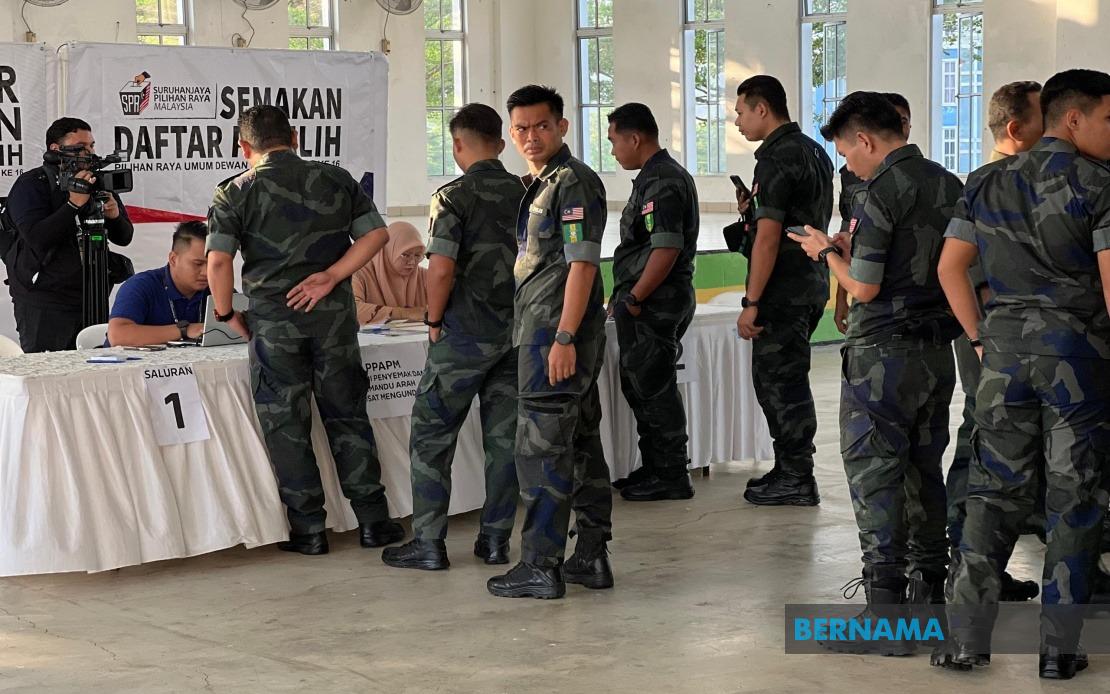
Early voting operations commenced across Johor this morning as the Election Commission facilitated advance polling for security personnel ahead of Saturday's 16th state election. The initiative enabled approximately 24,751 members of the Malaysian Armed Forces, Royal Malaysia Police, and General Operations Force—together with their spouses—to discharge their civic duties at designated centres that began accepting voters at 8 am.
The staggered approach to security force voting reflects long-standing electoral practice in Malaysia, where military and police personnel require special scheduling to maintain operational readiness. The 64 polling stations established throughout the state represent a logistical undertaking designed to accommodate personnel who cannot participate in the standard voting day due to duty rosters and security commitments. This parallel voting mechanism ensures that those tasked with maintaining national security are not disadvantaged in exercising their democratic rights.
Among the early voters, the Malaysian Armed Forces contingent comprised 12,041 service members and their spouses, who cast their ballots across 11 dedicated polling centres. This military vote represents a significant bloc within the security force electorate, reflecting the substantial presence of armed personnel in Johor and the importance of their participation in state-level elections. The concentration of military voters in dedicated centres allows for coordinated logistics while maintaining the secrecy and integrity of the ballot.
The remaining 12,710 voters consisted of police and General Operations Force personnel alongside their family members, who distributed their voting across a broader network of 53 polling stations. This larger geographical spread accommodates the more dispersed nature of civilian police deployments and paramilitary force postings throughout the state. The Police contingent, as the largest uniformed service, required proportionally more voting infrastructure to prevent congestion and ensure efficient ballot processing.
Operational planning by the Election Commission incorporated a staged closure schedule, with early voting centres shuttering sequentially from noon onwards through 6 pm. This rolling conclusion prevented bottlenecks and allowed election officials to conduct proper procedures at each location before sealing results. The scheduling demonstrates the Commission's experience in managing large-scale electoral operations where thousands of voters must be processed within defined timeframes without compromising voting integrity.
Weather conditions in major districts across Johor favoured voting operations on the day. Reports from Batu Pahat, Muar, Pontian and Tangkak indicated sunny conditions, which typically encourage voter turnout by removing weather-related barriers to participation. Clear skies and dry conditions reduce logistical complications for election personnel managing polling stations and transporting ballots, while also improving accessibility for voters traveling to centres.
The early voting phase represents merely the opening chapter of an election cycle that culminates with Saturday's main polling day, when approximately 2.7 million ordinary voters will participate in the 56 state seats contested in the 16th Johor state election. This broader electorate encompasses the general population across diverse demographic groups, occupational backgrounds, and residential areas spanning both urban and rural districts. The contrast between the 25,000 early voters and the 2.7 million main-day voters underscores the scale of the election machinery mobilized for this single state contest.
The 56-seat distribution represents the current configuration of Johor's state assembly, with constituencies ranging from competitive marginal seats to strongholds where particular parties hold entrenched support. The variety of electoral contests means that Saturday's polling will generate widely divergent results across different regions, with some constituencies producing commanding majorities while others remain contested between closely-matched candidates. The cumulative outcome from these 56 individual contests will determine which coalition controls the state government and shapes Johor's policy direction for the ensuing term.
For Malaysian voters, Johor's state election holds significance beyond its immediate state-level implications. As Malaysia's second-largest state by population and a major economic driver, Johor's political complexion influences national political dynamics and coalition-building at the federal level. Election results in Johor often signal broader trends in voter sentiment, particularly regarding incumbent performance and opposition momentum, making them closely analyzed by political observers assessing the trajectory of Malaysian democracy and party support.
The security force voting mechanism also illuminates the practical arrangements required to accommodate public servants within democratic systems. Balancing the operational requirements of the military, police, and General Operations Force with citizens' rights to participate equally in elections demands sophisticated administrative coordination. The successful execution of early voting for these personnel demonstrates the Election Commission's institutional capacity to manage complex logistical challenges while maintaining procedural fairness and voter confidentiality across simultaneous polling operations.

