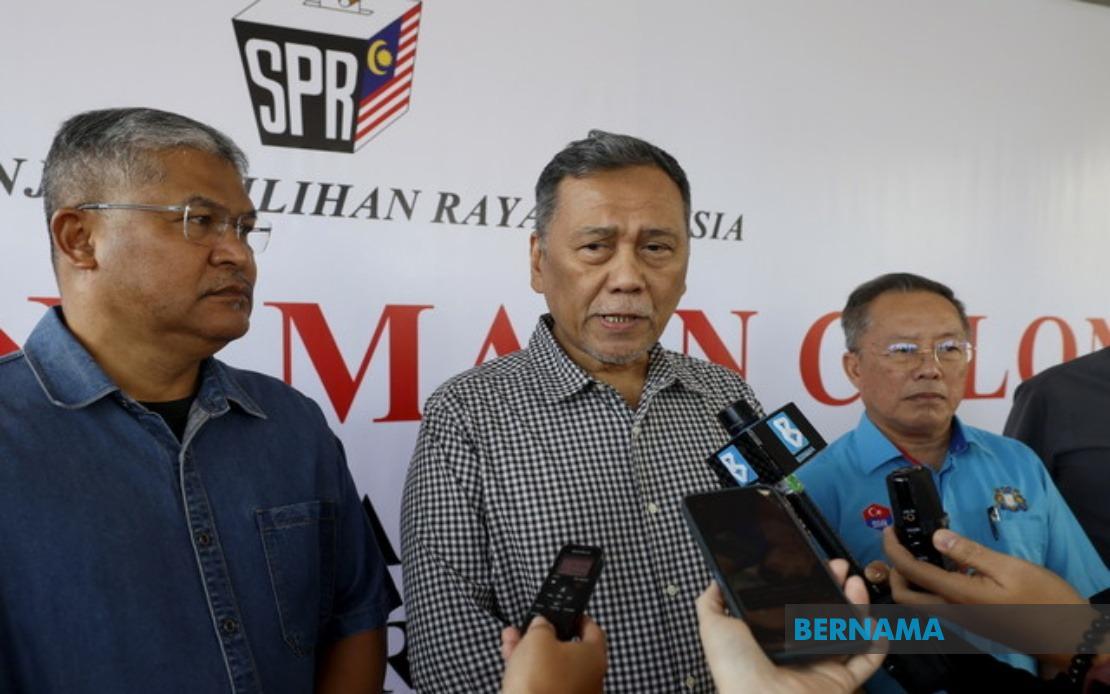
The Johor state election campaign enters its formal phase tomorrow with 133 prospective candidates having confirmed their participation through deposit payments, according to Election Commission chairman Datuk Seri Ramlan Harun. The figure represents slightly more than one-fifth of the 593 nomination forms that have been distributed at returning officer offices throughout the state, suggesting a significant increase in registrations is still anticipated before the nomination window closes. The gap between forms sold and deposits paid indicates many potential candidates remain undecided, possibly awaiting final party endorsements or assessing their electoral prospects in individual constituencies.
Ramlan emphasised that candidates have until the start of tomorrow's nomination process to complete their formalities, encouraging those committed to contesting to expedite their paperwork. The compressed timeline between form distribution and the formal nomination process—less than 24 hours—creates practical challenges for returning officer staff managing an anticipated surge of last-minute applications across all 56 state constituencies. This pattern is consistent with previous Malaysian elections, where many candidates delay confirmations until the final permitted moment, reflecting uncertainty about candidate selection processes or tactical considerations by political parties seeking to maintain strategic flexibility.
The Election Commission has confirmed that all 56 nomination centres across Johor are operationally ready following two consecutive days of trial runs. This preparation phase is crucial for managing what is expected to be a high-volume, time-pressured process. Each centre must process candidate nominations, verify documentation, collect deposits, and maintain detailed records while accommodating party representatives and supporters. The logistical complexity intensifies when multiple candidates from competing parties arrive simultaneously, requiring trained staff to maintain order and accuracy while processing dozens of applications daily.
Security remains a significant consideration given the charged political environment surrounding Johor's election. Ramlan issued explicit reminders to all political parties, candidates, and their supporters to comply with established regulations and avoid provocative behaviour. These warnings reflect historical tensions during nomination periods, when competing supporters have occasionally clashed. The nomination process, despite being primarily administrative, has occasionally witnessed confrontations as parties seek to assert dominance or respond to perceived slights by rivals.
MaharaniReturning Officer Zainal Eran outlined specific crowd management measures designed to segregate party supporters at nomination centres. Only official nomination participants—the candidate, proposer, and one designated supporter—will be permitted inside the centre itself. Additional party supporters will occupy a designated outdoor field where metal barriers will create physical separation between different political camps. This staged access system balances transparency with security, allowing party officials to oversee proceedings while minimising direct confrontation opportunities. However, such arrangements occasionally create tension when supporters feel excluded from witnessing their party's nomination process.
The multi-party competitive landscape for Johor reflects Malaysian electoral politics' increased fragmentation beyond the traditional Pakatan Harapan versus Barisan Nasional binary. Pakatan Harapan will contest all 56 seats with a coalition formula allocating 20 to PKR, 19 to Amanah, and 17 to DAP, maintaining its unified front approach. Barisan Nasional similarly contests all 56 seats, distributing them as 36 to UMNO, 16 to MCA, and four to MIC, though this coalition has faced internal strains in recent years, particularly regarding resource allocation and seat negotiations.
Perikatan Nasional's participation reflects its continued assertion as a significant electoral force despite recent federal government changes. PAS will contest 11 seats, Bersatu 16, the Malaysian Indian People's Party five, and Pejuang one, totalling 33 seats. This distribution reveals tensions within the coalition, particularly regarding Bersatu's significant allocation despite being a smaller party than PAS. The coalition's strategy appears designed to maintain Bersatu's parliamentary relevance while providing PAS opportunities in constituencies where it possesses grassroots strength. However, seat-sharing disagreements have historically undermined opposition coalitions' effectiveness.
Independent and smaller party candidacies add further complexity. The Malaysian United Democratic Alliance will contest four seats, while Parti Sosialis Malaysia fields a single candidate. Most significantly, Parti Bersama Malaysia will make its electoral debut by contesting 15 state seats, suggesting either new party registration or emergence of a previously unknown electoral vehicle. This proliferation of minor parties can influence constituency outcomes, particularly in closely contested seats where vote splitting between similar ideological camps determines winners.
Johor's electoral cycle carries significance extending beyond state-level politics. As Malaysia's second-largest state by population and a traditional political battleground, Johor election results often signal broader national political trends. A substantial showing by any coalition provides momentum for subsequent federal political manoeuvring. Additionally, Johor's economic importance and its role as a gateway to Singapore make governance outcomes relevant to business investment decisions and cross-border regional stability. The state has experienced relatively stable governance, but electoral patterns here frequently preview shifts in national political preferences.
The compressed election timeline—nomination tomorrow, early voting on July 7, and polling day on July 11—leaves minimal time for sustained campaign activity. Candidates will have approximately two weeks to canvass voters, conduct rallies, and establish their policy positions. This abbreviated campaign period may advantage incumbents with existing voter recognition and party machinery capabilities over newcomers or smaller parties lacking organisational depth. It also reduces opportunities for policy-focused campaigning, potentially resulting in more personality-driven or identity-based electoral competition.
The 56-seat Johor state assembly represents a significant electoral undertaking, generating hundreds of competitive races across diverse constituencies. Johor's constituencies range from urban areas with educated, cosmopolitan electorates to rural districts with traditional voting patterns and concerns focused on agriculture, land issues, and local infrastructure. This diversity ensures that election outcomes will reflect complex local considerations beyond partisan national narratives, with individual candidates' personal appeal and local reputation remaining consequential factors determining results.
Preliminary deposit payment figures suggest measured enthusiasm for contesting among prospective candidates, possibly reflecting economic considerations regarding campaign costs or uncertainty about party nomination chances. The final deposit figure, once nomination closes tomorrow, will provide clearer insight into electoral competitiveness and party recruitment success. Three-cornered fights in multiple constituencies would amplify vote fragmentation and create unpredictability, while one-on-one contests would enable more straightforward voter choice dynamics. The ultimate distribution of candidates will significantly shape the election's competitive character and final outcome possibilities.

