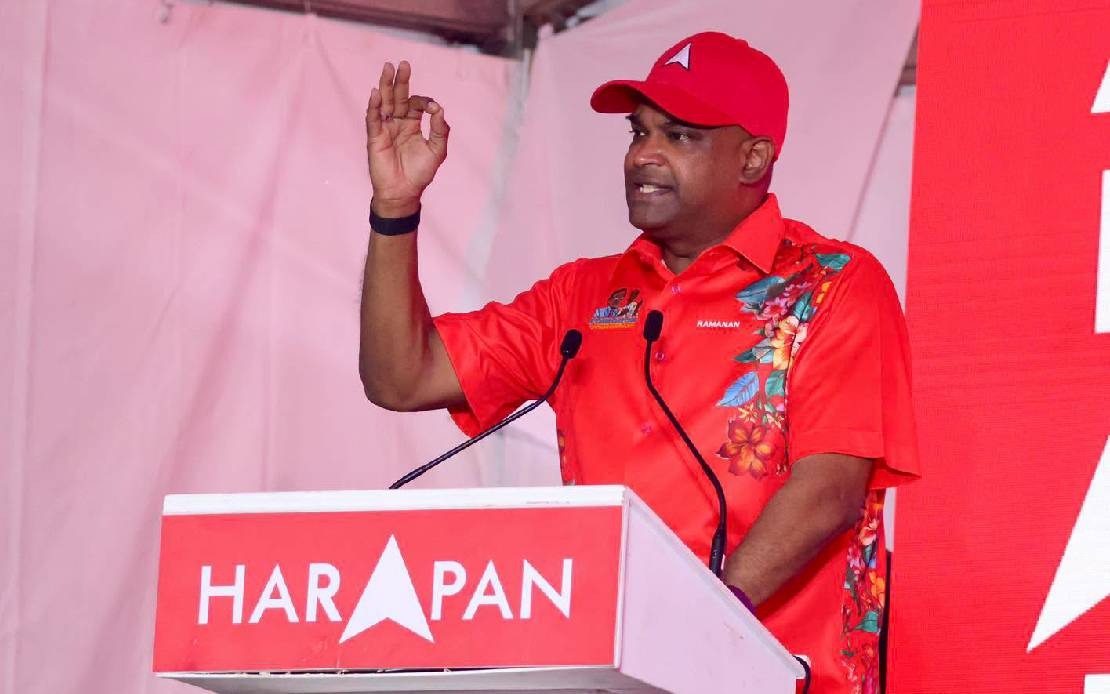
The Federal Government's sustained focus on Johor's development remains a cornerstone of national economic strategy, with senior coalition figures emphasizing ongoing investment in infrastructure and social support across the southern state. Speaking at a Johor Ke Depan campaign event in Simpang Renggam, PKR Vice-President Datuk Seri R Ramanan outlined the breadth of federal initiatives designed to translate national growth into tangible improvements for Johor's residents, signalling that development gains should reach households at every economic level.
Ramanan's remarks underscore a deliberate political positioning by the Pakatan Harapan-led Federal Government to demonstrate sustained engagement with Johor's economic and social needs. The statement arrives at a critical juncture, with the 16th Johor State Election scheduled for July 11, making such public commitments both substantive policy declarations and campaign messaging. The timing reflects broader coalition strategy to anchor its electoral appeal in concrete delivery rather than rhetorical promises, a calculation particularly relevant in a state with significant swing voter populations and a history of competitive electoral contests.
The emphasis on "various investments, infrastructure developments and assistance programmes" reflects federal recognition that Johor's prosperity directly influences national economic performance. As Malaysia's second-largest economy and a critical hub for manufacturing, petrochemicals, and logistics, Johor's trajectory shapes broader regional competitiveness. Major infrastructure undertakings—whether port expansions, transportation networks, or industrial park development—represent federal acknowledgement that state-level growth engines require sustained capital allocation and institutional support.
Among the dignitaries present at the Simpang Renggam event were PKR Vice-President Datuk Seri Amirudin Shari, Amanah Secretary-General Faiz Fadzil, and three Pakatan Harapan candidates contesting Machap, Benut, and Layang-Layang state constituencies. Their collective presence underscored coalition unity and the multi-party nature of Johor's political landscape, where Amanah and PKR operate alongside DAP in constructing electoral narratives. This configuration highlights how Johor elections test not merely governmental legitimacy but also coalition cohesion—a factor particularly acute given periodic tensions within Pakatan Harapan's membership.
Ramanan's specific appeal for administrative alignment between state and federal governments addresses a practical governance challenge that Johor has navigated. When state and federal administrations operate under different political leadership, development coordination becomes administratively complex, potentially delaying project implementation and creating policy contradictions. By framing electoral choice as a mechanism for institutional harmony, the coalition positioned alignment itself as a development enabler rather than merely a partisan advantage.
The assertion that Johor remains a "top priority" carries particular weight given Malaysia's concurrent economic pressures and competing regional demands. Federal resource allocation involves difficult choices between Peninsular and East Malaysian states, between urban and rural constituencies, and between maintenance of existing infrastructure and expansion of new capacity. Johor's prominence in federal calculations reflects both its economic scale and its electoral significance within the broader national political arithmetic.
Assistance programmes directed at households represent the distributive face of federal engagement, extending beyond infrastructure to encompass welfare, education, healthcare, and livelihood support. These programmes become increasingly visible and electorally salient during campaign periods, when citizens directly encounter messaging about benefits received or promised. The cumulative effect of multiple smaller interventions—conditional cash transfers, skills training, subsidy mechanisms—arguably shapes voter perception as powerfully as headline infrastructure projects, particularly among lower-income demographics.
The election logistics reveal a substantial contest: 172 candidates competing across Johor's constituencies on July 11, with early voting scheduled for July 7. This scale of candidacy reflects both the state's size and the fragmentation of Malaysia's political landscape, where federal and state coalitions operate alongside independent contenders and state-specific parties. For voters, this multiplicity requires navigating complex ballot choices with potential implications for both state governance and federal coalition stability.
For Malaysian observers monitoring federal development strategy, Ramanan's statement offers insight into how the Pakatan Harapan coalition frames its development agenda in economically significant states. The emphasis on fairness and inclusive benefit-distribution suggests sensitivity to perceptions that development gains concentrate among particular communities or constituencies. In Johor, where industrial growth has generated both prosperity and disparity, messaging around equitable inclusion carries political resonance.
Looking forward, the election outcome will indicate whether voters perceive federal commitment as credible and translatable into continued state-level progress. A Pakatan Harapan victory would validate the coalition's development messaging and create administrative conditions for accelerated implementation of announced projects. Conversely, divergent results would reset the political calculation and potentially constrain federal-state coordination capacity, affecting project timelines and funding mechanisms.
The campaign rhetoric surrounding Johor's development trajectory ultimately reflects competitive efforts by political actors to demonstrate competence in delivering material improvements. Whether through infrastructure completion, employment generation, or expanded social services, electoral legitimacy increasingly depends on voters' assessment of whether government—whether state or federal—translates policy commitments into lived improvements. Johor's political importance ensures this calculus will remain central to Malaysian politics regardless of electoral outcomes.

