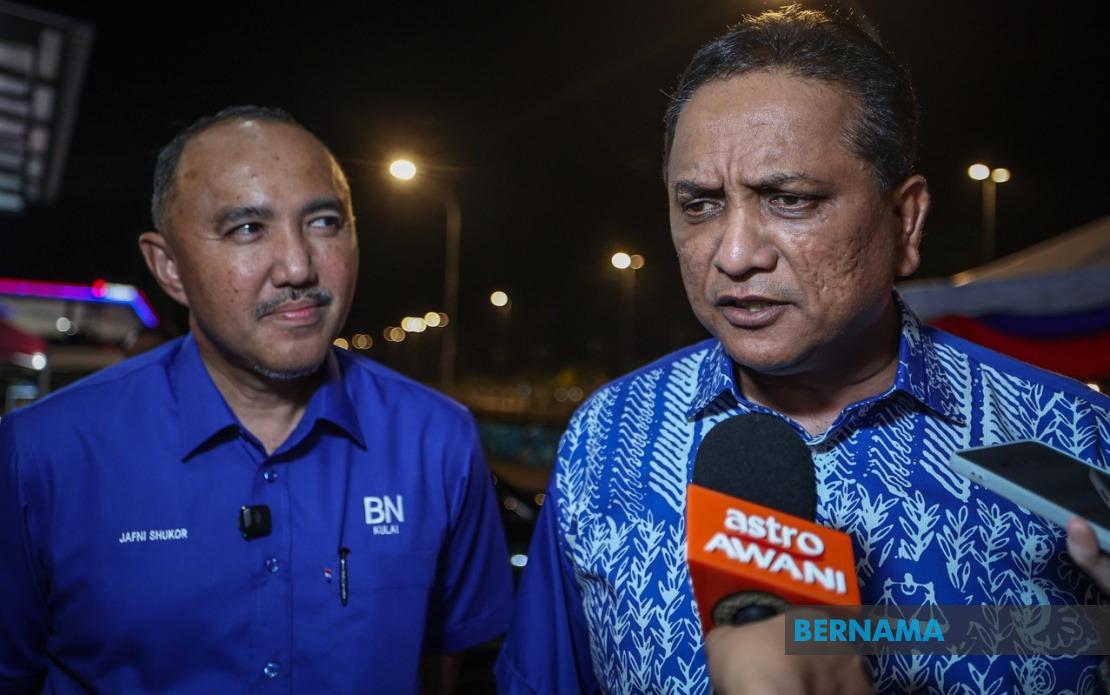
Johor's Regent exercises legitimate constitutional oversight of the state administration rather than controlling the government like a puppet master, according to a prominent UMNO leader responding to recent political accusations. Datuk Seri Reezal Merican Naina Merican, a member of UMNO's Supreme Council, made the statement in Johor Bahru on June 25, pushing back against what he described as grossly exaggerated and factually unfounded claims about the relationship between Tunku Mahkota Ismail and the state's political leadership.
The remarks came in response to Datuk Dr Mohd Puad Zarkashi's departure from UMNO, in which the former Johor State Legislative Assembly Speaker alleged that Menteri Besar Datuk Onn Hafiz Ghazi had become subservient to palace interests. The timing of these accusations has drawn scrutiny, arriving just as Johor prepares for a state election with nomination day set for June 27 and polling day scheduled for July 11. Reezal Merican suggested that Mohd Puad's decision to weaponize the royal institution for political gain raised serious questions about the motivations behind such claims, particularly as the state heads toward a crucial electoral contest.
According to Reezal Merican, the Regent's public statements regarding Johor's development trajectory reflect his constitutional role and responsibility to the people, not an attempt to dominate elected officials. Each directive or observation issued by Tunku Mahkota Ismail represents both a right and an obligation inherent to the position of Regent, exercised ostensibly for the benefit of Johor's residents. Rather than constituting overreach, this engagement should be understood as part of the constitutional framework that grants royalty certain supervisory functions within state governance structures.
The UMNO leader characterized the Regent's relationship with the Menteri Besar and State Secretary as a system of checks and balances—a mechanism intended to safeguard public interests rather than consolidate power in palace hands. This framing aligns with traditional interpretations of constitutional monarchy in Malaysian states, where rulers maintain certain prerogatives to ensure proper governance without direct administrative control. The distinction Reezal Merican drew is significant: oversight and influence differ fundamentally from puppet-mastering or outright control of executive functions.
Reezal Merican's denial extended to the broader claim that UMNO's Johor operations function as palace-controlled entities. Speaking from personal experience as a Supreme Council member, he asserted that no credible suggestion of such palace dominance over party structures has ever been raised within senior UMNO circles. This assertion carries weight given his position within the party hierarchy and his direct involvement in high-level decision-making, suggesting that if palace interference existed at an organizational level, it would likely surface in Supreme Council discussions.
The political context surrounding these statements cannot be overlooked. The accusation of royal overreach emerged during a sensitive pre-election period when UMNO and its Barisan Nasional coalition seek to consolidate support in Johor. Mohd Puad's departure and his accompanying criticism of the Menteri Besar-palace relationship introduce a divisive narrative precisely when party unity matters most for electoral success. Reezal Merican's response appears calculated to neutralize this narrative before it gains traction among voters concerned about democratic accountability and institutional balance.
The broader implications for Malaysian politics touch on persistent tensions between monarchical institutions and elected governments. States across Malaysia navigate the constitutional relationship between rulers and elected representatives, yet Johor's situation has attracted particular attention due to the high-profile nature of recent tensions. How these relationships operate in practice—whether rulers exercise appropriate oversight or overstep constitutional boundaries—remains contentious among observers and constitutional scholars.
For Southeast Asia more broadly, the Malaysian experience reflects broader patterns in constitutional monarchies where traditional institutions interact with modern democratic structures. Thailand, Cambodia, and other regional nations face similar questions about the appropriate scope of royal influence in governance. Malaysia's federal system, which grants substantial autonomy to state governments and recognizes rulers' constitutional positions, adds complexity to this balance. The Johor case study offers insights into how these tensions manifest when political actors explicitly challenge the institutional arrangement.
Reezal Merican's intervention serves multiple purposes within the current political environment. By delegitimizing Mohd Puad's accusations as exaggerated and politically motivated, he attempts to prevent the narrative from destabilizing UMNO's election campaign. Simultaneously, his statement reinforces UMNO's preference for maintaining harmonious ruler-government relationships, positioning the party as respectful of constitutional monarchy while committed to democratic governance. This balancing act proves essential given UMNO's historical reliance on both institutional support and electoral legitimacy.
The comments also reveal internal party anxieties about potential defections and the arguments being deployed to justify them. If Johor UMNO members increasingly believe that palace influence undermines their political autonomy, recruitment and retention challenges may intensify. Reezal Merican's public rebuttal attempts to reassure rank-and-file members that no such subordination exists, thereby countering Mohd Puad's implicit argument that principled politicians must distance themselves from UMNO to maintain independence.
Moving forward, the election results in Johor will provide one measure of whether concerns about palace influence affect voter behavior or intra-party dynamics. Should UMNO and Barisan Nasional perform strongly, Reezal Merican's framing will appear vindicated. Conversely, significant losses might suggest that such accusations resonated with constituencies questioning governmental independence. The July 11 polling date will offer clarity on whether Mohd Puad's departure represents an isolated protest or signals broader dissatisfaction with the current power configuration.

