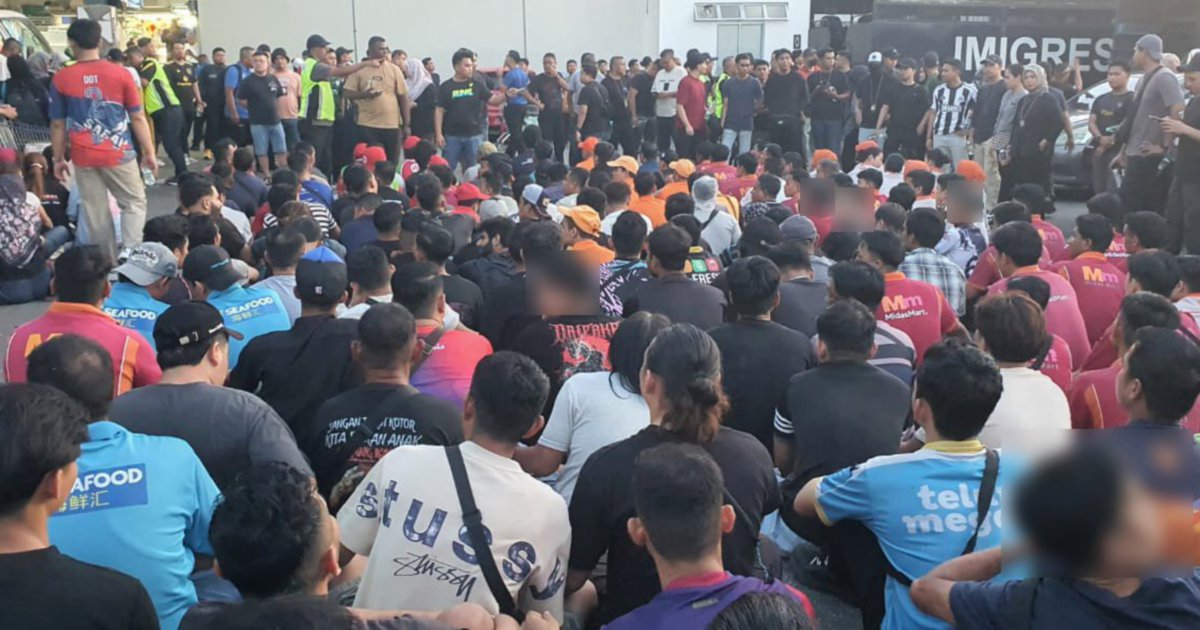
Immigration enforcement officers in Johor Baru have arrested 226 undocumented migrants following the discovery of an organised network that enabled foreign workers to maintain falsified legal entry stamps across the state. The breakthrough came after authorities identified a systematic scheme whereby individuals would repeatedly cross the Malaysia-Indonesia border at controlled intervals, ostensibly to obtain routine passport stamps while using forged documentation or invalid travel permits.
The operation represented a sophisticated workaround to Malaysia's migrant labour regulations, allowing workers to accumulate false evidence of legal entry and stay while remaining active in the informal economy. One Indonesian fishmonger, whose case became the focus of the investigation, had successfully circumvented detection for four consecutive years by conducting monthly border crossing cycles. Each crossing was strategically timed to create an appearance of temporary visits and departures, when in reality he maintained permanent residence and continued undisclosed employment throughout the period.
This method of systematic document manipulation reveals significant gaps in border monitoring protocols and raises questions about coordination between Malaysian and Indonesian immigration authorities. The monthly stamping routine, repeated across dozens of individuals within the network, suggests operational familiarity with checkpoint procedures and possible collusion at enforcement points. The fact that such a pattern persisted undetected for years indicates either insufficient data-sharing between agencies or inadequate cross-referencing of travel records during processing.
The scale of the operation—involving 226 individuals—suggests this was not merely opportunistic fraud but rather a functioning underground employment facilitation system. Workers appear to have been directed or organised through established channels, possibly involving employers, recruitment intermediaries, or immigration brokers who understood how to exploit procedural weaknesses. The coordination required to maintain such cycles points to structural demand from Malaysia's labour market for undocumented workers willing to accept employment below regulatory wage standards and without formal protections.
For Malaysian businesses, particularly in sectors including agriculture, manufacturing, construction, and domestic services, reliance on informal migrant labour creates significant legal and reputational risks. The discovery of such networks may prompt closer scrutiny of industries known to employ large numbers of foreign workers, though enforcement capacity remains a persistent constraint. Authorities will face pressure to implement more rigorous verification systems, yet every enhancement carries cost implications for legitimate businesses and administrative overhead.
Indonesia's role as both source country and transit point compounds the challenge. While Johor shares an active border with Indonesia's Riau Islands province, neither country has established integrated real-time systems to flag suspicious crossing patterns or verify employment status automatically. The monthly cycle exploited in this case would theoretically be detectable through data analysis comparing departure and arrival records, yet such analytical capabilities remain limited across the region.
The detained migrants now face deportation procedures, though the broader question concerns why such schemes flourish despite Malaysia's explicit prohibitions on undocumented employment. Push factors in Indonesia—limited job availability, lower wage expectations—continue driving migration, while pull factors in Malaysia remain substantial. Wages for low-skilled work in Malaysian urban and manufacturing areas significantly exceed Indonesian rural and provincial opportunities, creating persistent incentive structures that no enforcement action alone can eliminate.
From a Southeast Asian perspective, this incident illustrates how labour migration operates across formal and informal pathways simultaneously. Countries including Thailand, Vietnam, Myanmar, and the Philippines similarly contend with mixing of documented and undocumented migration flows, yet regional cooperation mechanisms to address organised trafficking and document fraud remain underdeveloped. The Association of Southeast Asian Nations lacks binding protocols for labour verification or migrant worker protection standards that would apply uniformly across member states.
The passport stamping scheme also highlights vulnerabilities in document integrity. Modern travel documents include security features and biometric identification, yet analogue procedural checks—relying on manual review and officer judgment—remain critical junctures where fraud occurs. If individuals successfully obtained repeated stamps despite false documentation or expired permits, it suggests either inadequate officer training, insufficient access to databases for real-time verification, or deliberate oversight.
Government agencies will likely respond to this discovery through increased checkpoint staffing, more frequent border spot-checks, and possibly enhanced IT systems for recording and flagging irregular crossing patterns. However, such reactive measures address symptoms rather than structural causes. Malaysia's migrant labour needs appear to exceed the number of workers it formally admits through official channels, creating persistent pressure for informal employment arrangements.
The 226 detainees represent only those apprehended in a single operation; the broader network of undocumented workers actively employed across Johor likely extends into thousands. This enforcement action, while significant, touches the surface of a much larger immigration phenomenon shaped by economic disparities, regulatory constraints, and employer demand for flexible, low-cost labour. Without addressing these underlying factors, future schemes will likely emerge using different methodologies to achieve similar outcomes—inserting workers into Malaysia's economy outside formal labour frameworks and enforcement visibility.

