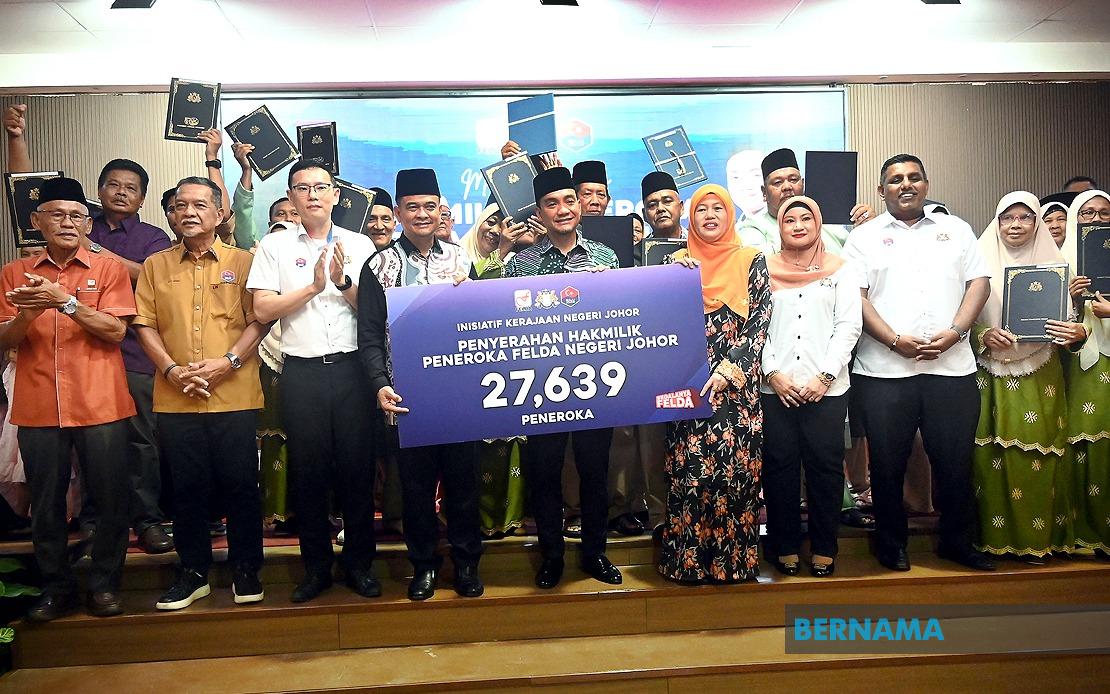
Johor has nearly eliminated a longstanding administrative burden affecting thousands of Federal Land Development Authority settlers, with state authorities confirming that 27,639 land title applications out of 27,642 have been successfully processed and resolved. Menteri Besar Datuk Onn Hafiz Ghazi announced the achievement during a presentation ceremony in Kluang on June 23, marking a watershed moment for rural communities in the state that have waited years for formal documentation of their property rights.
The resolution of 99.99 per cent of pending applications represents the culmination of systematic efforts by the Johor government to address a bureaucratic logjam that had created uncertainty for FELDA smallholders and their families. At the ceremony, 210 settlers from Kluang, Kota Tinggi and Mersing formally received their land titles, completing the transfer of documented ownership for both plantation holdings and residential properties. This tangible distribution of certificates underscores a shift from administrative promise to concrete delivery for communities that form the backbone of Malaysia's agricultural sector.
The significance of this achievement extends beyond mere statistics. For decades, FELDA settlers operated their holdings without formal title documentation, a vulnerability that constrained their ability to access credit, undertake property transactions, or pass assets to heirs with legal certainty. The outstanding three cases represent marginal exceptions to what has been an essentially comprehensive administrative operation, reflecting either exceptional complexities in those particular applications or minor procedural issues unlikely to derail the broader initiative.
Datuk Onn Hafiz framed the resolution as evidence of the state government's commitment to rural development and the welfare of FELDA communities, positioning the initiative as integral to Johor's broader development agenda. His statement that FELDA settlements will remain a priority for the state administration signals continuity in addressing grievances and forestalling future disputes over land ownership. This represents a marked departure from historical periods when FELDA communities felt neglected by state authorities, and their concerns were relegated to the margins of policy attention.
The Federal Land Development Authority has historically struggled with administrative efficiency in land management, a challenge compounded by the scheme's geographic dispersion across multiple states and the inherited complexities of earlier colonial-era land records. Johor's success in substantially clearing its backlog of title applications suggests that sustained political will and dedicated administrative resources can overcome these institutional obstacles. The involvement of the state's Agriculture, Agro-based Industry and Rural Development Committee, chaired by Datuk Zahari Sarip, indicates that the initiative benefited from coordination across relevant government agencies.
For Malaysian policymakers and development practitioners across Southeast Asia, the Johor experience offers practical lessons about resolving land tenure uncertainty in smallholder agricultural communities. Secure property rights are foundational to rural economic development, enabling farmers to invest confidently in land improvements, access formal financial services, and participate more fully in market economies. The psychological relief for settlers of finally obtaining documentary proof of ownership after years of administrative delay cannot be overstated, as it eliminates a persistent source of anxiety and insecurity that undermines social cohesion.
The completion of this initiative also carries implications for Johor's rural economy and agricultural productivity. Settlers with secure land titles are statistically more likely to engage in long-term investments in soil improvement, crop diversification, and infrastructure development on their holdings. The availability of formal documentation creates pathways for younger family members to access agricultural financing for modernization or expansion, potentially revitalizing schemes that might otherwise experience generational decline as aging smallholders retire without succession plans.
Beyond Johor's borders, this resolution addresses a historical grievance that transcends state lines, as FELDA settlements operate across peninsular Malaysia. The successful clearance of the Johor backlog may serve as a template for federal authorities overseeing FELDA's consolidated operations, demonstrating that comprehensive title registration is achievable even for large, dispersed populations of smallholders. This could accelerate similar efforts in other states, progressively eliminating a source of rural discontent that has occasionally surfaced in political discourse.
The three unresolved applications warrant attention, as they may indicate systemic issues requiring different approaches or resources. Whether these involve disputed boundaries, conflicting claims, or incomplete documentation, addressing them would complete the administrative resolution and eliminate any perception that the initiative remains unfinished. The state government's acknowledgment that 99.99 per cent completion remains short of 100 per cent suggests institutional honesty about remaining challenges rather than complacent satisfaction with near-total achievement.
Looking forward, the Johor government faces the task of establishing mechanisms to prevent new title disputes from accumulating. This may require modernizing FELDA land administration systems, improving record-keeping, streamlining processes for title transfers or inheritance, and enhancing communication between state authorities and settlers regarding their property rights. Investment in digital land registry systems could reduce future administrative burdens and provide settlers with efficient access to their documentation.
The presentation ceremony itself served both administrative and symbolic functions, publicly celebrating an achievement that directly benefits thousands of families and communities. Such ceremonies reinforce government commitment to rural populations and acknowledge the accumulated frustration of communities awaiting resolution of longstanding grievances. For settlers finally receiving their titles, the moment represents vindication after years of navigating bureaucracy, and recognition that their concerns were ultimately taken seriously by state authorities.
As Malaysia continues its transition toward higher-income status and technological advancement, ensuring that rural agricultural communities enjoy secure land tenure and access to modern administrative systems remains crucial for inclusive development. The Johor initiative demonstrates that even deeply entrenched administrative challenges can be substantially resolved through determination and adequate resourcing, offering encouragement that other long-standing development obstacles might similarly yield to focused government attention and commitment.