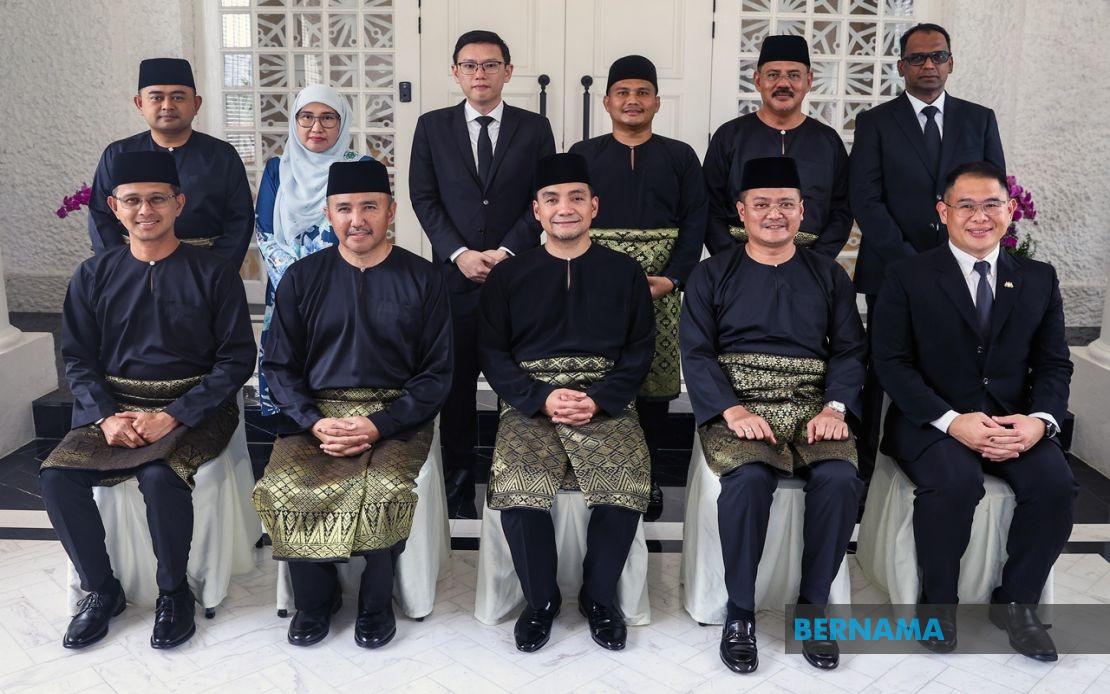
Johor's new state administration took formal shape on July 18 when all ten members of the State Executive Council were sworn in before Tunku Mahkota Ismail at Istana Bukit Serene. The ceremony marked a significant moment for the state following the recent electoral success of Barisan Nasional, which had secured a commanding mandate to govern. While six exco members carried over from the previous term, four newcomers were introduced into the cabinet-level positions, signalling both continuity and strategic refreshment in the leadership structure.
The new faces entering Johor's top administrative tier represent a cross-section of the governing coalition's assembly members. Md Israk Abdullah, representing the Kukup constituency, takes charge of the Agriculture, Agro-Based Industry and Rural Development portfolio—a significant responsibility given Johor's substantial agricultural sector and rural communities. P. Pannir Selvam, elected from Perling, heads the Unity, Heritage and Culture Committee, reflecting the state's diverse demographic composition and cultural heritage. Hasrunizah Hassan of Pulai Sebatang assumes leadership of the Women, Family and Community Development Committee, bringing gender-focused governance into the executive structure. Dr Muhammad Naqib Md Ghazali, representing Panti, has been assigned the Education and Information Committee, a critical portfolio for policy dissemination and human capital development.
The composition of the exco reflects the broader political configuration that emerged from Johor's sixteenth state election, held the weekend before the swearing-in ceremony. Barisan Nasional achieved a decisive outcome, winning 48 of the 56 available state seats—a substantial majority that provided clear instruction for governance direction. This electoral performance granted the coalition both the legitimacy and numerical strength to implement its policy agenda across the state's administrative machinery without significant parliamentary obstruction. The scale of the victory suggested not merely a return to power but a reaffirmation of voter confidence in BN's approach to state-level governance.
Leading this new governmental term is Onn Hafiz, who was sworn in as Johor Menteri Besar for his second consecutive tenure. Hafiz, who represents the Machap state assembly seat, had already been re-elected in the same polling exercise with an impressive personal majority of 15,375 votes, demonstrating substantial constituent support. Beyond his chief executive role, Hafiz chairs the Johor Barisan Nasional apparatus, positioning him as the coalition's undisputed state-level leader. His continuation in office reflects voter preference for leadership continuity while the introduction of four new exco members allows for fresh perspectives and broader representation within the governing circle.
The retained exco members continue their previous committee assignments, preserving institutional memory and policy consistency across several key governmental functions. Datuk Mohd Jafni Md Shukor maintains oversight of housing and local government matters, ensuring continuity in urban development and municipal administration. Mohd Hairi Mad Shah continues directing youth, sports, entrepreneurship and cooperative initiatives—portfolios increasingly important for economic diversification and social engagement. Mohd Fared Mohd Khalid retains the Islamic Religious Affairs portfolio, a sensitive and crucial function across Malaysia's federal system. Ling Tian Soon persists with health and environmental responsibilities, areas of growing public concern. Lee Ting Han continues managing investment, trade, consumer affairs and human resources, vital for economic performance. Mohamad Fazli Mohamad Salleh remains in charge of public works, transport, infrastructure and communications—perhaps the most visible and resource-intensive state portfolio.
The appointment structure reveals strategic distribution of power across Johor's demographic and sectoral landscape. Agricultural matters, long central to Johor's economy despite modernisation, receive dedicated executive attention through Md Israk's committee. The explicit inclusion of a Women, Family and Community Development portfolio at exco level demonstrates intentional integration of gender-focused governance into top-tier decision-making. The appointment of Dr Muhammad Naqib to education and information roles underscores recognition that knowledge dissemination and educational advancement remain foundational for state development. The Heritage and Culture assignment suggests commitment to preserving Johor's unique position as a state with distinctive Malay-Muslim traditions alongside multicultural urban centres.
This exco configuration arrives at a moment when Malaysian state governments face mounting expectations across multiple fronts. Citizens increasingly scrutinise performance on economic management, particularly given inflation pressures and employment concerns affecting the region. Healthcare delivery remains contested politically, with states bearing responsibility for primary health infrastructure despite federal oversight. Education quality, environmental management and infrastructure development have moved to the forefront of state-level political debate. Johor's exco, therefore, inherits not merely administrative positions but expectations for tangible delivery across these competing priorities.
The formation of Johor's new executive council also carries implications for regional political dynamics within Malaysia's federalised system. Johor, as the nation's second-most populous state and economically significant through its manufacturing base, port facilities and agricultural production, functions as a bellwether for broader political trends. The composition and performance of its government influence perceptions of national coalition strength and federal-state coordination. BN's dominance in Johor—in contrast to opposition victories in some other states—provides the federal government with a crucial political base for implementing policies and mobilising support for national initiatives.
Looking forward, the success of this exco line-up will be measured against delivery metrics spanning economic growth, public service efficiency, and social policy outcomes. The blend of experienced members and new appointees should theoretically balance institutional continuity with fresh energy and ideas. However, exco effectiveness ultimately depends on interpersonal dynamics, resource allocation decisions, and the quality of bureaucratic implementation beneath the political layer. The four new faces will require both time to establish authority within their domains and the institutional support necessary to translate policy intentions into grassroots impact. The retained members, meanwhile, must balance protecting their established interests with embracing innovations that the new appointments may champion, ensuring the exco functions as a cohesive governing unit rather than a collection of competing fiefdoms.

