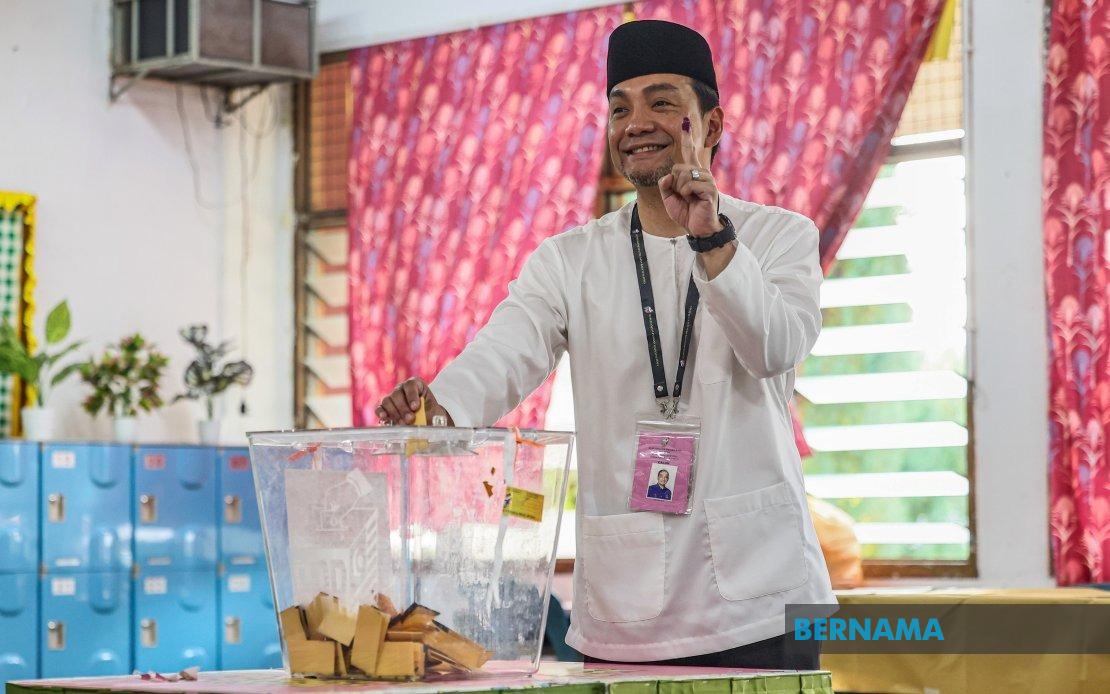
Johor Menteri Besar Datuk Onn Hafiz Ghazi exercised his franchise in the 16th state election on July 11, arriving at Sekolah Kebangsaan Simpang Renggam early in the morning to cast his vote at 8.33 am. As the incumbent seeking a second term and chairman of Johor's Barisan Nasional chapter, Onn Hafiz cut a prominent figure at the polling station, pausing before entering Stream 4 to acknowledge other voters and exchange greetings with constituents waiting to participate in the democratic process.
The Menteri Besar faces a two-candidate race against Nur Hafiz Roslan of Pakatan Harapan, a considerably tighter electoral contest than many other constituencies witnessing multi-cornered battles across the state. This direct confrontation underscores the polarised nature of Malaysian politics at the state level, where the traditional binary between ruling coalitions and opposition forces remains the dominant narrative in many seats. The straight fight between BN and PH incumbency and opposition reflects both parties' electoral strengths in their respective strongholds and the consolidation of voter preferences along established partisan lines.
After voting, Onn Hafiz made an appeal to the electorate emphasising the importance of early participation in the polling process. He characterised voting as a fundamental democratic responsibility and positioned timely turnout as essential to ensuring efficient and orderly election administration. Such messaging from sitting leaders is standard during polling day, designed to mobilise support and frame civic engagement as both a duty and practical necessity. The emphasis on smooth polling operations also carries implicit messaging about state competence and preparedness.
Simultaneously, the Puteri Wangsa constituency witnessed its own polling activity as Dr Maszlee Malik, the Pakatan Harapan candidate, arrived at SJK (C) Tuan Poon in Simpang Renggam at 8.58 am to cast his ballot. The former education minister's candidacy in this seat represented the opposition's effort to contest seats across Johor's electoral landscape, demonstrating PH's intent to challenge BN dominance in a state long considered a stronghold of the ruling coalition. Malik's ministerial background provided the opposition with a high-profile candidate capable of articulating alternative governance visions.
The Puteri Wangsa contest itself demonstrated the complexity of contemporary Malaysian electoral dynamics, featuring a five-way competition that fractured voter choice beyond the traditional BN-PH binary. Challenging Maszlee were Rashifa Aljunied representing MUDA, the youth-oriented party that has emerged as a significant electoral force in recent years; Teow Chia Ling standing for BN; Nicholas Paul Vincent of Parti Bersama Malaysia, a newer entrant to the political landscape; and independent candidate Wang Wee Siong. Such multi-cornered contests reflect the proliferation of registered political parties and the growing willingness of candidates to contest outside traditional coalitions, complicating seat predictions and vote distribution analysis.
The presence of MUDA as a competing force in Puteri Wangsa and likely across other Johor constituencies marked a significant shift in state electoral competition. Having emerged as a notable political actor nationally, MUDA's participation in state elections represented an attempt to translate its appeal among younger voters into state-level representation. The party's insurgent positioning—distinct from both BN and PH while claiming to represent reform and generational change—offered voters an alternative framing of political choice beyond the traditional ruling-opposition dichotomy.
Johor's electoral contest carried particular significance within Malaysia's broader political context. As the nation's second-largest state by population and a traditional BN stronghold, the results would provide crucial indicators regarding voter sentiment toward the ruling coalition and Anwar Ibrahim's federal government. State elections in Johor also carry implications for neighbouring Selangor and national coalition dynamics, as successful opposition performances strengthen PH's state-level presence and federal negotiating position. Conversely, BN dominance in Johor reinforces the coalition's demographic and electoral resilience outside Peninsular Malaysia's urban centres.
The timing of these polls occurred amid Malaysia's complex political landscape, where federal and state governance involved different coalition arrangements. Johor's electoral outcome would reflect voter assessments of state-level governance performance, local development priorities, and national political currents filtered through regional perspectives. The state's economic importance, centred on manufacturing, port operations, and tourism, meant that voters weighed incumbent performance on pragmatic deliverables alongside ideological and partisan considerations.
Poll observers and analysts would scrutinise both turnout patterns and seat distribution across the five-cornered contests to discern emerging electoral trends. Early voting by prominent candidates like Onn Hafiz and Maszlee signalled confidence and compliance with electoral participation norms, setting tone for broader public engagement. The culmination of voting would determine not merely Johor's state government composition but potentially influence calculations within federal coalitions regarding stability, electoral viability, and strategic positioning heading toward future national elections.

