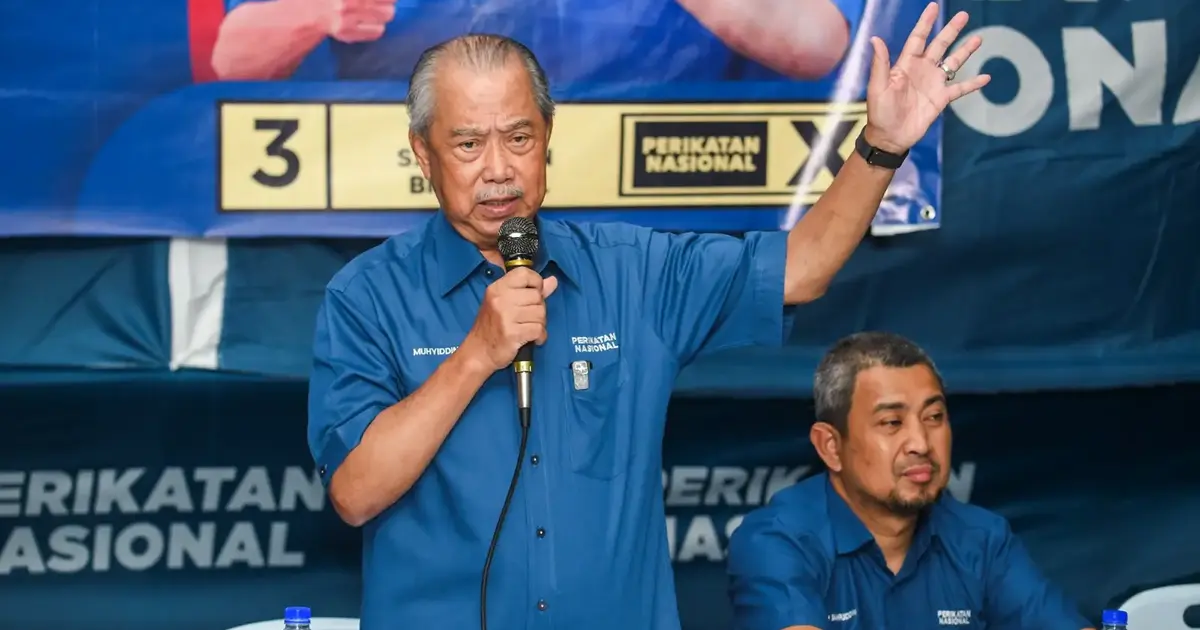
Bersatu president Muhyiddin Yassin has pushed back against suggestions that the upcoming Johor state election is linked to any potential release or reprieve for former Prime Minister Najib Razak, stating that the former leader has already been duly convicted through the legal system. Muhyiddin's remarks address mounting speculation within political circles about the timing of the electoral contest and whether it coincides with broader considerations affecting Najib's legal status.
The Bersatu leader's position reflects an effort to separate electoral proceedings in Johor from questions surrounding Najib's incarceration, a distinction that matters significantly in Malaysian political discourse where institutional credibility depends on perceived independence between government actions and judicial outcomes. By emphasizing Najib's conviction status, Muhyiddin underscores that the courts have rendered a binding judgment, which cannot simply be overturned through political manoeuvre or electoral convenience.
Najib Razak's legal trajectory has dominated Malaysian politics since his 2018 electoral defeat and subsequent prosecution for offences stemming from the 1Malaysia Development Berhad scandal. His conviction represented a watershed moment, demonstrating that even former heads of government could face criminal accountability. However, ongoing discussions about possible pardons, sentence reductions, or early release mechanisms have periodically surfaced, occasionally coinciding with significant political events or electoral contests.
The Johor state election assumes particular importance within this context because the state constitutes Najib's political stronghold, where his Umno party traditionally maintains substantial grassroots support. A state-level contest provides an opportunity for his allies to consolidate control and potentially advance his interests through sympathetic political actors. Opposition figures and political analysts have questioned whether electoral calculations might influence governmental decisions regarding clemency or sentence modifications.
Muhyiddin's clarification attempts to establish clear boundaries between judicial matters and electoral politics, a distinction essential for maintaining public confidence in both systems. The Bersatu president's intervention suggests that concerns about such linkages have achieved sufficient prominence to warrant explicit denial from within the ruling coalition. Such denials, however, often reflect the very anxieties they seek to dismiss, indicating that questions persist among observers and commentators.
The timing argument itself warrants examination, as Malaysian state elections typically occur on fixed schedules established years in advance, leaving limited room for purposeful coordination with developments in particular individuals' legal cases. Nonetheless, the convergence of Johor's electoral period with broader discussions about Najib's legal status has created an unavoidable optics problem for the government, regardless of actual causal connections.
From a Southeast Asian perspective, Malaysia's handling of high-level corruption cases carries regional implications. Neighbouring countries monitor how successful governments are in maintaining rule of law while managing political pressures. If judicial independence becomes perceived as compromised by electoral considerations, Malaysia's standing as a functional democracy with reliable institutional checks diminishes, affecting regional stability and investor confidence.
Umno's internal dynamics further complicate this landscape. While Najib remains popular among certain party constituencies, his case has fractured the party into factions supporting versus opposing his interests. Some Umno leaders view advancement of his cause as crucial for party unity and electoral prospects, whilst others prioritise distancing themselves from the 1MDB scandal's reputational damage. This factional tension influences how various Umno figures position themselves relative to the Johor election and parallel developments regarding Najib.
The broader implications extend beyond Najib's individual circumstances. How Malaysia navigates questions about clemency for high-profile convicted politicians establishes precedents affecting governance integrity. Appearing to grant favours based on electoral utility rather than established legal criteria would undermine the legitimacy of judicial processes and weaken public faith in anti-corruption institutions. Conversely, rigid adherence to sentences without considering any legitimate mechanisms for sentence review could appear excessively punitive if applied inconsistently across cases.
Muhyiddin's intervention appears calculated to address emerging perceptions without offering substantive clarity about potential future actions. By anchoring discussion to Najib's existing conviction, the Bersatu president reaffirms that judicial determination has occurred whilst leaving deliberately ambiguous the question of what circumstances might subsequently alter Najib's status. This rhetorical positioning maintains flexibility for future government actions whilst attempting to shield current electoral contests from explicit contamination by such considerations.
The convergence of these issues reflects deeper tensions within Malaysian politics between institutional independence and pragmatic political management. Electoral contests require managing competing interests and coalitional dynamics, yet judicial integrity depends on decisions remaining insulated from such pressures. Muhyiddin's statement represents an attempt to sustain public belief that these systems can operate separately, even when political actors themselves navigate pressures pulling in contrary directions.
For Malaysian voters and regional observers, the question persists whether actions will eventually align with stated principles regarding the separation between electoral and judicial matters. Johor's campaign will unfold alongside continued scrutiny of whether any developments affecting Najib's legal status emerge before, during, or after the contest. The credibility of Malaysian democratic institutions may ultimately depend on how convincingly this separation can be maintained in practice.

