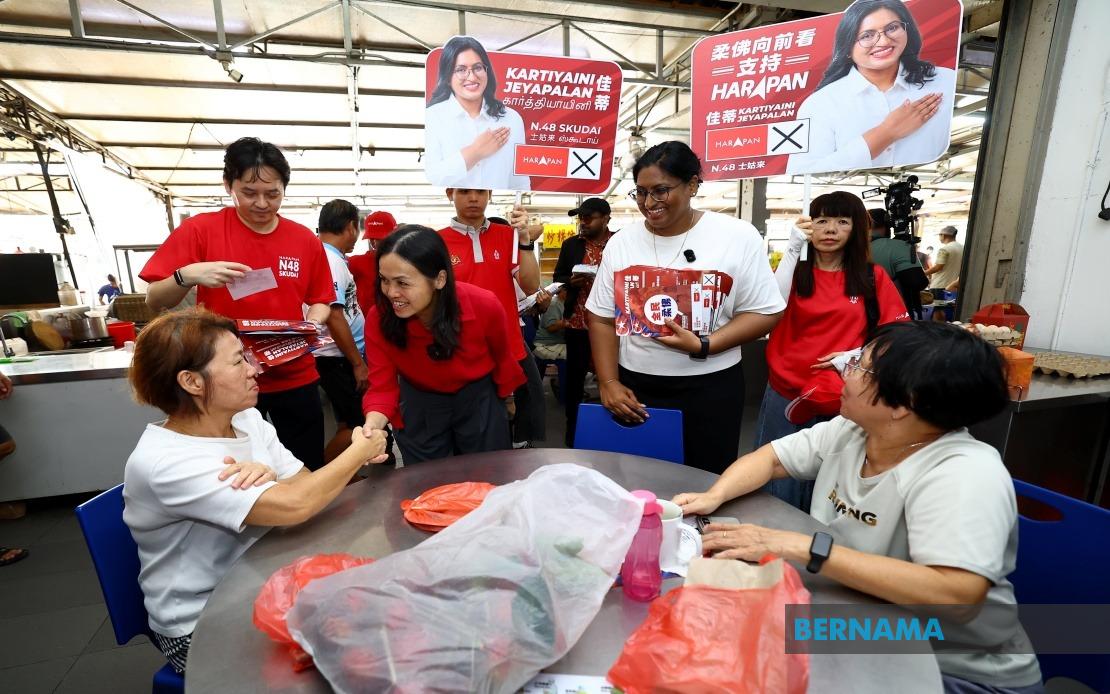
As Johor heads toward its state election on Saturday, party leaders are making a final push to mobilise voters, with DAP chairman Teo Nie Ching emphasising both the privilege and responsibility that comes with casting a ballot. Speaking in Johor Bahru on July 9, Teo called particularly on Johor residents working elsewhere in Malaysia or abroad to return home and participate in the democratic process, framing voter participation as a fundamental right worth protecting and exercising.
The Deputy Communications Minister drew upon compelling anecdotes to illustrate her point, sharing stories of Malaysians living far from home who were going to extraordinary lengths to ensure their votes counted. A voter in Queensland, Australia, had rushed to the airport hoping to find someone willing to hand-carry his postal ballot back to Malaysia after discovering that courier services could not guarantee timely delivery before the July 11 polling deadline. Similarly, a graduate student in China had decided to rebook his flight at a personal cost exceeding RM1,000 simply to be present for the election. From the United States, another voter had invested considerable effort in locating a Malaysian citizen to witness and validate his postal voting process. These narratives, Teo suggested, should inspire those in more accessible locations such as Kuala Lumpur or Singapore to regard their voting privilege with equal seriousness.
Teo's remarks came during a community engagement session in Kampung Baru Skudai, where she met with residents alongside Kartiyaini Jeyapalan, the Pakatan Harapan candidate contesting the Skudai state assembly seat. The visit underscored the coalition's ground-level campaign strategy in the weeks leading up to polling day, maintaining personal connections with constituents while amplifying the broader call for voter turnout. The focus on the Skudai constituency reflects PH's efforts to consolidate support in urban and semi-urban areas of Johor that have traditionally been competitive battlegrounds.
Beyond encouraging participation, Teo raised a pressing concern about the integrity of the electoral information environment. She cautioned the public against succumbing to deliberately manufactured falsehoods and fraudulent social media accounts designed to sway voter behaviour during the final stretch of campaigning. The spread of disinformation during election periods has become an increasingly serious challenge across Southeast Asia, and Malaysia is no exception. Teo advocated for digital literacy as a defence mechanism, encouraging citizens to adopt a "verify before you share" approach to information encountered online. Her message acknowledged a fundamental paradox of modern communications: while the internet enables rapid dissemination of accurate information, it equally facilitates the acceleration and amplification of false narratives. In such an environment, individual responsibility becomes paramount; voters must cultivate the habit of questioning claims, cross-referencing sources, and resisting the urge to propagate unverified content.
Kartiyaini expanded on the party's mobilisation efforts, revealing that Pakatan Harapan had launched a targeted campaign to reach the substantial number of Johor workers employed in neighbouring Singapore. This cross-border workforce represents a politically significant demographic, as these voters could swing outcomes in constituencies with high migrant worker populations. Rather than simply exhorting workers to return, the campaign message emphasised the substantive importance of state-level elections in shaping Johor's trajectory. Kartiyaini articulated a perspective that state elections deserve equivalent civic engagement to general elections, given that capable and responsive state governments can tangibly improve living standards, implement locally relevant policies, and catalyse economic development.
To operationalise this messaging, PH leaders positioned themselves at the Sultan Iskandar Building Customs, Immigration and Quarantine (CIQ) Complex at the early morning hour of 5 am, engaging directly with cross-border commuters as they departed for Singapore. The timing was strategic, capturing workers at a moment when they were already thinking about their movement between jurisdictions. Additionally, party campaigners boarded buses carrying workers to Singapore, seizing the opportunity to reinforce the importance of returning to vote. According to Kartiyaini, this grassroots approach generated notably positive responses, suggesting momentum that organisers hope will translate into elevated voter turnout. The enthusiasm observed during these interactions may signal receptiveness among mobile workers, though converting such sentiment into actual ballot-casting requires overcoming logistical barriers, including the need to request leave from employers and arrange transport back to Johor.
The 16th Johor state election encompasses an electorate of approximately 2.7 million registered voters across 56 state assembly constituencies. The scale of this exercise underscores the logistical complexity of executing statewide balloting while simultaneously managing high levels of voter mobility. With significant numbers of eligible voters working in Singapore, Kuala Lumpur, and other locations, and an additional cohort of Malaysians scattered across continents, election officials and campaigning parties face real challenges in facilitating meaningful participation. The postal voting mechanism and overseas voting provisions represent attempts to accommodate geographical dispersion, yet as Teo's anecdotes suggest, these systems remain imperfect and sometimes unreliable.
The emphasis on combating misinformation carries particular weight in Malaysia's evolving political landscape, where social media has become a primary vehicle for political messaging and where electoral outcomes have increasingly hinged on information warfare. False claims about candidate credentials, fabricated endorsements, misleading economic statistics, and divisive communal narratives have all circulated in previous election cycles. By foregrounding the problem of fake news during this campaign, Teo and other party leaders are attempting to inoculate voters against manipulation while also implicitly signalling that they regard information integrity as essential to legitimate electoral competition. The challenge, however, lies in moving beyond rhetoric to meaningful action, as identifying and systematically countering disinformation requires coordination between platforms, regulators, fact-checkers, and civil society organisations.
For Malaysian readers and observers across Southeast Asia, this election illustrates broader regional tensions around democratic participation in an era of high labour mobility and digital communication. The stories of Malaysians abroad valuing their franchises challenge assumptions about voter apathy and highlight the genuine attachment many citizens maintain to their home countries' political processes. Simultaneously, the disinformation challenge reflects anxieties common throughout the region about weaponised information and the fragility of public discourse. How Malaysian voters and institutions respond to these paired challenges will offer insights relevant to other democracies in the region grappling with similar pressures.

