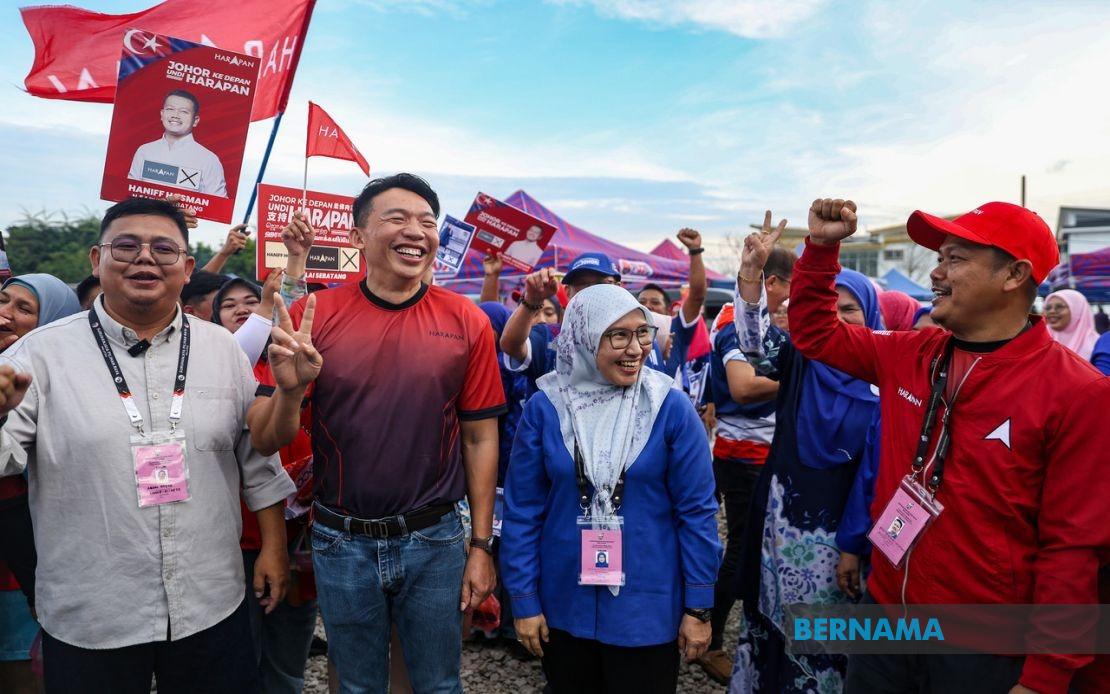
The Johor state election campaign took a notably civil turn this week when candidates from opposing political alliances crossed paths at the Taman Megah night market in Pontian, offering a refreshing snapshot of electoral decorum in Malaysia's southern state. The unscripted encounter between Pakatan Harapan campaigners and a Barisan Nasional representative became a moment of note precisely because it embodied the kind of professional respect that election observers often struggle to witness during heated political seasons.
The meeting involved three PH contenders—Haniff @ Ghazali Hosman seeking the Pulai Sebatang seat, Abd Razak Ismail competing for Benut, and Cheah Chee Hong standing in Kukup—who were jointly conducting their nighttime canvassing when they encountered Hasrunizah Hassan, the BN candidate also contesting Pulai Sebatang. What could have developed into an uncomfortable confrontation between representatives carrying the symbolic red and blue colours of their respective coalitions instead evolved organically into a straightforward greeting.
The candidates' spontaneous interaction occurred as they navigated the bustling market environment, where traders and shoppers were present throughout the evening. Rather than avoiding one another or maintaining pointed distance, the four politicians acknowledged each other directly, a gesture that caught the attention of market-goers who momentarily halted their activities to observe the exchange. The incident subsequently gained traction among attendees, who discussed the unusual civility on display between political rivals operating within metres of each other.
When questioned by journalists following the encounter, Haniff characterised the moment as evidence of democracy functioning healthily within Johor's political landscape. He emphasised that the campaigning environment in Pontian had remained consistently peaceful throughout the election period, with no disruptions marring the campaign activities of either coalition. His framing of the incident highlighted how candidates from opposing sides could maintain collegial relations while simultaneously competing vigorously for voter support. The distinction between fierce electoral competition and personal acrimony, often blurred in Malaysian political discourse, appeared distinctly clear in this instance.
Cheah elaborated on the broader campaign environment, expressing satisfaction with the opportunity to conduct joint canvassing alongside his PH colleagues across the three constituencies they represent. He directed his remarks toward voters in Pulai Sebatang, Benut, and Kukup, appealing for continued support for the Pakatan Harapan coalition. His comments positioned the campaign as a substantive contest over policy and representation rather than a personality-driven conflict.
Hasrunizah's perspective on the encounter added further dimension to understanding how political maturity manifests in contemporary Malaysian elections. She characterised such meetings between candidates from different parties as entirely unremarkable within a functioning democratic system, suggesting that Johor's political culture has evolved to accommodate vigorous competition without breeding hostility. Despite acknowledging that the campaign period had intensified in recent days, she stressed that Johor continued experiencing a stable, incident-free election environment without the confrontations or disturbances that occasionally plague electoral periods elsewhere.
Her remarks about campaign intensification carry particular weight given that polling day approaches. The traditional escalation of campaign rhetoric and activity in the final weeks before voting typically tests the resilience of electoral civility. That candidates could meet and exchange pleasantries even as their respective organisations campaigned harder for Barisan Nasional and Maju Johor suggests a foundational commitment to democratic norms transcending immediate partisan interests. Such conduct stands in marked contrast to election cycles where personal attacks and inflammatory rhetoric dominate the discourse.
The Johor state election scheduled for July 11 will determine the composition of the state assembly across multiple constituencies, making the contest consequential for the state's political direction. Early voting arrangements have been established for July 7, allowing certain eligible voters to participate before the main polling date. This election occurs within a broader Malaysian political context where state-level elections have increasingly become tests of national political trends and factional dynamics within major coalitions.
The peaceful campaign environment evident in Pontian reflects broader patterns across Johor's electoral preparations. While political competition naturally generates passionate advocacy from supporters and candidates alike, the absence of violence or serious disruptions speaks to institutional maturity and voter sophistication. The night market encounter, seemingly unremarkable in isolation, gains significance when understood as illustrative of how Malaysian democracy continues functioning despite occasional tensions and controversies that dominate headlines.
For Malaysian observers monitoring electoral practices and democratic health, such moments offer useful perspective. They demonstrate that competition and civility need not prove mutually exclusive, and that candidates can advance competing visions for their constituencies while respecting the basic dignity and professional standing of opponents. As Johor voters prepare to cast their ballots, the conduct displayed by these candidates provides a template for the kind of electoral engagement that strengthens rather than undermines democratic institutions.

