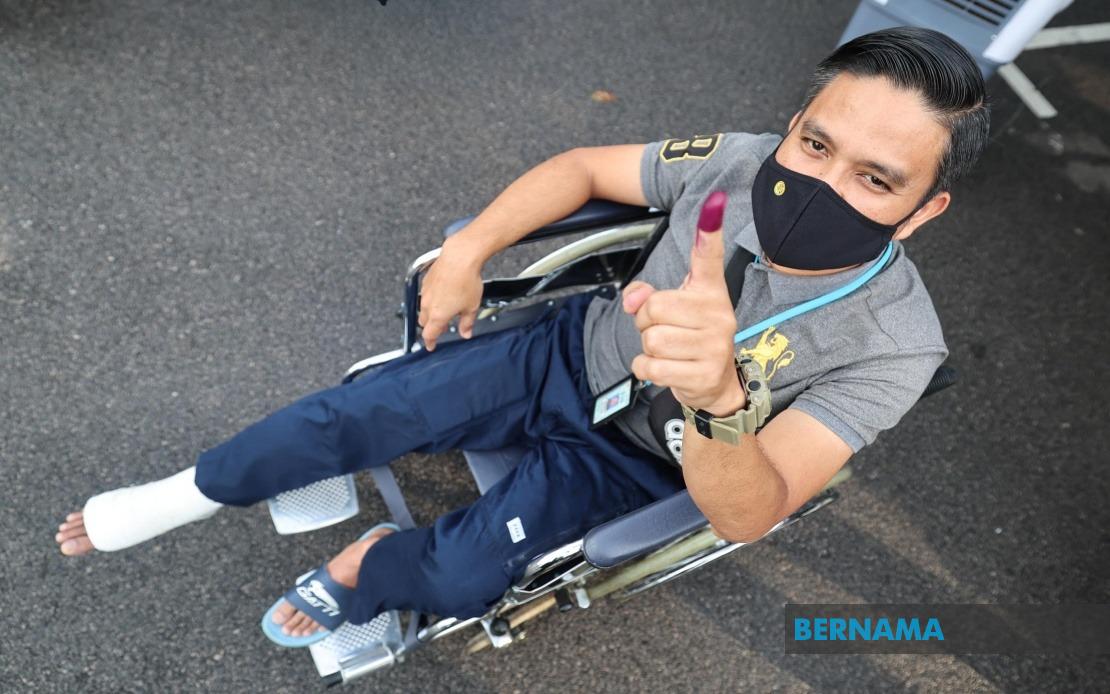
A police sergeant's determination to fulfil his electoral responsibility took precedence over a serious sports injury during early voting in Johor's 16th state election on Wednesday. Sergeant Syahrizal Musa, 40, arrived at the Johor Police Contingent Headquarters voting centre in a wheelchair after sustaining an Achilles tendon tear while playing sepak takraw the previous week. The incident occurred during a recreational match, a sport the longtime police officer has pursued competitively since his youth and has represented the police contingent in multiple tournaments. Yet the injury and mandatory medical leave extending through July 16 proved insufficient reason for him to forgo his participation in the electoral process.
Syahrizal's insistence on voting underscores a deeper commitment within Malaysia's civil service to model civic engagement. With more than two decades of police service, he has never missed an election opportunity, a track record he was unwilling to break despite the physical impediment. He travelled from the police quarters in Tampoi with assistance from a colleague to reach the polling centre, transforming what would ordinarily be a straightforward administrative task into a demonstration of resolve. His participation carries symbolic weight in an electoral environment where turnout and voter engagement remain ongoing concerns for democratic participation across the nation.
The injury itself resulted from a minor tear to the Achilles tendon, the thick band of tissue connecting the calf muscles to the heel bone. Medical professionals confirmed the diagnosis, necessitating the extended leave period. Yet Syahrizal's willingness to navigate the voting process while immobilised raises questions about accessibility provisions within Malaysia's electoral infrastructure. The provision of early voting centres specifically accommodates uniformed personnel who may face deployment or operational constraints, but the arrangement equally demonstrates the system's capacity to facilitate participation among voters facing temporary mobility challenges. His experience offers practical insight into whether existing facilities adequately serve citizens with physical limitations during elections.
The timing of Syahrizal's vote reflected broader early voting arrangements for the Johor election. Across 64 designated polling centres, approximately 24,751 early voters participated, comprising military and police personnel plus their spouses. The Armed Forces contributed 12,041 participants while the Royal Malaysia Police and General Operations Force combined for 12,710 voters. These advance voting mechanisms exist to ensure security force members can participate despite operational commitments that might otherwise prevent their attendance during the main polling day scheduled for Saturday. The system recognises that democracy requires accommodation for those whose professional duties might conflict with standard election day schedules.
Syahrizal's service trajectory illustrates the evolving career pathways within Malaysian law enforcement. After nine years at the Muar police district, he transferred to the Johor headquarters in 2014, where he eventually became attached to the Internal Security and Public Order Department. His professional progression reflects the police force's human resource management, though his case also highlights the physical demands associated with maintaining active engagement in recreational sports alongside demanding security sector employment. The sepak takraw injury, while incidental to his core responsibilities, exemplifies how off-duty activities can create unexpected complications for personnel management and operational readiness.
The sergeant's personal commitment resonates particularly given contemporary discourse surrounding voter participation rates in Malaysia. Public statements emphasising the franchise as a responsibility rather than merely a right carry credibility when demonstrated through personal sacrifice. By articulating to reporters that voting constitutes a fundamental obligation worthy of physical effort and inconvenience, Syahrizal articulated a philosophy that extends beyond individual participation to encompass broader civic values. His reflection on over two decades without missing an election opportunity projects consistency and discipline, qualities evidently characterising both his professional conduct and personal convictions regarding democratic participation.
The 16th Johor state election itself represents a significant political contest within Malaysia's federal structure. With 172 candidates competing across 56 constituencies and approximately 2.7 million ordinary voters eligible to participate during the main polling event, the election encompasses diverse demographic and geographic interests spanning the state. Early voting provisions for security personnel and military forces constitute a critical component of ensuring comprehensive representation, particularly given the substantial populations within these sectors. The infrastructure supporting their participation, demonstrated through the 64 polling centres and accommodation of voters with medical constraints, reflects institutional maturation in electoral administration.
Syahrizal's narrative also intersects with broader questions regarding workplace culture within Malaysia's security sector. That a sergeant would prioritise voting despite significant physical discomfort and medical restriction suggests organisational values emphasising civic participation and democratic engagement. Police contingent leadership's provision of transportation and facility access for injured personnel to vote demonstrates institutional commitment extending beyond mandatory compliance. Such organisational culture, when cultivated deliberately, can strengthen public confidence in security institutions and their alignment with democratic principles.
The emotional resonance of Syahrizal's participation derives partly from the contrast between physical limitation and volitional choice. He possessed legitimate grounds for postponement—medical leave justifying absence, mobility constraints presenting practical obstacles, pain potentially discouraging effort. Instead, he activated agency despite these impediments, choosing participation over convenience. This distinction between capacity and choice illuminates how citizens engage with democratic processes. While robust electoral systems should minimise barriers for all voters, individual motivation and values ultimately determine participation patterns. Syahrizal's example suggests that when citizens view voting as essential rather than optional, even substantial obstacles become surmountable challenges rather than insurmountable barriers.

