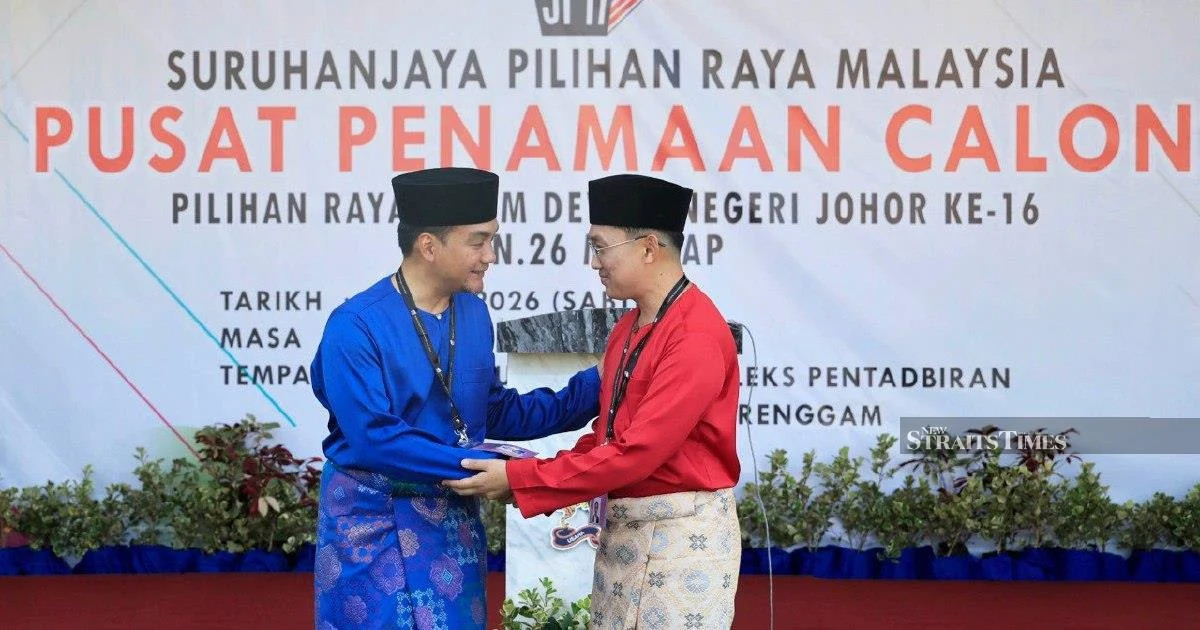
The Johor political landscape is bracing for an intensely contested electoral battle, with Caretaker Menteri Besar Datuk Onn Hafiz Ghazi adopting a notably measured tone about his prospects despite pursuing re-election in the state poll scheduled for July 11. His comments, made while campaigning in Simpang Renggam, underscored the unpredictable nature of electoral competition and suggested that even incumbent advantage may not guarantee electoral success in the current political climate across Malaysia's southernmost peninsula.
Onn Hafiz's acknowledgement that the Machap contest carries inherent uncertainty reflects broader dynamics reshaping Malaysian electoral politics. The Johor state election represents a critical barometer for voter sentiment, particularly as the nation grapples with evolving political alignments and shifting public priorities. The caretaker leader's cautious rhetoric stands in contrast to typical incumbent messaging, suggesting internal awareness of genuine competitive pressures rather than assumed electoral comfort.
The timing of the election itself carries significance for Johor's development trajectory. As one of Malaysia's most economically consequential states, the election outcome will influence policy directions affecting manufacturing, agriculture, port operations, and urban development across the region. Investors and business stakeholders monitor such contests closely, recognising that political stability or transition shapes regulatory frameworks and infrastructure investment priorities that ripple through Southeast Asian supply chains.
Machap, the specific constituency where Onn Hafiz is contesting, has become a symbolic focal point of this electoral contest. The constituency encompasses both urban and semi-rural communities with distinct economic interests and governance expectations. Competition in such mixed constituencies typically proves particularly fluid, as voter coalitions prove less predictable than in homogeneous urban or rural areas, rendering traditional political calculations unreliable.
Onn Hafiz's leadership of Johor since 2022 has been marked by initiatives addressing economic diversification and fiscal consolidation following the Covid-19 pandemic. His track record forms the basis for his re-election campaign, yet his cautionary language suggests recognition that incumbency alone cannot insulate candidates from broader dissatisfaction or rival appeal. This realistic assessment aligns with recent trends across Malaysian states, where voters have demonstrated willingness to punish ruling coalitions despite economic management credentials.
The broader political context involves maneuvering among multiple competing blocs at both state and federal levels. Alliance configurations continue shifting, creating uncertainty about which coalitions will benefit from ground-level voter behaviour. Onn Hafiz's party positioning within these evolving landscapes adds another layer of complexity to his re-election mathematics, as coalition fortunes fluctuate independently of individual candidate performance.
Civilian priorities heading into the election have crystallized around familiar concerns: living costs, employment opportunities, educational facilities, and healthcare accessibility. These bread-and-butter issues typically dominate voting calculus among ordinary Malaysians far more than abstract political ideology. Candidates addressing these grievances effectively tend to accumulate support irrespective of incumbent status, a factor that likely prompted Onn Hafiz's cautious messaging rather than overconfident prognostication.
The caretaker period between election announcement and polling day provides both advantages and vulnerabilities for sitting executives. While officeholders retain platforms for announcing development initiatives or disbursing benefits that generate voter goodwill, they simultaneously become targets for accumulated grievances and opposition amplification. This inherent tension may explain Onn Hafiz's reluctance to predict outcomes despite his institutional advantages.
Regional implications of the Johor election extend beyond state boundaries. The outcome influences confidence among investors evaluating Southeast Asian business environments, affects coordination between federal and state governments on infrastructure megaprojects, and shapes legislative capacity to address transnational challenges like water security and labour mobility with Singapore. Neighbouring Selangor, Perak, and Pahang watch Johor outcomes as indicators of broader electoral momentum.
Onn Hafiz's statement serves as a reminder that Malaysian electoral contests, increasingly, defy conventional predictive models. Decades of relatively stable voting patterns have given way to more volatile and unpredictable electoral behaviour, particularly among younger and urban constituencies. His acknowledgement of this unpredictability demonstrates political maturity and realistic assessment of contemporary electoral dynamics rather than weakness or pessimism.
The July 11 polling date approaches rapidly, leaving limited time for campaigns to meaningfully reshape voter preferences. For constituencies like Machap and the broader Johor state, this compressed timeline intensifies competition, as candidates attempt to mobilise their core supporters while simultaneously persuading marginal voters. In such environments, overconfidence frequently proves electoral liability, making Onn Hafiz's cautious posture strategically prudent messaging.

