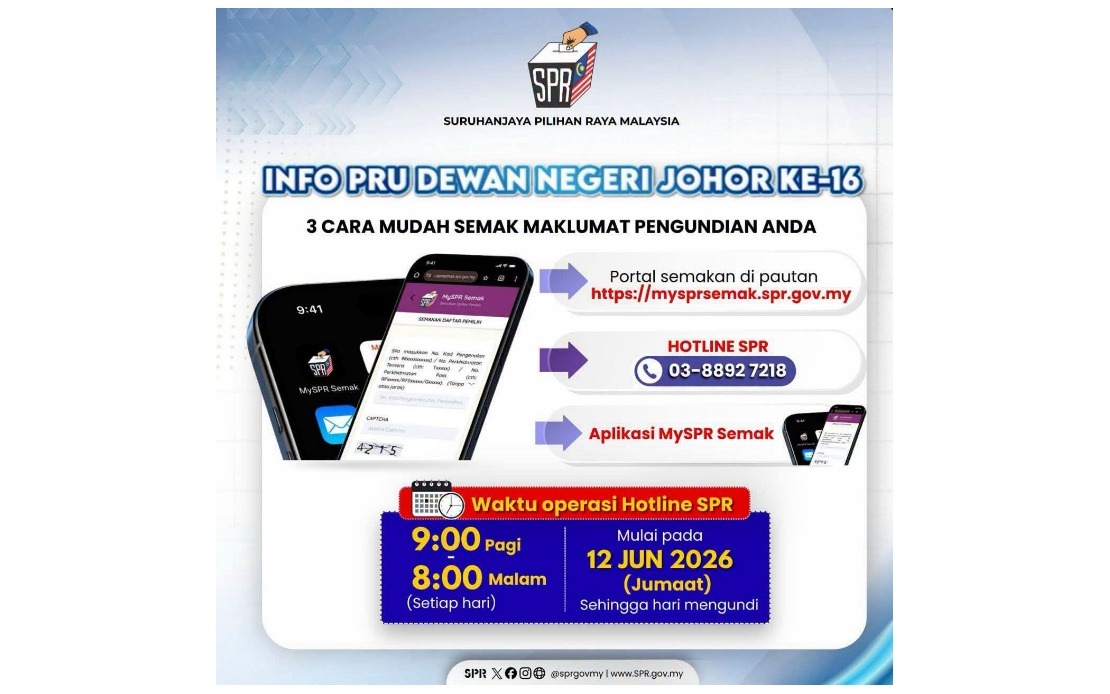
With Johor's 16th state election set to take place on Saturday, July 11, the Election Commission has issued a timely reminder for the state's 2.7 million registered voters to verify their assigned polling centres and voting streams well ahead of polling day. The advisory underscores the importance of advance preparation to ensure a smooth and efficient voting process across the state, particularly given the substantial voter turnout expected in what promises to be a closely watched electoral contest in one of Malaysia's most politically significant states.
Voters seeking this essential information now have convenient digital options at their disposal. The EC has directed citizens to utilise the MySPR Semak portal or download the dedicated MySPR Semak mobile application to access their polling details. This digital infrastructure reflects efforts to streamline administrative processes and reduce confusion at polling stations, allowing voters to complete their research from home at their own convenience rather than risking last-minute confusion on election day itself.
The EC's appeal carries particular weight given the scale of the election and the diversity of voter categories participating. In the days leading up to Saturday's main polling exercise, early voting already demonstrated substantial participation from specific groups. Between July 8 and Tuesday, a total of 19,471 voters comprising military personnel and their spouses, as well as police officers from various forces including the General Operations Force alongside their families, exercised their franchise through advance voting mechanisms designed to accommodate those whose duties prevent them from voting on the standard polling day.
The electoral landscape in Johor presents a notably fragmented competitive environment, with seven distinct political entities and independent candidates vying for representation. The two dominant coalitions have fielded comprehensive slates, with Pakatan Harapan and Barisan Nasional each presenting 56 candidates to contest all available seats, representing their commitment to compete comprehensively across the state. Perikatan Nasional, the third significant player, has positioned itself as a challenger with 33 candidates spread across the 56 constituencies.
Beyond these major contenders, the election demonstrates the broadening of Malaysia's political representation landscape. Parti Bersama Malaysia has entered the competition with 15 candidates, while MUDA, the newer reformist party, is fielding four aspirants. Additionally, Parti Orang Asli Malaysia has placed candidates seeking to represent indigenous communities' interests, while Parti Sosialis Malaysia maintains its tradition of fielding candidates despite limited historical electoral success. Six independent candidates complete the roster of 172 total contenders competing for the 56 assembly positions.
For Malaysian voters across the state, this election carries significance beyond the immediate contest for state assembly seats. Johor remains a strategically important state within the broader Malaysian political framework, serving as a traditional power base with considerable demographic and economic weight. The electoral outcome will influence the balance of power in one of the nation's largest states and may provide indicators regarding voter sentiment on national issues, making the exercise consequential for federal politics as well.
The EC's emphasis on voters checking their polling locations reflects standard best practice in electoral administration, yet assumes particular importance in a state as geographically diverse and densely populated as Johor. With millions of voters spread across urban centres, industrial areas, and more rural constituencies, clarity regarding venue locations helps prevent disorganisation and bottlenecks that could impede voting efficiency. The digital tools provided represent a straightforward mechanism for individual voters to take responsibility for their own election day preparation.
The advancement of early voting for security personnel demonstrates the EC's accommodation of groups whose occupational obligations might otherwise conflict with standard polling procedures. The participation of over 19,000 military and police voters in early voting indicates that these mechanisms are functioning effectively in enabling crucial stakeholder groups to participate in democratic processes without compromise to their professional duties. This arrangement has become standard practice in Malaysian elections, ensuring that no category of citizen is disenfranchised by virtue of their service roles.
As Saturday's polling day approaches, the responsibility for a successful election rests partly on the Election Commission's administrative preparations but significantly on individual voters' engagement with the process. The EC's reminder that citizens should "fulfil our responsibility as voters" frames electoral participation as a civic obligation, not merely a right. This framing reflects the understanding that democratic systems function effectively only when citizens actively engage rather than treating voting as optional or passively assuming others will handle democratic participation.
For voters across Johor, the message is straightforward: take advantage of the available digital tools immediately to ascertain your assigned polling station and voting stream, plan accordingly for Saturday, and arrive prepared to cast your vote. Such advance preparation prevents unnecessary delays at polling stations, reduces administrative burden on election officials, and contributes to the orderly conduct of what will be a significant electoral exercise. The EC's advisory, though seemingly routine, represents a critical component of effective electoral management in a diverse, multi-candidate contest involving millions of voters distributed across a substantial geographical area.

