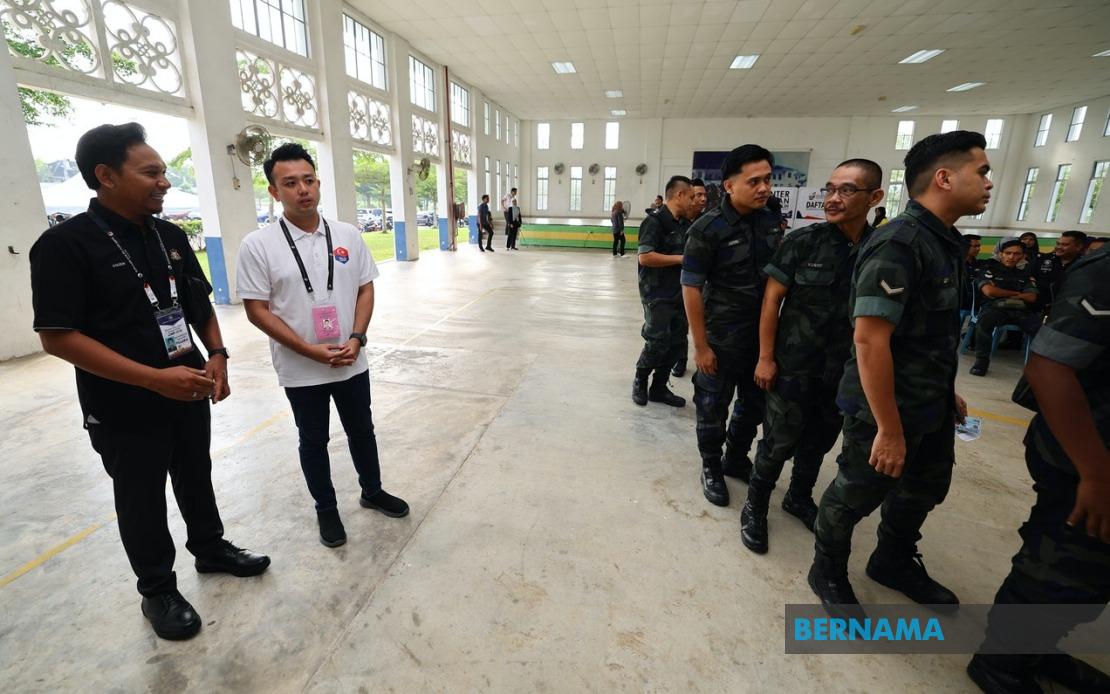
With the Johor state election set to take place on Saturday, political candidates put their campaign activities on pause on Thursday to witness the early voting process unfolding at dedicated centres across the state. The decision to observe these proceedings reflected the significance of the early voting exercise, which allowed members of the Malaysian Armed Forces, police personnel, and their spouses to cast their ballots ahead of the main polling day. This practice, established to accommodate the operational demands placed on security forces, has become a standard feature of Malaysian electoral processes.
At the 5th Battalion General Operations Force Camp in Simpang Renggam, all three contenders for the Layang-Layang seat assembled to monitor the voting process. Guna Balakrishnan representing Pakatan Harapan, Chua Jian Boon of Barisan Nasional, and Abd Mutalip Abd Rahim from Perikatan Nasional each took the opportunity to observe how their potential constituents participated in the democratic exercise. The presence of competing candidates from across the political spectrum underscored the transparent nature of the early voting arrangement, with election officials overseeing proceedings and ensuring all established protocols were maintained throughout the day.
Elsewhere in Johor, similar scenes played out as representatives from the three major political coalitions gathered at various polling locations. The Tenggaroh seat candidates—Muhamad Amerul Muhamad from Perikatan Nasional, Mohd Youzaimi Yusof of Barisan Nasional, and Md Yusof Dawam from Pakatan Harapan—assembled at the Iskandar Camp early voting centre in Mersing. This pattern of candidate observation extended across multiple constituencies, suggesting a coordinated approach among the parties to maintain electoral transparency and demonstrate their commitment to the integrity of the voting process.
Notable figures from the election campaign also made appearances at designated early voting venues. Lim Chin Eng, the oldest candidate participating in the Johor polls, visited the Johor Contingent Police Headquarters to observe proceedings, while Muhammad Faezuddin Mohd Puad, the Pakatan Harapan candidate for Kempas, monitored voting at Kempas Police Station. In Bukit Permai, Datuk Jafni Md Shukor from Barisan Nasional attended the Kulai District Police Headquarters to witness the exercise. These individual appearances highlighted the decentralised nature of the early voting process across different polling locations throughout the state.
High-ranking military and security officials also prioritised attendance at the early voting centres, reinforcing the importance placed on the democratic participation of uniformed personnel. Army Chief General Tan Sri Azhan Md Othman and Major General Datuk Ahmad Shuhaimi Mat Wajab, commander of the 21st Special Service Group, visited the Iskandar Camp in Mersing. Meanwhile, Johor police chief Datuk Ab Rahaman Arsad cast his own vote at Dewan Dato Onn within the Johor Contingent Police Headquarters, demonstrating leadership by personal example.
Despite challenging weather conditions, the early voting process proceeded without significant disruption on Thursday morning. Rain fell intermittently at several locations across Johor, yet security personnel continued to arrive in steady succession to fulfil their voting responsibilities. From 8 am onwards, eligible voters moved through the designated centres in an orderly fashion, with Election Commission officials maintaining strict adherence to established voting procedures. The smooth execution of the process reflected careful planning and coordination among election authorities to accommodate the large number of early voters expected throughout the day.
The scale of early voting in this election was substantial, with a total of 20,607 registered voters participating through the special arrangement. This figure comprised 8,544 members of the Malaysian Armed Forces and their spouses, while police personnel and their family members accounted for the remaining 12,063 registrations. The significant size of this voter group underscores the contribution of security sector employees to electoral participation, and the necessity of providing them with alternative voting mechanisms that do not compromise their operational capabilities or security responsibilities.
Organisation of the early voting exercise required considerable logistical coordination across Johor. A total of 64 early voting centres opened their doors at 8 am on Thursday, with staggered closing times between noon and 6 pm depending on individual location demands and registered voter numbers. This phased approach allowed election officials to manage voter flow efficiently while ensuring no one was turned away before the closing time at their particular venue. The infrastructure required to set up and staff these multiple centres across the state demonstrated the Election Commission's capacity to conduct large-scale electoral operations simultaneously.
The broader electoral context for this exercise involves significant political stakes, with 172 candidates competing across 56 state legislative assembly seats in the 16th Johor State Election. The field encompasses representatives from the three major political groupings—Pakatan Harapan, Barisan Nasional, and Perikatan Nasional—each fielding candidates in multiple constituencies. Saturday's polling will determine the composition of the Johor state government and could signal shifting political preferences among voters in this strategically important state. The early voting process on Thursday therefore represented the opening phase of what is expected to be a closely contested electoral contest.
For Malaysian and Southeast Asian observers, the Johor state election carries implications extending beyond state-level governance. Johor remains one of Malaysia's largest and most economically significant states, and electoral outcomes here often influence broader national political dynamics. The participation of security personnel in early voting, though logistically complex, reflects Malaysia's commitment to inclusive democratic processes that accommodate the unique circumstances of different voter groups. As Saturday's main polling day approaches, the early voting results and subsequent turnout across the general electorate will provide early indicators of voter sentiment and engagement with this important state election.

