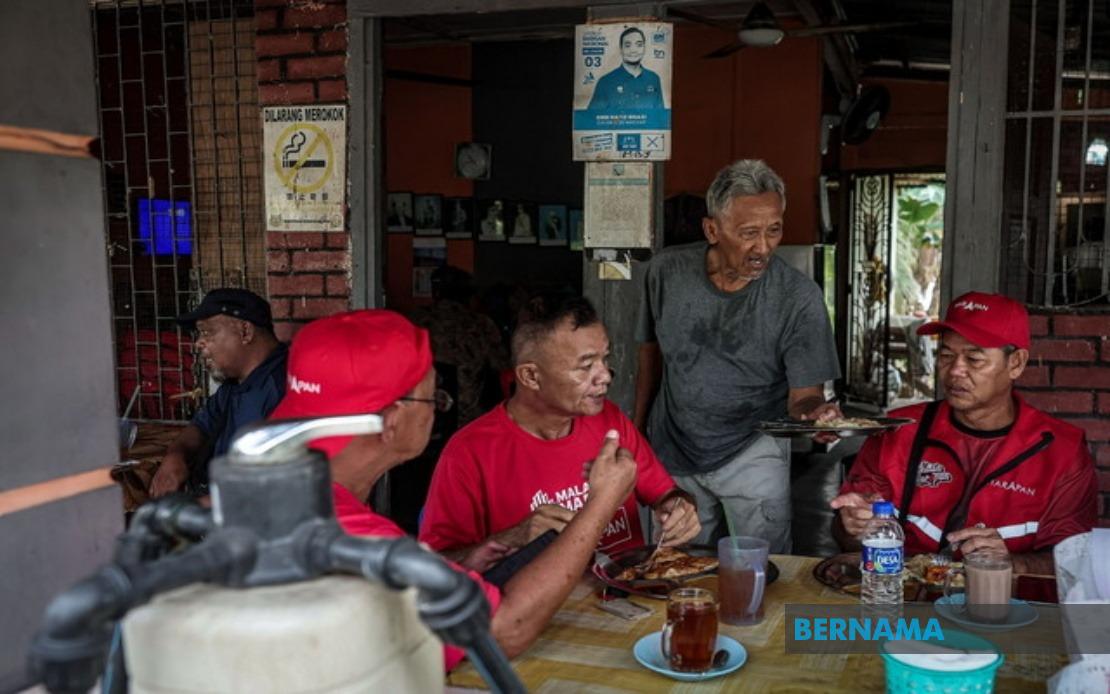
The Johor state election campaign, which culminates in polling on July 11, has unexpectedly transformed itself into a significant economic stimulus for grassroots traders and food vendors across the state. Beyond its democratic function, the electoral process has created a temporary surge in consumer activity that has materially improved earnings for hawkers in key constituencies, particularly in communities like Layang-Layang and Simpang Renggam. This phenomenon illustrates how political processes in Malaysia can generate localized economic benefits even as voters exercise their franchise, offering a glimpse into the interconnected relationship between democratic participation and grassroots commerce.
In Felda Layang-Layang, 70-year-old Noorma Zafmeeden operates a modest breakfast establishment serving roti canai and nasi lemak alongside her husband, Bahari Madiran, 76. The couple has maintained their pre-dawn to evening routine at the same location since settling in the Felda scheme in 1987, preparing and selling traditional Malaysian cuisine to a steady but unremarkable clientele on ordinary days. What ordinarily generates less than RM400 in morning revenue has now swelled substantially since the commencement of campaigning activities, demonstrating the electoral season's outsized impact on microsized food enterprises that operate on razor-thin profit margins.
Noorma attributes this transformation directly to the campaign period, noting that election seasons produce demonstrable and material increases in customer throughput and aggregate revenue. She describes the contrast between routine operations and election-period performance with clarity: the baseline remains unpredictable and modest, but the arrival of campaign machinery and associated political activity brings welcome economic relief. For vendors like Noorma, whose livelihood depends upon daily foot traffic and cash transactions, this seasonal surge represents genuine financial improvement during a compressed timeframe.
The warung has evolved into something beyond a simple commercial transaction point, functioning instead as a de facto community gathering space where customers from diverse ethnic and religious backgrounds converge in an atmosphere of genuine cordiality. Bahari expresses satisfaction not merely with increased sales volumes but with the social dimension of the election campaign, which brings visitors and campaign workers from across Malaysia into the Felda settlement. This interaction has value beyond monetary returns, enriching the couple's engagement with broader Malaysian society and reinforcing their sense of participation in national democratic processes.
The economic windfall extends beyond individual vendors to encompass broader commercial ecosystems. In Simpang Renggam, 45-year-old Ahmad Ridzuan Awang operates a nasi campur establishment where customer demand has doubled during the campaign period. Under normal circumstances, his trays of prepared dishes sell gradually throughout the day, with complete sell-out occurring only toward evening. Since election campaigning intensified, bulk orders from various political organizations and campaign teams have depleted inventory as early as 1.30 pm, eliminating the extended operating window that characterizes ordinary business days.
Ahmad Ridzuan frames the phenomenon as the arrival of "political tourists"—campaign workers, volunteers, and party operatives who converge upon constituencies in concentrated numbers during electoral seasons. Their concentrated presence and purchasing power represent an unprecedented demand shock for vendors accustomed to stable, predictable customer patterns. More significantly, Ahmad Ridzuan recognizes that this economic stimulus ripples outward to encompass local suppliers, ingredient providers, and adjacent commercial enterprises that benefit from increased transactions and cash circulation within their immediate locality.
The 16th Johor state election encompasses 172 candidates contesting across 56 seats, with early voting scheduled for July 7 and general polling occurring on July 11. The concentration of political activity necessary to contest such a substantial number of seats generates significant temporary movement of personnel and supporters throughout the state, creating the transient demand surge that benefits food vendors. Every campaign motorcade, every political rally, every organizational meeting requires sustenance—a fact well understood by petty traders positioned to capture these expenditures.
This election-driven economic phenomenon carries implications for understanding how Malaysian commerce operates at the grassroots level. The experiences of Noorma, Bahari, and Ahmad Ridzuan reveal how precarious income generation remains for informal sector workers, for whom a temporary doubling of revenue represents material improvement in household finances and business viability. Elections, typically analyzed through political lenses, simultaneously function as transitory economic stimuli that provide relief to vendors operating within constrained margins and limited customer bases during non-campaign periods.
The dynamics also suggest underlying structural questions about the viability of informal sector hawker enterprises and their dependence upon episodic demand surges rather than sustained customer flow. Vendors cannot sustain operations based upon election cycles occurring every few years; rather, they require consistent traffic to remain economically viable. The election campaign boost, while welcome, highlights rather than resolves the baseline challenges confronting small-scale food traders throughout rural and semi-urban Johor constituencies. The temporary relief masks longer-term sustainability concerns that extend beyond electoral seasons.
For Malaysian policymakers attentive to informal sector dynamics and grassroots economic vitality, the Johor experience offers instructive observations. The demonstrated willingness of campaign organizations to source meals locally suggests that aggregating demand through political and institutional channels can generate measurable benefits for street-level vendors. Whether such lessons might translate into sustained institutional purchasing patterns or deliberate procurement policies favoring informal sector suppliers remains an open question, but the electoral season has at least demonstrated the potential magnitude of such impacts.
The Johor state election thus functions simultaneously as a democratic exercise and as an accidental economic stimulus program, channeling temporary purchasing power toward the vendors positioned throughout constituencies. Whether measured in individual stall revenues or aggregate commercial activity, the campaign season produces observable economic consequences that extend well beyond political calculations and vote counts. For traders like Noorma and Ahmad Ridzuan, this electoral cycle represents something more than civic process—it represents tangible financial opportunity in an otherwise constrained commercial environment.

