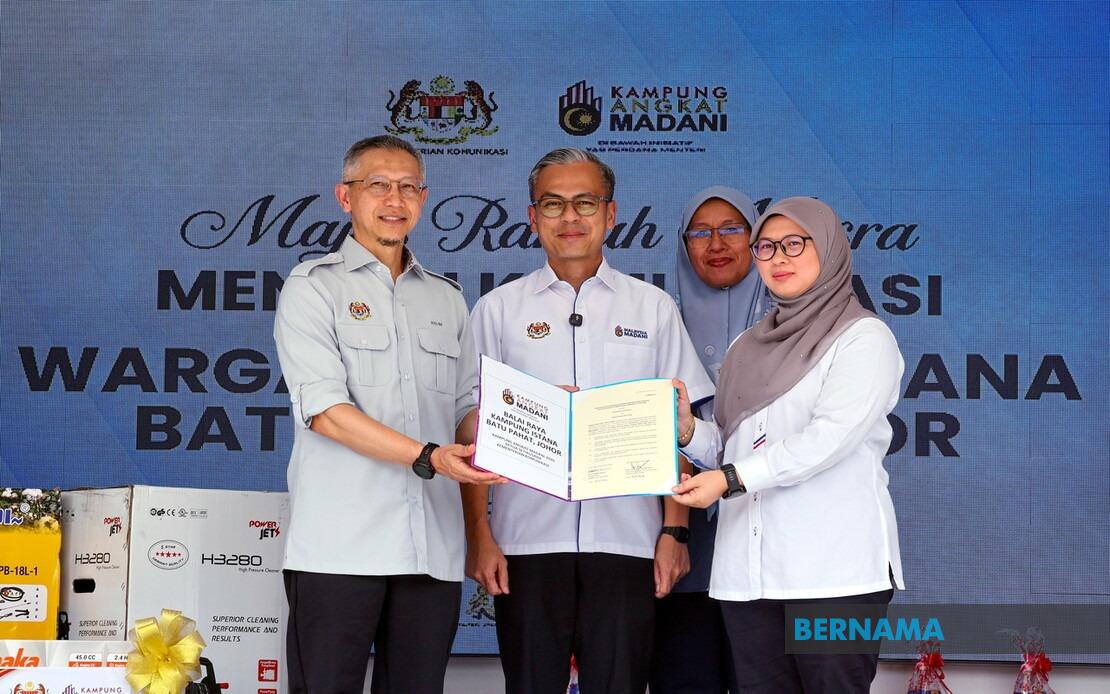
The 16th Johor State Election represents a defining moment for voters to select leaders committed to advancing the state's development, according to Pakatan Harapan Communications Director Datuk Fahmi Fadzil. Speaking after engaging with residents of Kampung Istana in Batu Pahat on July 4, the Communications Minister rejected characterisations that framed the electoral contest as a personal endorsement for any individual, emphasising instead that the ballot should centre on substantive governance and state prosperity.
Fahmi's comments came in direct response to earlier statements from Datuk Nazifuddin Mohd Najib, who suggested that a Barisan Nasional victory would constitute public approval for his father, former Prime Minister Datuk Seri Najib Razak, to receive a pardon. The suggestion drew sharp criticism from the PH leader, who cautioned that such framings should serve as a signal to voters about what truly matters in electoral contests. By attempting to reduce the election to a personality-driven narrative, Fahmi argued, political actors risked misrepresenting the genuine stakes for ordinary Johoreans.
The Communications Minister articulated a broader philosophy about voter responsibility and political accountability. He stressed that citizens must approach voting decisions with awareness that their choices extend beyond immediate personal preferences to encompass the long-term trajectory of both their state and the nation. This framing directly challenges what has historically been characterised as the "fixed deposit" voting pattern, where certain demographic groups were assumed to automatically support particular parties regardless of performance or alternative options. Fahmi contended that no political party should presume permanent voter loyalty, cautioning that public support must be continuously earned through demonstrated competence and responsiveness to constituent concerns.
Fahmi highlighted concerning patterns he observed in campaign messaging, noting that when voters encounter statements designed to provoke anxiety or alarm, such rhetoric may inadvertently prompt deeper reflection about the importance of their vote. This psychological dynamic, he suggested, could catalyse voters to recognise that electoral participation carries profound implications for determining not merely state-level outcomes but the broader direction of Malaysia's political and economic future. The implication was that missteps by political opponents might actually benefit PH by awakening voter consciousness about electoral stakes.
The PH campaign has sought to demonstrate growing cross-party support by highlighting defections and endorsements from figures traditionally aligned with UMNO and Bersatu. Fahmi pointed to Datuk Dr Mohd Puad Zarkashi, the former Rengit assemblyman, as a significant symbolic case. The fact that someone long assumed to be firmly embedded within UMNO's organisational hierarchy publicly supported a PH candidate suggested that even traditional strongholds could no longer be taken for granted by BN. This represented a meaningful crack in what UMNO had historically regarded as its "fixed deposit" within Johor's political landscape.
Additionally, Fahmi cited momentum from Sri Medan, where members of Bersatu had reportedly rallied behind the PH candidate Hishamuddin @ Misrin Ishak. These instances of cross-party endorsements, while individually modest in scale, collectively suggested to PH strategists that their coalition was attracting broader-based support than traditional electoral alignments would predict. Each such endorsement, particularly when announced publicly, carried symbolic weight beyond the individual voter or activist, signalling to undecided voters that established political boundaries were becoming more fluid.
The broader implication Fahmi drew from these patterns was that PH's appeal was expanding in Johor, extending beyond its traditional support bases to incorporate voters and activists who had previously identified with rival coalitions. He attributed this growth partly to what he characterised as increasing confidence in Prime Minister Anwar Ibrahim's leadership, particularly regarding the government's economic recovery initiatives in Johor. This connection between national-level governance performance and state-level electoral outcomes reflects the reality that Malaysian state elections are seldom entirely insulated from national political currents and perceptions of federal economic management.
For Malaysian and regional observers, the Johor election carries significance beyond the state itself. As Malaysia's second-largest state by population and a major economic hub, Johor's electoral direction influences the broader balance of power between PH and BN at the national level. A PH victory would strengthen the coalition's parliamentary position, while a BN success would provide momentum to the opposition and complicate the government's legislative agenda. The 172 candidates contesting the 56 available seats will compete under rules that have historically favoured the incumbent coalition, making any PH gains particularly noteworthy.
Fahmi's emphasis on issue-based rather than personality-driven politics also reflects PH's strategic calculation that focusing on governance competence and economic outcomes plays to its strengths. While BN has historically excelled at personality-centric campaigns that mobilised ethnic and community loyalties, PH has increasingly sought to reframe electoral contests around policy performance, anti-corruption messaging, and institutional reform. This strategic divergence represents a fundamental debate about what Malaysian politics should prioritise and how voters should evaluate their political choices.
The campaign phase leading to the July 11 polling date, with early voting on July 7, will test whether PH's messaging about future-oriented governance can overcome BN's traditional organisational advantages and embedded voter networks in Johor. The appearance of defectors and cross-party endorsers will likely continue, with both coalitions interpreting such developments through their preferred narratives. PH will emphasise these as evidence of growing dissatisfaction with BN's stewardship, while BN may characterise them as isolated incidents or tactical manoeuvres by opportunistic individuals.
Ultimately, Fahmi's intervention represents an attempt to elevate Johor's electoral discourse beyond personality politics toward substantive questions about governance, economic management, and institutional direction. Whether this framing resonates with voters will become apparent on July 11, but the Communications Minister's emphasis that elections should concern states' futures rather than individual vindication reflects a modern challenge facing Malaysian democracy: how to foster electoral choices grounded in policy evaluation and institutional performance rather than personal allegiances or ethnic mobilisation.

