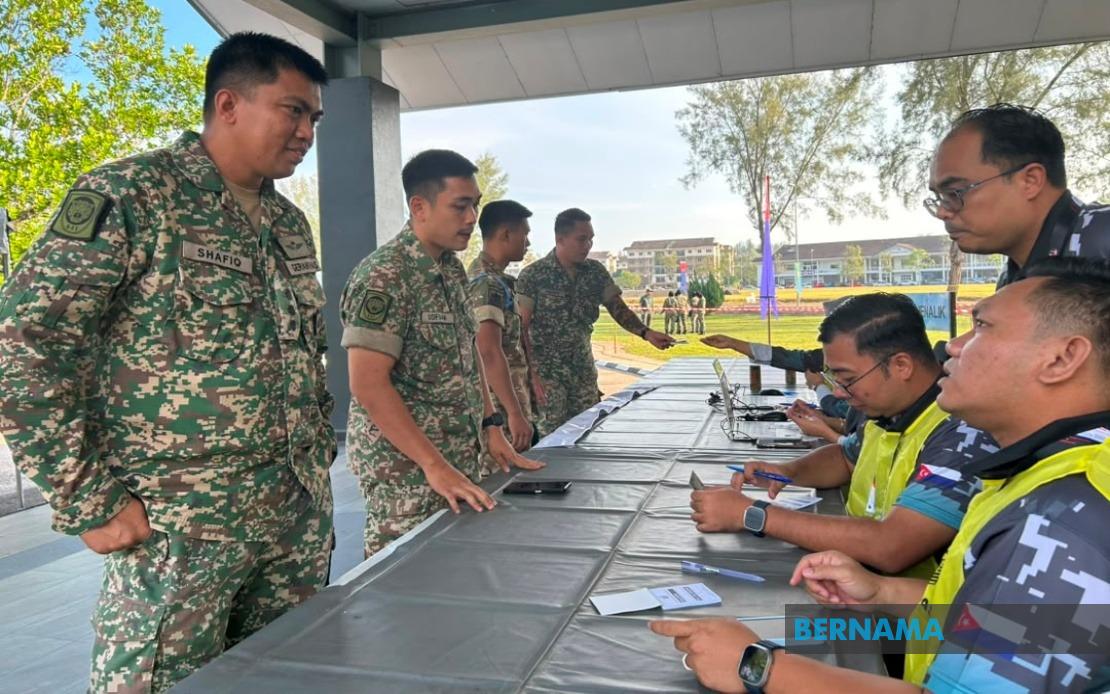
The first wave of voters in Johor's upcoming state election cast their ballots on July 7 under predominantly clement conditions, marking the commencement of an extended polling period ahead of the main election scheduled for Saturday. Security forces and their family members began arriving at designated voting centres from the early morning hours, with personnel mobilizing from 7.30 am onwards to participate in the exercise. The Election Commission had established 64 dedicated polling centres across the state to manage what amounted to one of the larger early voting cohorts in recent state elections.
Favourable atmospheric conditions throughout the morning facilitated smooth operations at the voting venues, which commenced activities at 8 am. The orderly flow of voters and administrative staff during these initial hours reflected meticulous preparation by the Election Commission, whose personnel had conducted comprehensive checks prior to opening the centres. The infrastructure and logistics appeared well-coordinated, with observers noting that both security personnel and EC officials managed the process without significant delays or complications during the morning period.
Yet meteorologists cautioned that the benign conditions would not persist throughout the day. The Malaysian Meteorological Department issued warnings that thunderstorms were expected to develop across Johor during the afternoon hours, potentially disrupting voting operations at some locations. This seasonal weather pattern is not uncommon for Johor during this period, and the EC's decision to stagger polling centre closing times between noon and 6 pm was likely calibrated partly to accommodate such weather variability and ensure maximum accessibility for voters.
The early voting cohort comprised a substantial portion of the electorate structured around security sector participation. A total of 24,751 individuals were eligible to vote during this early period, comprising 12,041 Malaysian Armed Forces personnel along with their spouses, and 12,710 Royal Malaysia Police and General Operations Force officers and their families. This configuration reflects standard practice in Malaysian elections, whereby uniformed services are granted extended voting windows to facilitate their operational continuity during main polling days.
Spot checks conducted by news agencies at several early voting venues including the 5th Battalion GOF Camp in Simpang Renggam, Johor Contingent Police Headquarters, and Mahkota Kluang Camp all reported that voting proceeded without incident and maintained expected administrative standards. The absence of reported complications at these verification points suggested that the Election Commission's preparatory measures had translated effectively into ground-level execution, with poll workers demonstrating competence in managing voter flows and documentation.
The early voting window represents merely the preliminary stage of a much larger electoral exercise. Johor's 16th state election encompasses a substantially broader electorate and territorial scope. The state possesses 2,727,926 registered voters distributed across 1,140 polling centres statewide, reflecting the significant electoral weight that Johor carries within Malaysia's political landscape. As one of the nation's largest and economically important states, voting outcomes in Johor have historically influenced broader national political narratives.
Contesting for representation are 172 candidates seeking to fill 56 state assembly seats across the election. This ratio of candidates to available seats indicates competitive contests in multiple constituencies, signalling that parties and independent candidates view the election as consequential. The distribution of candidates across constituencies would shape the nature of campaign dynamics and voter choice in the lead-up to Saturday's main polling day.
The staggered approach to early voting underscores an institutional recognition that different voter categories face distinct operational constraints. By accommodating security personnel and their families before the general population votes, the EC manages to maintain optimal force deployment during the critical main polling period whilst honouring voting rights for these essential services. The timing and logistics of early voting thus serve dual administrative purposes: ensuring security sector participation and maintaining state security capacity during Saturday's main election.
Weather considerations, whilst perhaps appearing incidental, carry genuine operational implications for electoral administration. Afternoon thunderstorms can discourage voter turnout, damage ballot materials if storage facilities are inadequate, or create hazardous conditions for voters traveling to polling centres. The EC's decision to allow early voting for security personnel during what was forecast as a more weather-stable morning period therefore reflected practical electoral management. The decision to vary closing times across the 64 centres depending on voter registration numbers and location further demonstrates attention to operational efficiency.
The smooth commencement of early voting establishes a positive administrative foundation for the broader electoral exercise approaching on Saturday. Any disruptions or administrative failures during early voting often presage complications during main polling, making the absence of reported problems during July 7's operations an encouraging indicator. For Malaysian observers and regional analysts tracking Johor's democratic processes, the professional execution of early voting procedures demonstrates institutional capacity within the Election Commission to manage large-scale electoral events effectively, even as they confront practical challenges ranging from weather patterns to managing diverse voter populations across geographically dispersed locations.

