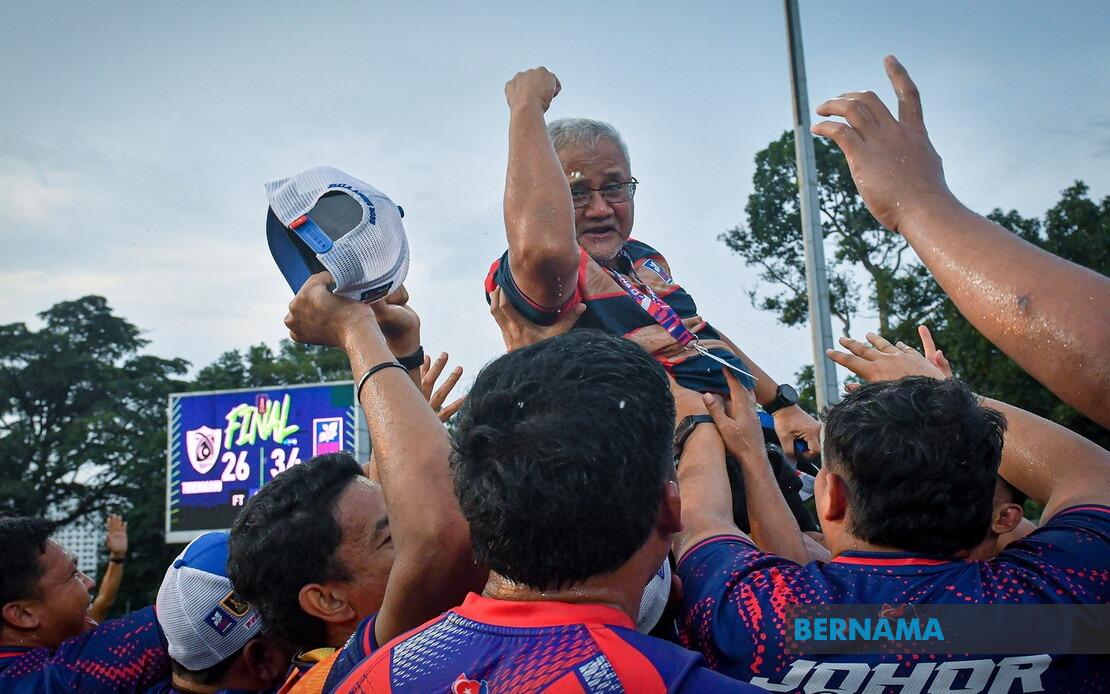
Johor has ended a nine-year championship drought in Malaysian rugby's most prestigious domestic tournament, capturing the Agong's Cup with a commanding second-half performance against Terengganu at the Universiti Teknologi MARA Stadium in Shah Alam. The southern state's rugby programme delivered a 34-26 victory to claim their third title in the tournament's history, marking a significant milestone for the programme that last tasted success in 2017.
The match itself proved a compelling contest between two competitive regional sides, with momentum shifting decisively after the interval. Terengganu entered halftime with apparent control of the game, holding a narrow 19-17 advantage that suggested the eastern state might be positioned to claim an upset victory. However, Johor's coaching staff and players clearly made critical adjustments during the break, and the structural changes implemented in the second forty minutes proved decisive in the encounter.
The comeback underscores the physical and mental resilience that characterises competitive rugby at the domestic level. Johor's ability to absorb Terengganu's first-half pressure, identify weaknesses in their opposition's approach, and exploit them systematically during the second period demonstrates the tactical sophistication now present in Malaysian state rugby. The nine-point winning margin in a final suggests a team that had prepared thoroughly and possessed superior conditioning and depth across the squad.
This marks Johor's third Agong's Cup championship, with their previous titles coming in 2013 and 2017. The extended gap between their last triumph and this one reflects the competitive depth now evident across Malaysian rugby, where multiple states have developed stronger regional programmes capable of challenging for top honours. The 42nd edition of the tournament illustrated that no state can assume dominance, and consistent investment in player development and coaching infrastructure remains essential for sustained success.
In the supporting third-place playoff, Kelantan demonstrated their own resilience by narrowly defeating the Royal Malaysia Police in an extraordinarily tight encounter that finished 43-41. The thriller highlighted the calibre of rugby now being contested at this level, with both teams displaying attacking intensity and defensive commitment that captivated observers. Police rugby continues to represent a significant force in the domestic competition, regularly fielding competitive squads that draw on their institution's training culture and resource base.
The tournament's financial structure reflected the prestige associated with the Agong's Cup. Johor collected RM20,000 in prize money for their championship, while runners-up Terengganu received RM15,000. Kelantan's third-place finish earned them RM10,000, and Police collected RM5,000 for fourth place. These prize allocations, though modest by international rugby standards, remain meaningful within the Malaysian context and underscore the tournament's significance as a major annual fixture.
Johor's Aqasha Daniel Irwan received individual recognition for his outstanding contributions throughout the tournament, winning the player-of-the-tournament award together with RM1,000 in cash and a commemorative plaque. Such individual honours serve an important function in domestic rugby, highlighting excellence and providing aspirational role models for emerging players across the state system. Irwan's selection for this award suggests he delivered consistently strong performances across multiple matches, demonstrating the technical skills, tactical awareness, and physical intensity demanded at this competitive level.
The tournament's significance extends beyond the immediate sporting context. The Agong's Cup represents one of Malaysia's longest-running rugby competitions and carries considerable cultural prestige as a tournament placed under royal patronage. For participating states, success in the tournament provides validation of their rugby development programmes and offers opportunities to identify talent for inclusion in national representative squads. Johor's victory, therefore, carries implications beyond immediate bragging rights, potentially elevating their profile for future national team selections.
The competition also reflects broader trends in Malaysian rugby development. The presence of strong teams from diverse regions—from northern Kelantan to the eastern coast represented by Terengganu, through to southern Johor and the institutional representation provided by Police—indicates that rugby infrastructure and player pipelines have expanded geographically. This contrasts with earlier eras when rugby was more concentrated in particular strongholds, suggesting that grassroots development initiatives have borne fruit across the country.
Looking ahead, Johor will aim to build upon this championship success and establish themselves as consistent contenders. The nine-year gap between their last title and this one demonstrates that maintaining competitiveness requires sustained commitment to player recruitment, coaching quality, and training resources. Other states will undoubtedly draw lessons from Johor's pathway to success and seek to replicate their investment strategies. The competitive landscape suggests that future editions of the Agong's Cup will feature equally compelling contests as more state programmes mature and develop their capabilities.

