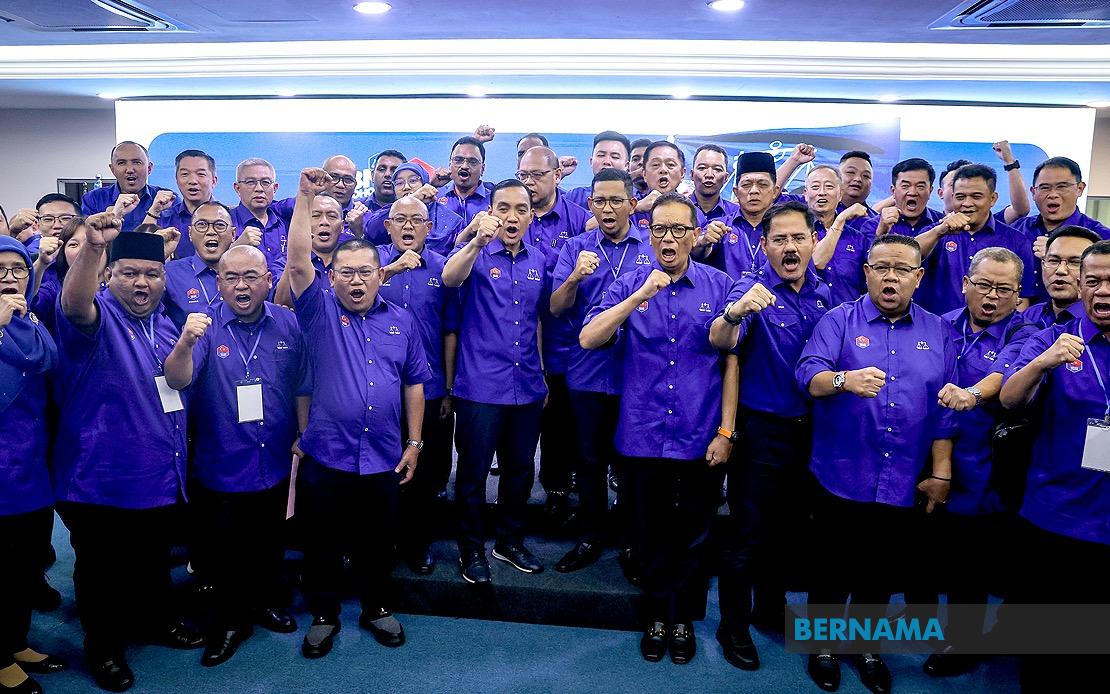
Johor Barisan Nasional has formally announced its complete roster of candidates for the 16th state election, presenting a carefully balanced mix of established political figures and newcomers across all 56 state constituencies. The coalition's strategic approach reflects an attempt to retain core support while injecting fresh perspectives into its campaign machinery, a calculated move as competition for state supremacy intensifies in Malaysia's southern heartland.
The 56-candidate lineup comprises 37 UMNO representatives, 15 from MCA, and four from MIC, unveiled by Johor BN chairman Datuk Onn Hafiz Ghazi at a public ceremony in Johor Bahru. The nomination process received formal endorsement from national BN chairman Datuk Seri Dr Ahmad Zahid Hamidi, underscoring the coalition's unity at both state and federal levels—a critical signal of internal cohesion at a time when Malaysia's political landscape remains fractious and unpredictable.
Onn Hafiz, serving simultaneously as the state's Menteri Besar, will contest the Machap seat that he successfully captured during the 2022 elections. His decision to defend the same constituency demonstrates confidence in his personal electoral strength and the coalition's performance in that particular district. This move also signals continuity and consolidation of power within the state administration, with the sitting chief minister seeking direct renewal of his mandate before voters.
Among the most noteworthy selections is the return of Datuk Seri Dr Adham Baba, the former health minister who has been fielded in Pasir Raja. Adham's inclusion represents a significant political rehabilitation and strategic repositioning for the veteran politician, who previously represented the same constituency for two consecutive terms spanning 2008 to 2018. His track record in national politics is equally substantial—he served as Tenggara MP across two separate parliamentary cycles from 2004 to 2008 and again from 2018 to 2022, building considerable political capital and grassroots support within his traditional stronghold.
The decision to renominate Adham reflects BN's broader strategy of leveraging experienced figures with established electoral records and administrative credentials. As current Tenggara UMNO division chief, Adham brings organizational muscle and demonstrated political machinery to a constituency where continuity and familiarity remain powerful electoral assets. His return may be interpreted as BN's answer to opposition efforts to penetrate historically secure Johor strongholds with fresh political narratives.
Notably, the selection process has also involved significant personnel changes in certain constituencies. In Benut, former Menteri Besar Datuk Seri Hasni Mohammad, who held the incumbent assemblyman position, was not renominated for this election cycle. This decision to step aside a former chief minister suggests internal party calculations regarding optimal candidate deployment and possibly age or performance considerations. In Hasni's place, BN has selected UMNO working secretary Datuk Mohd Sumali Reduan, introducing a fresh face to the constituency while maintaining the coalition's organisational presence.
The broader candidate slate demonstrates considerable continuity in terms of administrative experience and governmental engagement. Nine of ten former Johor executive councillors who contested the 2022 election have been retained as candidates, indicating that the coalition intends to build upon the institutional knowledge and public recognition accumulated by its incumbent office-holders. Only Khairin-Nisa Ismail @ Md On, who previously chaired the State Women, Family and Community Development Committee, has been removed from the Serom seat contest, a decision that warrants scrutiny regarding gender representation strategies within BN's electoral calculations.
Onn Hafiz used the candidate announcement ceremony to articulate the philosophical framework guiding his party's approach to the election campaign. He emphasised that nomination represents not entitlement or personal reward, but rather a sacred trust requiring candidates to conduct themselves with unwavering integrity and accountability to the electorate. This messaging strategy appears designed to preempt public criticism regarding candidate quality and party discipline, while simultaneously establishing clear ethical expectations for the campaign period ahead.
Crucially, Onn Hafiz urged all nominated candidates to maintain campaign standards characterised by courtesy, mutual respect, and prudent conduct, explicitly anchoring their behaviour to Johor's distinctive political culture and values. This appeal to local identity and established norms suggests BN's awareness that electoral success in Johor depends not merely on policy platforms but on resonance with the state's particular political personality—a consideration that carries implications for how the coalition will position itself against opposition parties that may adopt more confrontational strategies.
For Malaysian and Southeast Asian observers, the Johor election takes on heightened significance given the state's economic importance, population scale, and historical role as a political bellwether for national trends. BN's success or failure in retaining control of Johor state will reverberate through federal-level calculations and coalition dynamics, potentially influencing how other states approach upcoming electoral contests. The inclusion of seasoned figures like Adham Baba alongside fresh candidates suggests a coalition attempting to balance institutional continuity with generational renewal—a challenge facing many established political movements across the region.
The nomination of 37 UMNO candidates, representing the dominant party within the Johor BN structure, reflects UMNO's continued numerical preponderance in the state despite national-level vulnerabilities. The smaller presence of MCA and MIC candidates underscores the shifting demographic composition of Johor's voting patterns and the relative weakening of component parties representing non-Malay interests within the overall BN framework. This internal coalition arithmetic will likely shape post-election governance dynamics and cabinet composition decisions, depending on actual election outcomes.
The comprehensive candidate slate, with its deliberate mix of continuity and change, positions Johor BN for what appears to be a highly competitive state election. The coalition's strategy of fielding experienced administrators while introducing new political voices suggests confidence in its organisational machinery and electoral fundamentals. However, the composition also reveals potential vulnerabilities—the exclusion of certain former leaders and the limited progression opportunities for new entrants may create internal tensions that opposition parties could potentially exploit during the campaign phase. Whether this carefully calibrated candidate selection translates into electoral success will depend on broader national political currents and the effectiveness of opposition messaging in challenging BN's long-standing dominance of Malaysian politics' most significant state.