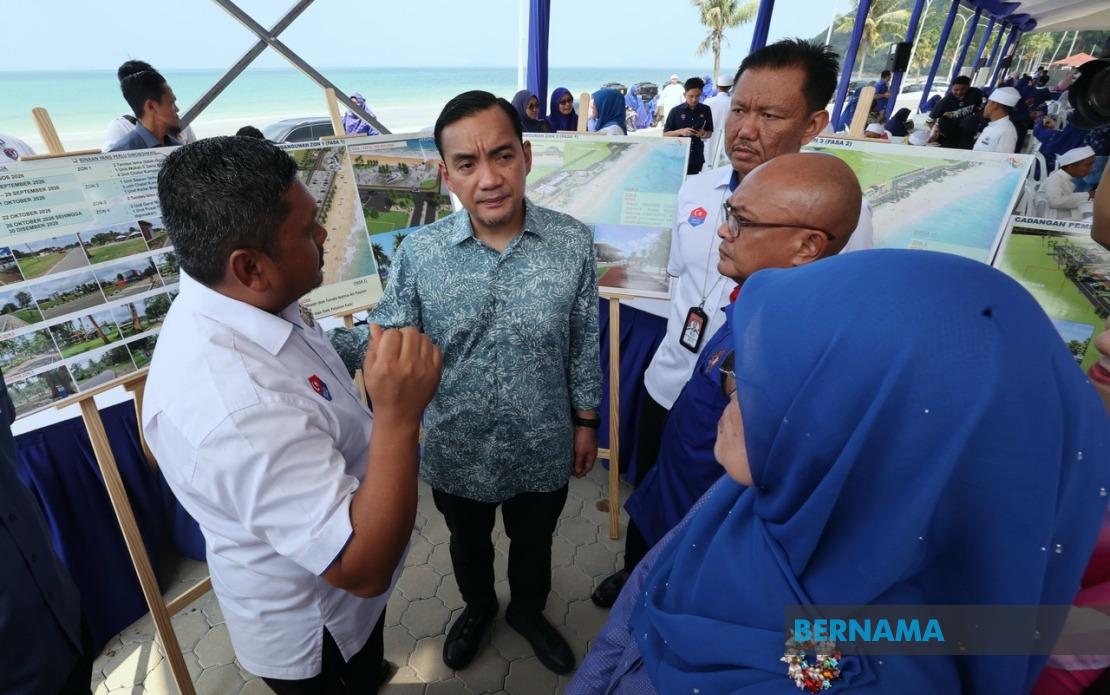
Johor's government has committed RM1.5 million to advance development across Mersing through a coordinated programme spanning infrastructure, sports amenities, healthcare services, and public utilities. The allocation was announced by Menteri Besar Datuk Onn Hafiz Ghazi, who emphasised the strategic importance of extending prosperity beyond the state capital to remote districts. The initiative represents an effort to address the perception that economic gains from Johor's rapid development have concentrated in urban centres, particularly Johor Bahru, leaving peripheral areas undersupported.
Onn Hafiz framed the spending within the broader Johor Economic Transformation Plan (JETP), a multi-year strategy that sets objectives across short, medium, and long-term horizons. He stressed that the plan's purpose extends beyond macro-economic metrics to deliver tangible improvements in residents' daily lives and job prospects. For Mersing, a district of approximately 80,000 people, this represents a deliberate pivot towards inclusive growth that acknowledges the region's tourism potential and existing economic assets while addressing infrastructure gaps and service deficiencies.
The allocation reflects a governance philosophy that development dividend must reach communities beyond major population centres. Onn Hafiz argued that having tourism products without corresponding benefits for residents undermines both social cohesion and long-term prosperity. The Mersing announcement, made in the presence of Tenggaroh assemblyman Mohd Youzaimi Yusof and Endau assemblywoman Alwiyah Talib, demonstrates how Johor intends to operationalise this principle through targeted spending that combines healthcare, recreation, and indigenous community support.
Healthcare improvements constitute the largest single allocation, with RM500,000 directed towards upgrading the haemodialysis unit at Mersing Hospital. This expenditure targets a critical service gap for renal patients in the district, reducing their dependence on travelling to larger medical centres for treatment. The health infrastructure investment signals recognition that peripheral areas often lack specialised facilities proportionate to population needs, a persistent challenge across Malaysia's rural healthcare landscape that affects both patient outcomes and quality of life.
Recreational facilities receive substantial support through multiple channels. RM200,000 each has been allocated to construct a futsal court at Taman Sri Mersing and repair an existing court in Felda Nitar, while another RM80,000 funds a sepak takraw court at Felda Tenggaroh 6. These investments in grassroots sports infrastructure address a common deficit in smaller towns and rural settlements, creating venues for youth engagement and community activity that also support skills development and health promotion.
Religious and community infrastructure improvements include RM200,000 for carpet replacement at Kampung Sri Lalang Mosque, reflecting acknowledgment of the religious dimension of community life in Malaysia. The Kami Anak Felda Malaysia (KAF) building upgrade, allocated RM100,000, targets support for smallholder settlers, while RM100,000 each for solar-powered streetlights in Orang Asli villages of Kampung Peta and Kampung Tanjung Tuan specifically addresses the marginalised indigenous communities' energy and safety needs.
Beyond immediate capital expenditure, Onn Hafiz outlined several strategic initiatives with longer development horizons. Plans to establish a Religious Affairs Office in Mersing would formalise the district's administrative infrastructure while acknowledging Islam's role in governance and community affairs. More significantly, a proposed Technical and Vocational Education and Training (TVET) campus would address youth unemployment by creating local access to skills training aligned with Malaysia's broader vocational education expansion agenda.
The proposal for a petrol station serving the Special Forces Group (GGK) at Camp Iskandar, to be coordinated through local legislative and administrative channels, represents convergence between defence infrastructure and commercial development. Such facilities typically generate employment and commercial activity that extends beyond military personnel to serve broader communities, though implementation details remain pending coordination between relevant authorities.
The Mersing allocation must be contextualised within Johor's development trajectory and the political imperative to demonstrate equitable resource distribution. As Malaysia's second-largest state economy and a growth engine for the region, Johor faces expectations to balance Kuala Lumpur-comparable development in urban centres with meaningful investment in peripheral districts. For Southeast Asia's broader development context, the Mersing case exemplifies how state governments across the region increasingly confront tensions between concentrated urban growth and political pressure for inclusive development reaching smaller towns and rural areas.
The emphasis on youth employment opportunities throughout Onn Hafiz's remarks reflects demographic and economic pressures facing Malaysia and the region. Youth unemployment and underemployment in rural areas drive migration to urban centres and contribute to social pressures. By combining TVET infrastructure with localised recreational and commercial development, Johor attempts to create conditions where young people might find viable livelihoods without relocating, a challenge shared across Southeast Asia's developing states.
For Malaysian readers, particularly those in smaller towns and rural districts, the Mersing announcement signals a governance model where regional economic growth comes paired with infrastructure investment and skills development access. The diversity of spending—from healthcare to sports to indigenous community support—demonstrates integrated thinking about development requirements beyond conventional infrastructure. The subsequent policy effectiveness will depend on implementation quality, local administrative capacity, and whether allocated funds translate into sustained service improvements rather than one-time capital injections.
The Johor model may offer insights for other Malaysian states and Southeast Asian governments grappling with urban-rural development disparities. By articulating development as contingent on dispersed prosperity rather than concentrated growth, and backing rhetoric with measurable allocations to specific communities, Johor presents an alternative to development paradigms that assume trickle-down effects. Whether this represents sustainable inclusive growth or primarily symbolic governance innovation remains subject to outcome measurement over coming years.

