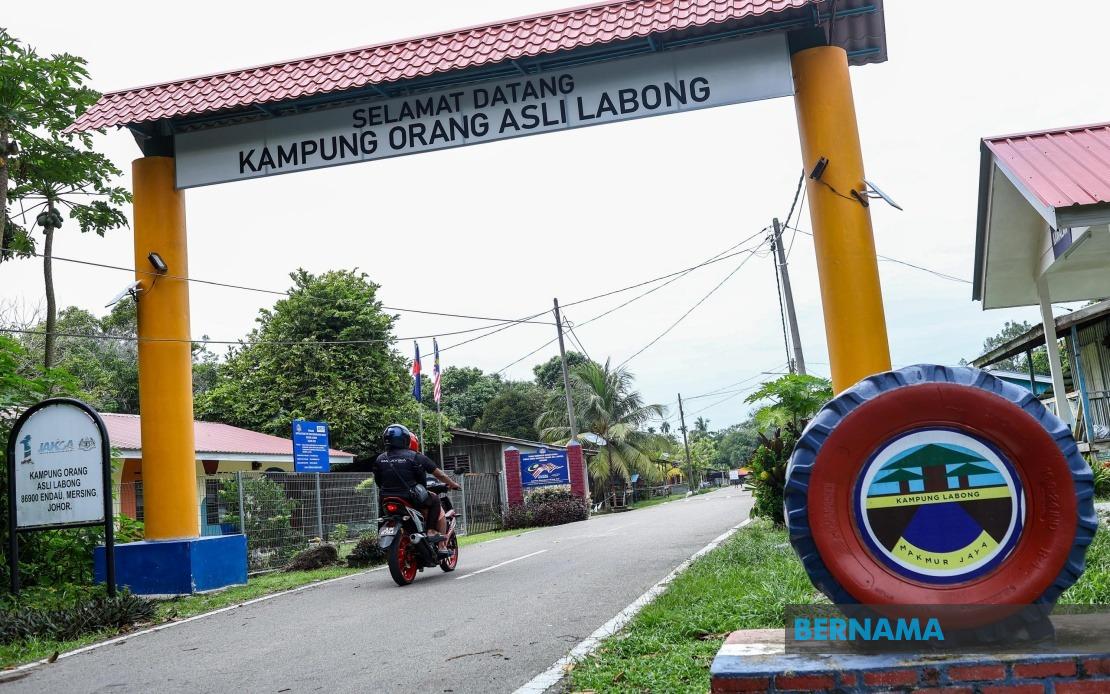
The Johor government is deepening its commitment to indigenous community development through an expanding programme of support coordinated with the Department of Orang Asli Development (JAKOA), with residents of Kampung Orang Asli Labong in Mersing providing concrete evidence of these efforts taking hold at the grassroots level. The collaborative initiatives, which encompass leadership training, enhanced financial support, and targeted welfare interventions, represent an attempt to address longstanding disparities affecting the state's Orang Asli population whilst simultaneously building local institutional capacity within indigenous settlements.
Mabot Sela, the 80-year-old Tok Batin of Kampung Orang Asli Labong, has emerged as an articulate advocate for the state's indigenous development agenda. Over his tenure, he has prioritised ensuring that community welfare concerns receive adequate governmental attention, a responsibility that has been substantially facilitated by the structured support now available through state and federal channels. The village leader's experience underscores a fundamental shift in how indigenous governance structures are being supported, moving beyond purely administrative recognition to provide practical capacity-building resources.
Central to this transformation has been the state's investment in leadership development programmes administered through JAKOA. These courses have equipped Mabot with contemporary governance techniques and administrative knowledge applicable to village management, enabling him to bridge the gap between traditional community structures and modern bureaucratic systems. The training represents a recognition that effective indigenous representation requires not merely custodial authority but operational competence in interfacing with government agencies, managing resources, and articulating community needs through formal channels.
The financial dimension of Johor's support framework has proven particularly consequential for village-level leaders. The state government's decision to increase monthly allowances for Orang Asli village heads and related functionaries has created tangible relief for individuals managing community affairs often without dedicated administrative infrastructure. For Mabot, the augmented allowance has directly improved his capacity to manage personal healthcare expenses and medication costs, illustrating how targeted financial support translates into improved quality of life for those serving indigenous communities in unpaid or inadequately remunerated roles.
Beyond individual leadership development, the state's broader development strategy encompasses multifaceted assistance extending across welfare services, educational opportunities, infrastructure improvement, and community development initiatives. Last year, Johor allocated RM3.8 million to fund nine separate programmes targeting empowerment and welfare enhancement for more than 18,000 Orang Asli residents across the state. This substantial financial commitment reflects recognition that indigenous communities require comprehensive support spanning multiple domains rather than narrow interventions addressing isolated problems.
Community perspectives reveal ongoing aspirations extending beyond the current support framework. Sekoi Janja, a 68-year-old Kampung Orang Asli Labong resident, articulated the generational dimension of development aspirations, noting that younger community members deserve opportunities transcending the forest-dependent livelihoods that historically sustained Orang Asli existence. This intergenerational perspective highlights tension between preserving cultural heritage and enabling economic mobility, with residents increasingly viewing development as essential for youth retention within communities.
Skills development and livelihood enhancement emerge as priority areas where community members perceive gaps in current provision. Norma Lonchai, a 44-year-old trader from the village, emphasised that financial assistance, whilst valuable, requires supplementation through structured vocational training and income-generating opportunities. This feedback suggests that beneficiaries increasingly distinguish between welfare provision and genuine economic empowerment, viewing the latter as prerequisite for sustainable development and reduced dependence on government support mechanisms.
The village continues confronting environmental challenges that constrain agricultural productivity and community safety. Recurring incidents of crop damage attributed to wild elephant intrusions, combined with hazards posed by roaming cattle herds, represent persistent obstacles limiting agricultural income and road safety. These issues illustrate how indigenous community development cannot focus exclusively on governance and skills training but must address concrete environmental management challenges affecting daily livelihood security and personal safety.
For Malaysia's broader indigenous policy framework, Johor's initiatives carry significant implications. As the peninsula's most populous state and a regional economic centre, outcomes in Johor's Orang Asli communities serve as potential models for replication elsewhere. The demonstrated effectiveness of combining governance capacity-building with financial support and multimodal development initiatives provides a template potentially applicable across other states managing substantial indigenous populations. However, the emphasis on youth opportunity and skills development suggests that future resource allocation may require rebalancing toward vocational training and employment intermediation rather than traditional welfare support.
The Johor experience also highlights the continued relevance of traditional leadership structures within contemporary development frameworks. Rather than attempting to displace customary governance arrangements, the state's approach reinforces these structures through professional development and adequate resourcing. This strategy acknowledges that indigenous communities maintain distinct governance preferences and institutional histories that state-led development programmes must accommodate rather than supersede.
Looking forward, sustainability questions emerge regarding the adequacy of current funding levels and programme intensity relative to development aspirations articulated by community residents. The RM3.8 million annual allocation, whilst significant, must sustain nine distinct initiatives across more than 18,000 beneficiaries, potentially limiting programme depth and individual impact. As communities increasingly aspire toward genuine economic transformation rather than welfare stabilisation, the state government may face pressure to substantially increase investment in skills development, employment facilitation, and income-generating enterprise support.
The Kampung Orang Asli Labong experience demonstrates that targeted, coordinated development efforts can meaningfully enhance indigenous welfare and community governance capacity when complemented by adequate financial investment and sustained governmental commitment. Nevertheless, resident feedback suggests that consolidating these gains and expanding opportunities for younger generations will require ongoing programme evolution and potentially increased resource allocation, particularly toward economic empowerment initiatives transcending traditional welfare frameworks.

