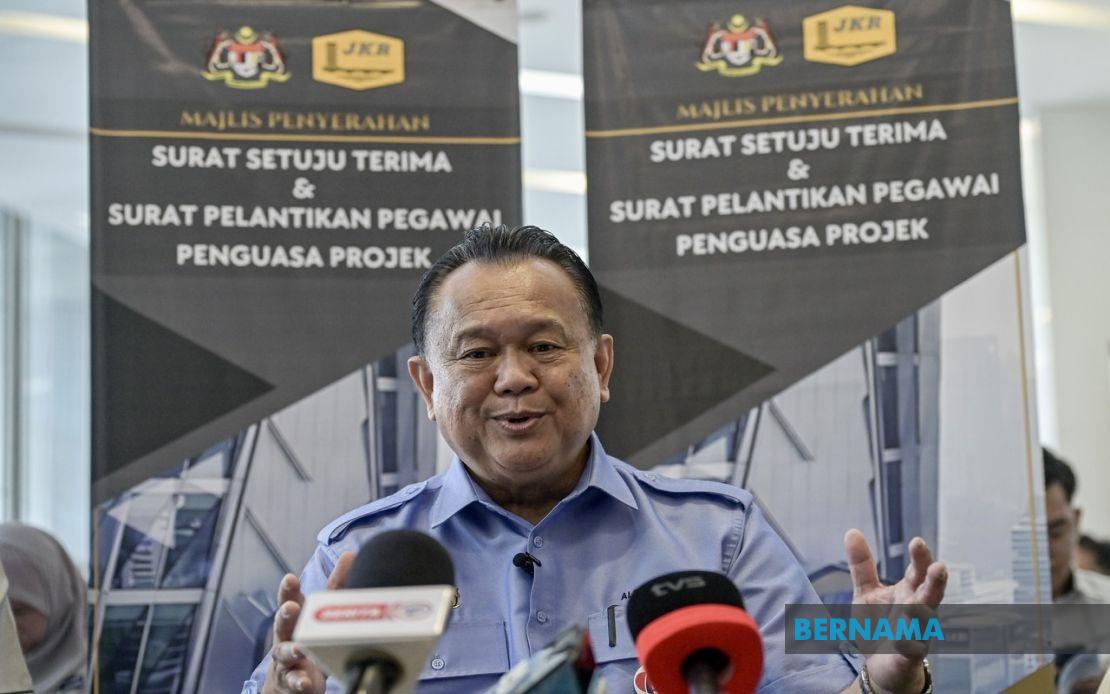
Works Minister Datuk Seri Alexander Nanta Linggi has cautioned against measuring the success of Public Works Department (JKR) initiatives purely by their speed of completion, insisting instead that genuine achievement requires meeting all three critical benchmarks: the contracted timeframe, the allocated budget, and the specified quality standards. Speaking in Kuala Lumpur, Nanta underscored that rushing to finish ahead of schedule while compromising on cost control or construction quality does not represent true progress. His comments reflect a fundamental shift in how Malaysia's infrastructure delivery is being evaluated, moving away from a completion-focused metric toward a more holistic assessment that acknowledges the real-world consequences of cutting corners or overspending to meet artificial deadlines.
The minister's statement carries particular weight given the persistent problem of underperforming infrastructure projects across the nation. Contractors shoulder the responsibility for maintaining this triple-bottom-line approach, Nanta stressed, as failure in any single dimension—whether schedule slippage, cost overruns, or quality deficiencies—can cascade into broader problems. When projects veer off track in one area, they frequently derail in others, eventually earning the dreaded classification of "sick projects" that drain government resources and public confidence in infrastructure delivery. This integrated framework signals that the Works Ministry and JKR are taking a more rigorous stance on accountability, moving beyond excuses and toward genuine performance management.
To enforce this disciplined approach, the Ministry of Works (KKR) and JKR have established key performance indicators explicitly designed to eliminate sick and abandoned projects from their portfolio. Beyond these metrics, the institutions have implemented standardised operating procedures and monitoring guidelines that govern how projects are implemented from contract signing through handover. This institutional architecture attempts to create systematic oversight rather than relying on individual project managers or political pressure to maintain standards. The preventive framework suggests recognition that infrastructure failure is not inevitable but rather stems from poor processes and weak enforcement mechanisms that can be corrected through deliberate institutional reform.
Recent data indicates these measures are beginning to yield results. According to Deputy Minister of Works Datuk Seri Dr Ahmad Maslan, the proportion of sick projects under JKR supervision has declined to 4.13 per cent from the previous five per cent benchmark. This improvement, though modest, involves real outcomes: of 871 projects currently under construction, only 36 remain categorised as sick or at risk. While this figure might appear troubling in absolute terms, the downward trajectory suggests that systematic intervention and heightened scrutiny are producing measurable improvements in project delivery outcomes across Malaysia's infrastructure ecosystem.
The remarks come as the ministry oversees several high-profile initiatives, including the Perak police contingent headquarters and residential complex in Bandar Meru, Ipoh. The RM366 million project represents a substantial investment in law enforcement infrastructure, with construction scheduled to unfold over 42 months and completion targeted for February 2030. The development, occupying a 25-hectare parcel adjacent to Bulatan Sultan Azlan Shah, will be undertaken by Serada Realty Sdn Bhd and falls under the Ministry of Home Affairs (KDN) as a strategic priority. The scale and complexity of such projects demonstrate why precise adherence to timelines, budgets, and quality specifications becomes essential rather than merely desirable.
The decision to build anew rather than rehabilitate reflects a pragmatic assessment of Malaysia's aging infrastructure stock. The existing Perak IPK complex, now 58 years old, has deteriorated to the point where comprehensive renovation would prove neither economical nor effective. This situation mirrors challenges across numerous government facilities nationwide, where deferred maintenance has left many institutions operating in substandard conditions. Choosing to construct modern replacements, while capital-intensive upfront, often yields superior long-term value and operational efficiency compared to piecemeal rehabilitation of decrepit structures.
Beyond the physical infrastructure itself, the new Perak complex carries strategic implications for law enforcement operations throughout the state. The facility is projected to enhance the effectiveness of Perak Police's security and command functions while enabling measurable improvements in public safety outcomes. Specifically, projections anticipate a five per cent annual reduction in crime statistics and a significant improvement in emergency response capabilities, with police reaction time decreasing from the current 15-minute average to 10 minutes. Such operational gains, when aggregated across the state, can meaningfully affect public perceptions of safety and police legitimacy.
For Malaysian readers, these developments carry broader significance regarding how government resources are deployed and overseen. The Works Minister's insistence on balanced performance metrics suggests a maturing approach to infrastructure governance, one that resists both the temptation to cut quality for speed and the equally seductive logic that lavish spending guarantees superior outcomes. As the nation seeks to modernise its public infrastructure while managing tight fiscal constraints, the framework articulated by Nanta—simultaneous achievement of schedule, budget, and quality targets—offers a pragmatic standard for evaluating whether projects genuinely serve public interests or merely transfer wealth without delivering lasting benefits.
The emphasis on superintendent officer oversight and proactive site management indicates recognition that technical specifications and contractual terms alone do not ensure success. Rather, vigilant supervision, rapid issue identification, and immediate corrective action represent critical success factors. This supervisory role, often underappreciated in infrastructure discourse, distinguishes between projects that merely comply with contracts and those that actively deliver value. As Malaysia pursues ambitious infrastructure ambitions across transportation, water management, and institutional facilities, embedding robust supervision mechanisms throughout project lifecycles becomes increasingly crucial to translating plans into functioning assets.
Looking forward, the trajectory of sick project reduction and the implementation of integrated performance frameworks suggest that Malaysian infrastructure delivery may be entering a more disciplined phase. However, maintaining this momentum requires sustained political will, adequate resourcing of oversight functions, and contractor selection processes that privilege competence and reliability over connections and lowest-bid pricing. For Malaysian taxpayers and the end-users who depend on government infrastructure—from police in Perak to commuters using transportation networks—the real test lies not in policy statements but in whether projects consistently deliver within promised timeframes and budgets while maintaining the quality standards necessary for decades of productive service.

