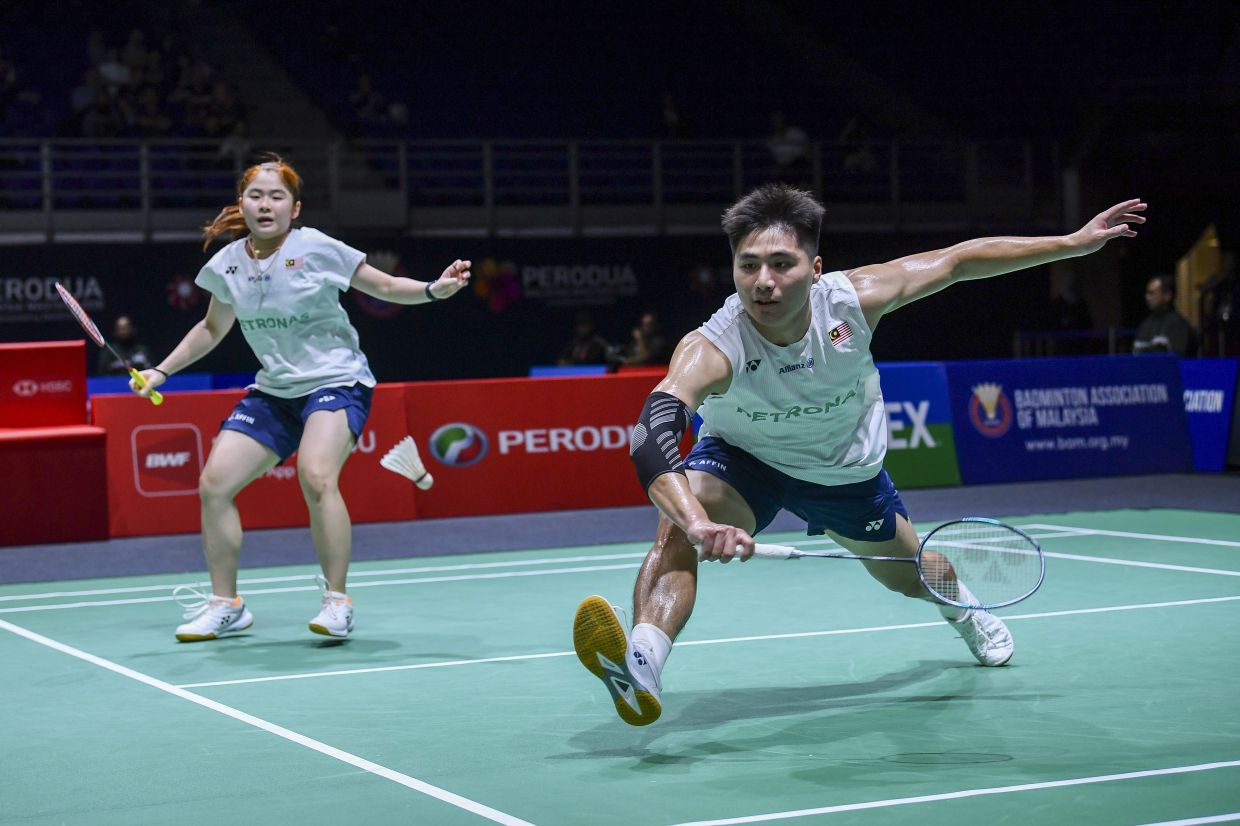
National mixed doubles badminton player Jimmy Wong has emerged as an optimistic prospect within Malaysia's high-performance badminton programme after settling back into the Badminton Association of Malaysia (BAM) system this year. The 23-year-old returned to the national set-up in April and is now channelling his efforts towards realising what represents his most significant career objective: competing at the 2028 Los Angeles Olympic Games alongside his doubles partner Cheng Su Yin. His confidence in the pathway ahead stems from both the quality of coaching infrastructure he now has access to and the tangible progress that he and Su Yin have already begun to demonstrate on the international circuit.
Wong's return to BAM marks a turning point in his competitive trajectory, one that he believes positions him favourably to achieve his Olympic aspirations. While acknowledging that qualifying for Los Angeles 2028 remains an ambitious objective, Wong has adopted a measured psychological approach that he credits with reducing the counterproductive pressure that can derail young athletes. Rather than overwhelming himself with multiple intermediate targets, he has opted to concentrate on consistent court performance, recognising that sustainable excellence accumulates through repeated efforts rather than pressure-driven peaks. This mindset reflects a maturation in his approach to competition that many established coaches actively encourage in developing talent.
The quality of coaching support surrounding Wong has undergone a significant upgrade through his reintegration into the national structure. Working under Nova Widianto, the mixed doubles coach whose credentials include Olympic silver-medal success and a former world championship title, represents an unprecedented opportunity for Wong to absorb knowledge from someone who has navigated the highest levels of competitive badminton. Widianto's influence extends beyond technical instruction in court positioning and shot selection; Wong emphasises that the Olympian's mentorship has fostered his overall development as a competitor and individual. This holistic coaching approach, which addresses both on-court decision-making under pressure and off-court mental resilience, distinguishes world-class coaching programmes from more modest competitive structures.
Wong and Su Yin have established a concrete intermediate milestone that will determine their pathway towards Olympic qualification: reaching the world rankings' top 32 by the conclusion of 2024. Currently positioned at 118th globally, this objective requires meaningful progression through the international tournament calendar but remains achievable given proper tournament selection and continued partnership development. The significance of the top-32 threshold lies in its direct correlation to tournament access; pairs achieving this ranking gain eligibility to compete in the Badminton World Federation's highest-tier events, namely the Super 750 and Super 1000 tournaments where the world's elite pairs regularly accumulate ranking points.
The partnership between Wong and Su Yin demonstrates the complementary strengths and communication patterns essential for mixed doubles success. Wong underscores that their mutual understanding on court—the ability to read each other's positioning, anticipate movements, and execute coordinated strategies—has developed positively over their initial four competitive outings together. However, he remains realistic about areas requiring refinement, acknowledging that the combination has not yet reached the consistency and tactical sophistication that would establish them among established top-tier pairings. This honest self-assessment suggests a maturity in recognising that genuine progress involves identifying deficiencies rather than celebrating partial achievements.
A particular moment of significance occurred when Wong and Su Yin faced the world's top-ranked mixed doubles pair, Feng Yanzhe and Huang Dongping of China, during the opening round of the Singapore Open. That they managed to defeat the top-seeded pairing—itself an accomplishment that catches international attention—demonstrated their capacity to compete against elite opposition and suggested that their technical and tactical capabilities may be further advanced than their current ranking reflects. The subsequent second-round exit prevented them from capitalising on this momentum, yet the victory itself provides concrete evidence of their competitive potential and serves as a psychological reference point for future encounters against higher-ranked opponents.
Malaysia's badminton tradition has long relied on developing strong mixed doubles combinations, a category where the nation has produced multiple world champions and Olympic medalists across different eras. Wong and Su Yin are positioned within this legacy, though they operate in a contemporary landscape where Chinese pairings have established considerable dominance in mixed doubles rankings. For Malaysian badminton followers and administrators, the emergence of competitive young pairings represents both a cultural continuity and a practical necessity, as sustained international competitiveness depends on continuously nurturing talent through the national system rather than relying solely on established names.
The decision to rejoin BAM represents a strategic choice for Wong, one that aligns his career trajectory with Malaysia's structured pathway towards international competition. The national association's investment in world-class coaching staff and its access to regular tournament opportunities through Southeast Asian and international circuits provide infrastructural advantages that independent players inevitably lack. For athletes harbouring Olympic ambitions, remaining integrated within national systems generally maximises the probability of accessing coaching expertise, competitive scheduling, and the psychological support networks that elite sport demands.
Wong's cautious optimism reflects a pragmatism increasingly common among emerging badminton athletes who understand that Olympic qualification involves both controllable variables—such as training consistency, tournament selection, and partnership cohesion—and external factors including injury, opponent form variations, and the inherent competitiveness of international badminton. His focus on delivering maximum effort in each tournament appearance, rather than fixating on distant Olympic selection criteria, represents a psychological strategy designed to accumulate the ranking points and competitive experience necessary for qualification without succumbing to the anxiety that often accompanies long-term objectives.
The pathway from Wong's current 118th ranking to the top 32 will likely require tournament participation across multiple continents and across varying competition levels. Badminton's ranking system rewards consistent performance across a season's worth of tournaments, meaning that sustained development through successive competitions carries more significance than isolated strong performances. Wong and Su Yin's strategy of competing in progressively higher-standard events—accessible only once they achieve top-32 status—creates a feedback loop whereby improving their competitive level unlocks access to tournaments with stronger fields, thereby accelerating future ranking improvements.
For Malaysian badminton observers, Wong's reintegration into the national system exemplifies the sport's continued capacity to develop emerging talent through structured programmes. While established players like Lee Zii Jia and others maintain Malaysia's competitive presence across various categories, the identification and development of promising younger combinations ensures the sport's domestic sustainability. Wong's Olympic aspirations, though ambitious, rest upon realistic foundations: partnership stability with Su Yin, access to world-class coaching through Nova Widianto, and a measurable intermediate ranking objective that provides concrete direction for tournament planning.
As Wong and Su Yin pursue their top-32 objective throughout the remainder of 2024, their progress will likely attract increasing attention from Malaysian badminton administrators and media observers monitoring the nation's emerging talent pool. The victory over the world's top-ranked pair provides a reference point suggesting that their trajectory, if maintained through consistent effort and coaching refinement, may indeed position them as realistic contenders for Olympic qualification within the coming years.

