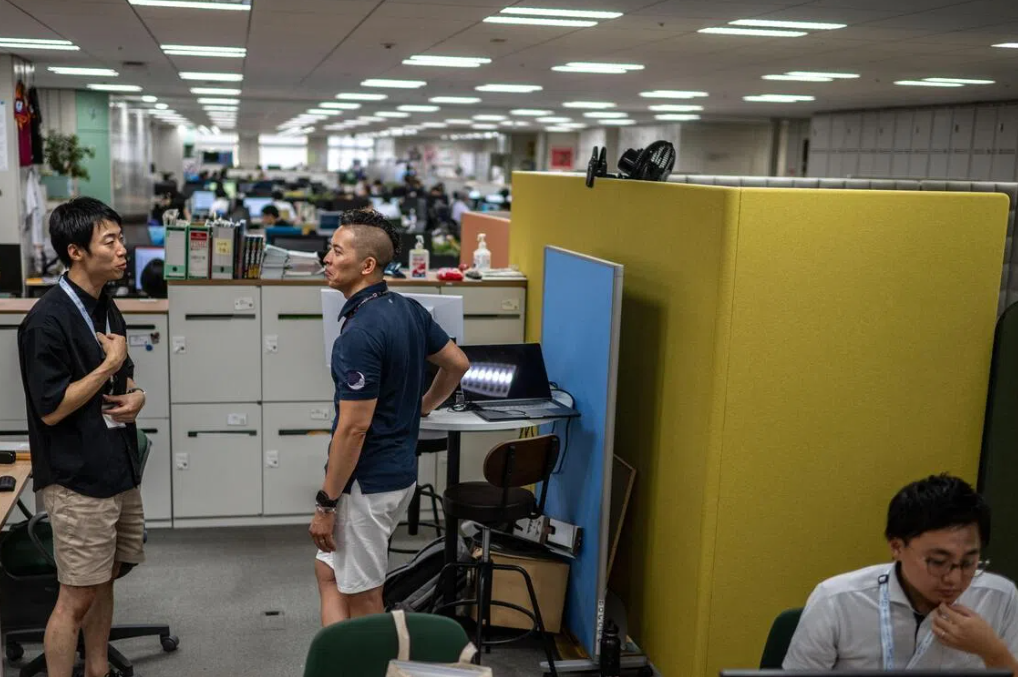
Tokyo's attempt to help its workers endure oppressive summer conditions through relaxed office dress codes has collided with an unexpected social friction: complaints about exposed male leg hair in the workplace. The metropolitan government's decision to expand its "Cool Biz" initiative beyond the existing short-sleeved shirt allowance to include shorts and trainers was framed as a practical response to the severe heat that regularly grips the Japanese capital during summer months. Yet the move has unleashed a surprisingly heated online debate, with some female workers using the term "sunehara" or "leg hair harassment" to describe their discomfort at viewing hairy male shins in professional settings.
The roots of Cool Biz trace back nearly two decades, when environment minister Yuriko Koike first championed the concept in 2005 as part of a broader energy conservation strategy. By encouraging workers to abandon jackets and ties in favour of short-sleeved shirts, the initiative aimed to reduce reliance on air conditioning while maintaining workplace formality. The campaign gained considerable momentum when then Prime Minister Junichiro Koizumi publicly endorsed it by appearing without neckwear or jacket, lending political weight to the cultural shift. Following Japan's catastrophic 2011 earthquake and tsunami, which severely strained the nation's power infrastructure, the government introduced an even more permissive "Super Cool Biz" framework that further loosened traditional dress conventions.
What began as energy policy has gradually transformed workplace culture across Japan's corporate landscape. Start-ups and technology companies have been early adopters of casual attire, reflecting their distance from Japan's conservative salaryman traditions. Yet the Tokyo metropolitan government's recent push to explicitly embrace shorts represents an unusually bold next step in normalising informal dress at work. Officials, including Tokyo environmental official Noboru Watanabe, have framed the expansion cautiously, arguing that employees deserve choice during periods of extreme heat rather than rigid prescriptions about appearance. "There should be no issue as long as the work attire is not offensive to anyone," Watanabe told the BBC, though this assertion has proved far more contentious than bureaucrats anticipated.
The controversy gained empirical dimensions through a June survey commissioned by Gorilla Clinic, a men's cosmetic treatment network operating across Japan. The findings revealed a sharply divided workplace: 53.5 percent of respondents opposed wearing shorts to work, whilst 46.5 percent supported the practice. More significantly, concerns about physical appearance and body hair emerged as primary objections among opponents. The survey's demographic breakdown exposed a pronounced gender divide, with women substantially outnumbering men among those expressing reservations about shorts in professional environments. This pattern suggests that female employees perceive particular discomfort when confronted with their male colleagues' exposed leg hair during routine office interactions, indicating that the "leg hair harassment" complaint reflects a genuine gender dynamic rather than isolated grumbling.
The unexpected backlash has triggered a psychological response among some male workers who now feel self-conscious about their appearance at work. Akifumi Funatsu, a director at Gorilla Clinic, reports observing increased demand for laser hair removal treatments driven not by aesthetic vanity but by what clients frame as "social etiquette when wearing shorts." This phenomenon reveals how workplace norms operate at a deeper psychological level than formal dress codes explicitly specify. Men are interpreting the social signals surrounding the shorts debate as communicating that visible leg hair represents a breach of professional decorum, leading them to seek cosmetic interventions to avoid potential discomfort among colleagues. The development illustrates how efforts to liberalise workplace culture can inadvertently create new forms of social pressure and body consciousness.
Japan's confrontation with extreme summer conditions underpins the practical urgency driving the Cool Biz expansion. The nation experiences significant periods of oppressive heat and humidity that fundamentally compromise the body's natural cooling mechanisms through perspiration. During a single week in mid-July, Japan's Fire and Disaster Management Agency documented seven deaths from heatstroke and hospitalised 4,580 individuals, underscoring the genuine public health dimensions of summer heat management. Government officials have issued coordinated guidance urging residents to maintain hydration, utilise air conditioning systems, and gradually build physiological tolerance to elevated temperatures through measured exposure.
Beyond regulatory measures, Japanese consumers have demonstrated entrepreneurial responses to summer heat through clothing innovations. The market now offers garments incorporating built-in fans, cooling wipes designed for temporary body temperature reduction, umbrellas engineered to block solar radiation, and portable fan devices that workers can deploy throughout the day. These innovations reflect the intersection of engineering capability and consumer demand in addressing seasonal discomfort, suggesting that Japanese industry perceives genuine commercial opportunity in heat mitigation products. The proliferation of such solutions indicates that Tokyo's population views summer conditions as a persistent problem requiring multiple concurrent approaches rather than relying solely on dress code adjustment.
The Cool Biz debate carries implications extending beyond Japanese office culture and climate adaptation, resonating across East Asia and the Pacific region where similar heat challenges confront large urban populations. Malaysia, Indonesia, the Philippines and other Southeast Asian nations endure comparable tropical heat and humidity, yet their workplace cultures maintain varying degrees of formality around dress conventions. Japan's experience demonstrates how attempts to modernise professional dress codes through environmental justification can encounter unexpected social resistance rooted in cultural aesthetics and gender perceptions. The controversy suggests that altering workplace norms requires not merely official sanction but broader social consensus about what constitutes appropriate professional appearance.
Looking forward, the resolution of Japan's leg hair conundrum remains genuinely uncertain. Tokyo officials maintain that workplace shorts present no inherent problem provided they do not offend colleagues, yet operationalising this principle requires some mechanism for determining offensiveness thresholds that currently do not exist. The survey data demonstrating nearly even division between supporters and opponents suggests no clear consensus will emerge spontaneously. Some organisations may implement shorts policies regardless of the controversy, whilst others may retreat to more conservative positions. Individual workers, particularly men, face ambiguous signals about whether removing leg hair represents genuine social expectation or optional precaution. The broader question of how much leg exposure proves acceptable in professional Japanese settings may ultimately resolve through gradual workplace practice rather than formal policy pronouncement.

