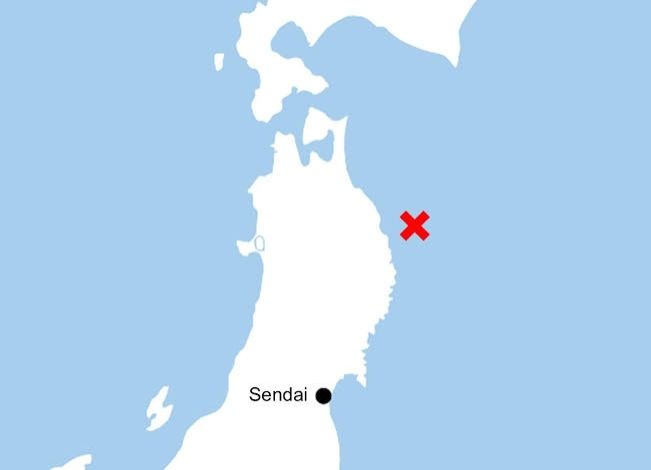
A powerful 7.2-magnitude earthquake jolted northern Japan on Thursday morning, though emergency responders and residents escaped with minimal consequences as kitchenware tumbled from shelves and security systems recorded violent oscillations across the affected region. The undersea event occurred in waters adjacent to Iwate prefecture on the main island of Honshu at 7:30 am local time, with initial seismic readings of 6.9 later upgraded by the Japan Meteorological Agency (JMA) to 7.2 magnitude, originating from a depth of 44 kilometres beneath the ocean floor.
The seismic waves propagated across considerable distances, with tremors detected in Tokyo several hundred kilometres away despite the offshore location. No tsunami alert was triggered following the event, sparing coastal communities from the additional hazard that can accompany major submarine earthquakes. The tremor's intensity nevertheless proved sufficient to disturb daily life across the region and trigger multiple emergency response protocols, demonstrating Japan's well-established earthquake management systems in operation.
Residential properties and small businesses sustained only trivial harm. Mutsumi Shimohata, a 61-year-old employee at a food processing operation in Hashikami within neighbouring Aomori prefecture, described her personal experience with characteristic restraint typical of earthquake-accustomed Japanese residents. Her household escaped with nothing more than a fallen picture frame, though her employer exercised precaution by instructing staff to remain home pending structural assessment of the office building, where the automated entrance door malfunctioned and ceiling sections had detached.
Broadcast imagery captured the characteristic aftermath of significant seismic events: kitchen cupboards disgorged their contents across countertops in disorganised heaps, supermarket shelves shed merchandise onto floors, and various unsecured items scattered throughout commercial spaces. The Shindo intensity scale, Japan's measurement system for earthquake effects on human activity and infrastructure, recorded upper-six readings across Aomori prefecture, a level at which people struggle to maintain their footing and unsecured furnishings typically overturn.
Transportation networks experienced temporary disruptions rather than catastrophic failures. Several shinkansen bullet train services underwent suspension during the immediate aftermath, while a primary school in Hashikami remained closed temporarily as a precautionary measure. Emergency services received approximately four urgent calls in the Hashikami and Hachinohe area, with reports of people becoming temporarily entrapped in a lift, stuck doorways preventing access, and a tanker truck that had overturned. Television footage from Hachinohe demonstrated that broader infrastructure remained functional, with traffic lights continuing normal operation and vehicle movement proceeding through the city.
Government spokesman Minoru Kihara emphasised the absence of confirmed human casualties while cautioning that damage assessment remained ongoing. Prime Minister Sanae Takaichi directed all ministries and government agencies to coordinate closely with regional authorities, while publicly urging residents to maintain vigilance regarding potential subsequent seismic events of comparable magnitude. Such warnings reflect the understood reality that significant earthquakes frequently generate aftershock sequences that can perpetuate hazardous conditions for extended periods.
The nuclear infrastructure across the region withstood the seismic event without incident, according to the Nuclear Regulation Authority. This outcome carries particular significance given Japan's sensitive relationship with atomic power following catastrophic nuclear failures. The nation's regulatory framework for nuclear facilities has incorporated increasingly stringent earthquake safety provisions since the 2011 Fukushima disaster, making real-time verification of nuclear facility integrity a matter of immediate national concern.
Japan's geographical situation places it among the world's most seismically volatile territories, positioned atop four converging major tectonic plates along the Pacific Ring of Fire's western margin. The 125-million-strong population inhabits a landscape characterised by tectonic activity, with hundreds of earthquakes registering annually across the archipelago. These seismic events account for approximately one-fifth of the world's total earthquake activity, establishing Japan as a centre of global tectonic research and a testing ground for earthquake-resistant infrastructure and emergency response systems.
Thursday's earthquake transpires within a broader pattern of heightened seismic activity that has elevated regional concerns. In April this year, a 7.7-magnitude quake rattled northern Japan, injuring at least ten people and rattling structures across Tokyo with sufficient force to prompt authorities to release a formal advisory warning of substantially elevated probability regarding magnitude 8.0 or stronger events. Though this advisory was rescinded after one week, the sequence demonstrates the region's continuing vulnerability to major seismic events.
The persistent seismic danger remains informed by national memory of the 2011 catastrophe, when a 9.0-magnitude submarine earthquake spawned a tsunami of devastating proportions. That disaster killed approximately 18,500 people or left them missing, while simultaneously triggering the Fukushima nuclear facility meltdown that reshaped the nation's energy policy and nuclear safety standards. Thursday's manageable earthquake outcome contrasts sharply with such historical devastation, reflecting the effectiveness of Japan's earthquake preparedness infrastructure, building codes, and public awareness systems developed through centuries of seismic experience and refined dramatically since 2011.

