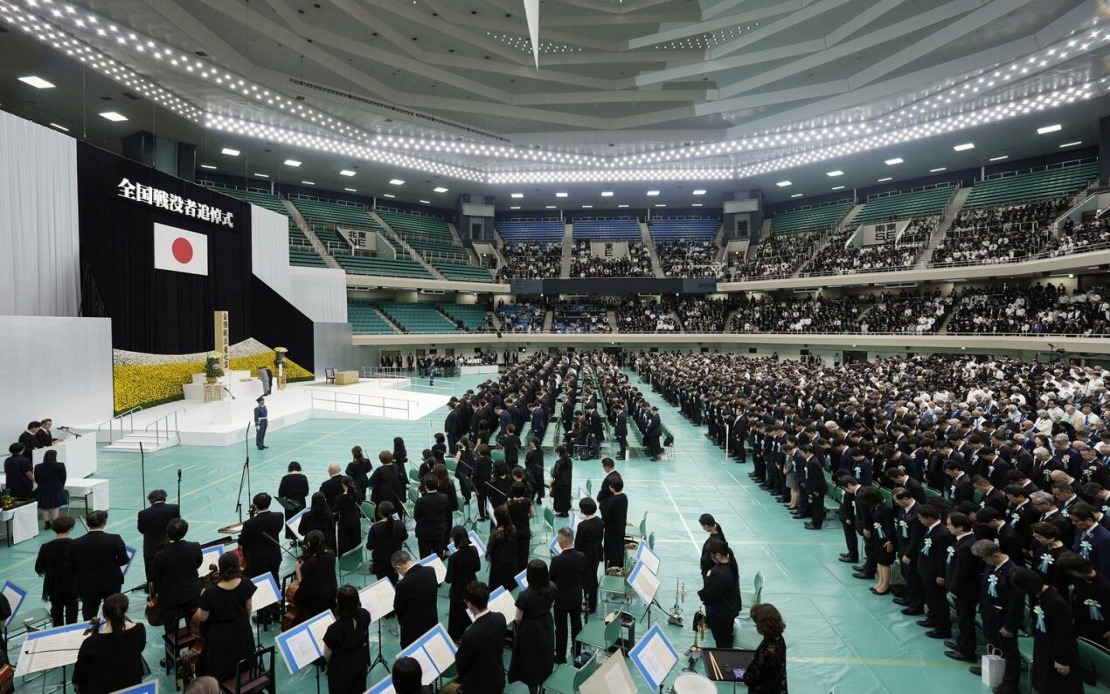
Japan observed the 81st anniversary of its World War II surrender on Saturday with a government-sponsored ceremony in Tokyo that underscored the complex relationship the nation maintains with its wartime past. Prime Minister Sanae Takaichi, who assumed office last October, attended the annual memorial for the first time in her current role, delivering remarks that emphasised Japan's commitment to peace without explicitly acknowledging the nation's "remorse" over the conflict that claimed approximately 2.3 million military personnel and roughly 800,000 civilian lives when it concluded in 1945. Emperor Naruhito and Empress Masako participated in the solemn gathering, which included a moment of silence observed at noon—the precise hour when Emperor Hirohito announced Japan's surrender by radio broadcast eight decades ago.
The linguistic choices made during Takaichi's speech represent a subtle but significant recalibration of Japan's official narrative about its wartime conduct. In her address, the prime minister stated that Japan has "consistently walked the path of a nation that values peace and made all possible efforts for world peace and prosperity," framing the country's identity through its post-war trajectory rather than through acknowledgment of past transgressions. This formulation differs notably from language used by her predecessor, Shigeru Ishiba, who just months earlier at last year's ceremony had pledged to keep in mind Japan's "remorse" and expressed the nation's "resolute pledge to renounce war"—words that had been largely absent from such occasions for thirteen years before Ishiba's tenure. Takaichi did invoke the broader commitment to peace across generations, but the deliberate avoidance of the word "remorse" sends a message about her administration's approach to Japan's historical reckoning.
The shift reflects broader ideological differences within Japan's conservative political establishment, where Takaichi represents a notably hawkish perspective on national security compared to the relatively dovish moderation associated with Ishiba and the Liberal Democratic Party's broader centrist wing. Takaichi, who has long counted the late former Prime Minister Shinzo Abe among her political mentors, follows a trajectory consistent with Abe's own reluctance to dwell on Japan's wartime aggression when he returned to power in December 2012. Before that pivotal moment in Japanese politics, successive prime ministers had routinely acknowledged Japan's aggression across Asia—including toward China and the Korean Peninsula—and formally expressed remorse at the August 15 anniversary ceremonies. The current prime minister has similarly refrained from directly addressing the nation's historical military actions in the region, continuing a pattern that marks a departure from the more introspective stance that had characterised Japanese leadership through much of the post-1995 period.
Emperor Naruhito's separate remarks at the ceremony maintained the imperial tradition of expressing contrition for the war's devastation. The Emperor, speaking in his consistent annual practice, voiced "deep remorse" while emphasising the importance of transmitting memories of wartime suffering to future generations as society pursues lasting peace and stability. His words carried particular weight given the imperial institution's unique historical position in Japanese society and the symbolic significance his statements hold for public discourse on the war. The Emperor's continued emphasis on passing down historical memory provides a counterbalance to the more forward-looking framing favoured by the current administration, illustrating the complexity of how modern Japan navigates between acknowledging historical responsibility and projecting a contemporary identity.
The timing of this year's anniversary ceremony coincides with Japan's most substantial recalibration of its defence posture in the post-war era. The government has initiated a sharp expansion of national security spending and simultaneously relaxed longstanding restrictions on defence equipment exports, reflecting changing strategic calculations driven by regional tensions and shifting global power dynamics. These policy adjustments toward a more assertive defence stance appear to correlate with subtle changes in how political leaders discuss Japan's wartime legacy, suggesting that contemporary security concerns and historical narratives are intertwined in ways that merit closer examination by regional observers. For neighbouring countries in Southeast Asia and beyond, Japan's evolving approach to both defence policy and historical accountability carries implications for regional stability and trust.
From a Malaysian and broader Southeast Asian perspective, Japan's official treatment of its wartime history carries relevance beyond mere diplomatic protocol or domestic political significance. Nations across the region retain their own complex memories of Japanese occupation and colonial aggression during World War II, with varying degrees of historical emphasis in contemporary education and public discourse. Malaysia and other Southeast Asian countries have pursued pragmatic engagement with modern Japan as a technological and economic partner, yet underlying historical sensitivities persist in ways that occasional statements or omissions at memorial ceremonies can amplify. The question of how Japan officially characterises its wartime conduct therefore extends beyond Tokyo's internal political debates to affect the tone and substance of regional relationships built on both shared interests and unresolved historical dimensions.
Takaichi's apparent departure from recent precedent regarding "remorse" also reflects generational shifts within Japanese society and politics. As more than eight decades separate contemporary Japan from 1945, successive cohorts of political leaders and citizens lack direct experience of the war itself. This temporal distance permits certain political actors to reshape historical narratives in ways that might have provoked greater public resistance in earlier decades when war survivors and their immediate families held greater influence over national discourse. The transition from Ishiba's brief acknowledgment of remorse back to its omission under Takaichi suggests that even minor rhetorical departures can indicate broader currents within Japan's political establishment regarding how the nation wishes to position itself internationally and internally.
The Emperor's continued adherence to language of remorse gains additional significance precisely because it stands in contrast to prime ministerial formulations. This divergence reveals that Japan's institutional landscape contains multiple authorised voices addressing the war, each with different constituencies and historical interpretations. While the prime minister emphasises Japan's post-war peace credentials and contemporary security commitments, the Emperor maintains a ceremonial function that privileges historical memory and acknowledgment of suffering. For foreign observers and neighbouring countries seeking to understand Japan's relationship with its past, this institutional plurality matters considerably—it demonstrates that no single formulation commands unanimous support across all sectors of Japanese governance and society.
The implications of Takaichi's rhetorical approach extend beyond symbolism into practical matters of regional diplomacy and historical education. How Japan's leadership publicly discusses the war influences how the conflict is taught in schools, how it features in diplomatic discussions with neighbouring nations, and how it shapes the broader context within which contemporary bilateral relationships develop. China and South Korea, nations particularly affected by Japanese wartime actions, carefully monitor such statements for indications of Japan's willingness to acknowledge historical responsibility—a factor that regularly surfaces in diplomatic tensions and public opinion polling within those countries. Malaysian observers attentive to regional dynamics recognise that while Malaysia itself has moved toward pragmatic engagement with contemporary Japan, the question of how nations address difficult historical episodes remains relevant to broader questions about regional trust and the foundations upon which modern partnerships rest.
Takaichi's inaugural appearance at the August 15 ceremony as prime minister thus marks a moment worth noting not for any dramatic pronouncements but precisely for what remained unsaid. The careful calibration of her language—neither explicitly denying the nation's wartime actions nor explicitly acknowledging them as sources of remorse—exemplifies how contemporary Japanese politics navigates between different constituencies with competing visions of national identity. Those seeking stronger acknowledgment of historical responsibility find her formulation insufficient, while those preferring to emphasise Japan's post-war achievements and contemporary security role may view her approach as appropriately balanced. This middle ground, however, represents a shift from the position staked out by her immediate predecessor, suggesting that the trajectory of Japanese historical discourse may continue evolving as successive administrations assert their own interpretive frameworks.
Looking forward, the question of how Japan's leadership addresses its wartime history will likely remain entangled with broader strategic considerations about Japan's regional role and defence posture. As the nation continues strengthening its military capabilities and expanding its security partnerships across the Indo-Pacific, the manner in which it publicly relates to historical episodes of aggression becomes increasingly freighted with contemporary significance. Southeast Asian nations, including Malaysia, have invested substantially in deepening relationships with Japan across multiple domains—technology, investment, security cooperation, and cultural exchange. These relationships rest partly on assumptions about Japan's commitment to peaceful conduct and rules-based regional order. When statements at historical ceremonies shift in subtle ways, they warrant careful attention not as indicators of imminent policy changes but as potential signals about evolving attitudes within Japan's political establishment regarding the nation's historical identity and contemporary aspirations.

