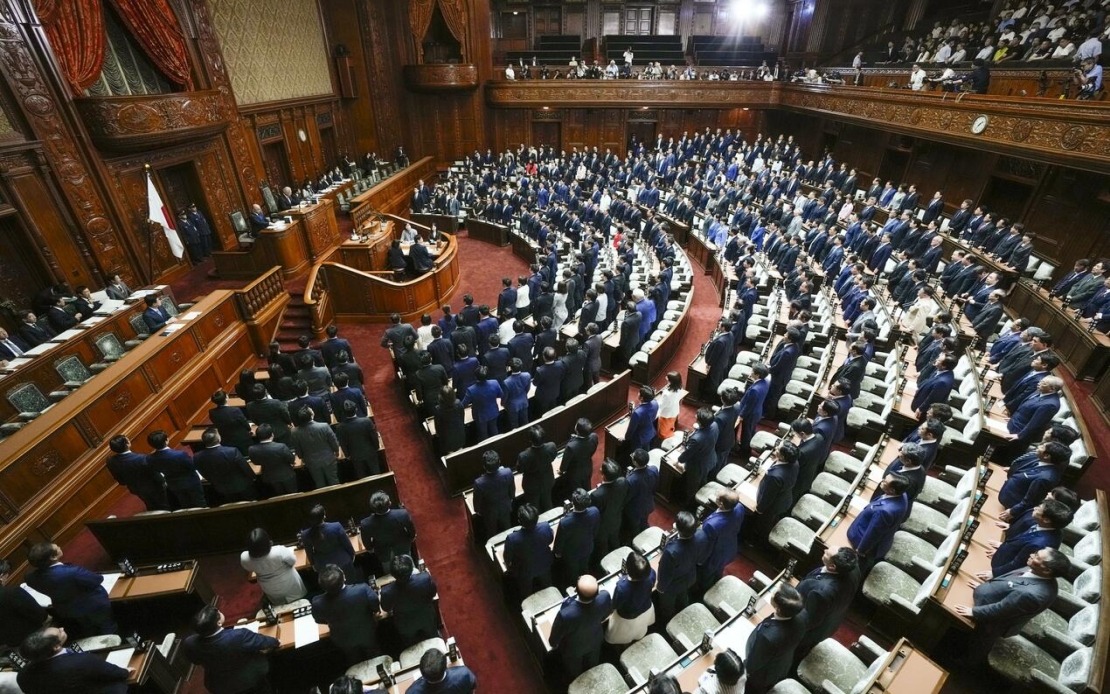
Japan's House of Representatives has approved sweeping changes to the Imperial House Law, marking the first substantial revision to the 1947 statute governing the monarchy. The bill's passage on Friday comes after a compressed day of parliamentary debate, representing a major breakthrough for Prime Minister Sanae Takaichi's administration following weeks of legislative gridlock over separate reform initiatives.
The ruling coalition of the Liberal Democratic Party and Japan Innovation Party commands the supermajority necessary to advance the legislation without upper house support, though both groups now pursue ratification through the House of Councillors before the parliamentary session concludes mid-July. The accelerated timeline reflects the government's determination to resolve a constitutional matter that has preoccupied Japanese policymakers for years: the alarming contraction of the imperial family pool and the consequent risk to succession.
At its core, the legislation addresses two interconnected problems. The first mechanism enables the imperial family to absorb males aged 15 and above descended patrilineally from emperors, drawing candidates from 11 historical branch families whose connections to the throne were severed during post-war reorganisation. The second permits women who marry outside the imperial circle to preserve their imperial standing, a significant departure from tradition that recognises modern marriage patterns. Notably, while male adoptees and their sons gain eligibility for the throne, the adopted individuals themselves remain barred from ascending.
For Malaysian and Southeast Asian observers, this constitutional evolution carries broader implications. As regional monarchies navigate demographic and social change, Japan's deliberative approach—however contentious domestically—demonstrates how established institutions attempt reconciliation between tradition and contemporary realities. The involvement of all 13 parliamentary parties in preliminary consultations, despite subsequent partisan divisions, underscores institutional maturity amid disagreement.
The legislative journey reflects contemporary Japanese politics' fractious character. Prime Minister Takaichi's government introduced the bill in late June, yet parliamentary dysfunction stemming from opposition resistance to unrelated measures delayed substantive discussion. Opposition parties objected not merely to imperial reform but to what they characterised as heavy-handed governance, citing the administration's aggressive management of Diet business alongside accusations—rooted in media investigations—that Takaichi's political operation disseminated defamatory online content targeting rivals.
The parliamentary stalemate formally broke when the ruling coalition conceded ground on a second controversial initiative concerning lower-house seat redistribution, agreeing to abandon efforts to force that measure through the current session. This compromise created space for deliberation across multiple reform dossiers, including the imperial succession question. The apparent trade-off illustrates how parliamentary gridlock in mature democracies often resolves through strategic retreat rather than victory.
The imperial reform itself incorporates elements beyond the bipartisan proposal drafted by legislative leaders. Most contentiously, the enacted bill permits male children of adoptees from former branch families to become emperor—a provision absent from earlier consensus frameworks. This deviation sparked criticism from opposition quarters, suggesting that compromise remained incomplete despite the government's concessions elsewhere.
Perhaps more striking than the provisions included are those conspicuously absent. The legislation deliberately sidesteps the female emperor question, despite sustained public support for expanding the succession to women or those with maternal imperial lineage. This omission reflects conservative cultural and constitutional sensitivities that the Takaichi government evidently deemed insurmountable within the current political environment. By framing adoption and female retention as solutions rather than addressing female succession directly, policymakers attempted a middle path that satisfies neither reformists nor traditionalists comprehensively.
The practical urgency underlying the debate cannot be overstated. The imperial family's active membership has contracted precipitously, with only a handful of males in the direct succession line. Female members' automatic loss of status upon marrying commoners has accelerated this demographic crisis, as female descendants and their offspring fall outside the imperial register. Without intervention, the institution faces succession challenges within decades. The adoption mechanism addresses this by reincorporating male descendants of collateral imperial branches, effectively expanding the eligible pool without fundamentally restructuring succession principles.
For regional perspective, Japan's constitutional deliberation on imperial succession presents contrasts with Southeast Asian monarchy systems. While Thai succession rules have sparked intense constitutional controversy, Malaysian federal arrangement distributes monarchy across nine sultans with rotation procedures, diffusing succession pressures. Japan's unitary imperial system concentrates succession urgency into a single institution, intensifying both constitutional stakes and political salience.
The imperial reform's enactment during Takaichi's premiership carries symbolic weight beyond legislative substance. As Japan's first female prime minister navigating a bill that simultaneously constrains female succession while enabling female retention, Takaichi embodies the contradictions within Japan's constitutional modernisation. Her coalition partner, the Japan Innovation Party, has historically advocated more expansive female succession options, yet compromised within the coalition framework.
The legislative trajectory ahead remains uncertain despite the lower house approval. Upper house deliberations may introduce additional modifications, and opposition parties retain procedural mechanisms to delay or debate. The government's agreement to schedule one-on-one sessions between Takaichi and opposition leaders signals continuing negotiation rather than settlement.
Ultimately, Japan's imperial succession reform illustrates how constitutional democracies manage anachronistic institutions. The solution—adoption and female retention without female succession—represents pragmatic incrementalism rather than transformative restructuring. Whether this compromise architecture proves durable or merely postpones deeper constitutional reckoning remains an open question as Japan's Diet proceeds toward session closure.

