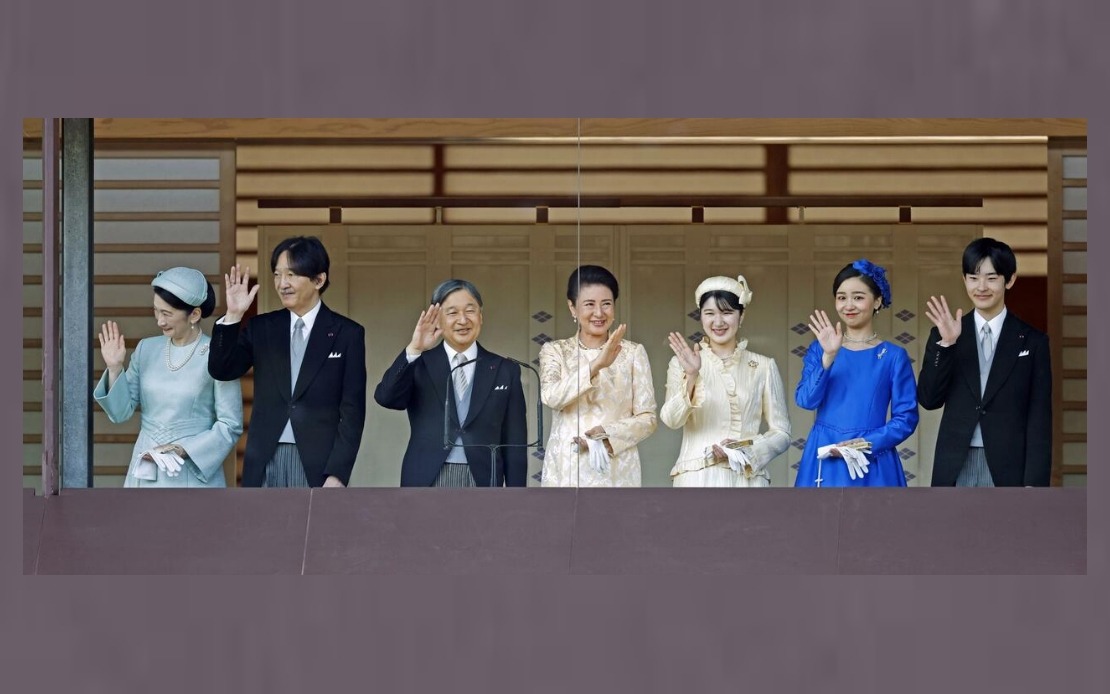
Japan's parliament has enacted sweeping changes to its Imperial House Law in what marks the first substantial revision since 1947, attempting to address a pressing demographic challenge that threatens the world's oldest continuous hereditary monarchy. The reform has sparked significant debate within government circles and among the public, with uncertainty clouding how the revised rules will function in practice and whether they truly resolve Japan's succession concerns.
At the heart of the revision lies a stark reality: the imperial family has dwindled to just 16 members, a decline that has become a leading policy priority for conservative Prime Minister Sanae Takaichi. The shrinking roster poses a genuine threat to the institution's long-term viability and has prompted lawmakers to seek creative solutions. Under the new law passed Friday, males aged 15 or older from 11 former imperial branch families that lost their status in 1947 may now be adopted into the imperial household, reopening pathways that had been closed for over seven decades.
Yet enthusiasm for the policy has not translated universally into confidence. Imperial Household Agency officials acknowledge the reform provides a framework for stability, with one high-ranking staffer noting that "there is now a path toward securing a stable number of imperial members." However, the same officials express deep reservations about execution. One concern centres on whether adoptees will truly grasp the symbolic role of the emperor under Japan's post-war constitution and whether they will be capable of earning public affection and understanding the philosophical underpinnings of the institution they would serve.
Skepticism extends even to members of the eligible families themselves. Asahiro Kuni, an 81-year-old from the Kuninomiya branch, expressed doubt about whether anyone would volunteer for adoption, calling the prospect "not very realistic." His candid assessment reflects the profound lifestyle changes and societal expectations adoption would entail, factors that may deter even those with historical imperial bloodlines from stepping forward.
A more contentious aspect of the reform concerns its implications for female succession, an issue that reveals the fault lines in Japan's political establishment. Princess Aiko, the only daughter of Emperor Naruhito, remains ineligible to ascend the throne despite widespread public polling indicating support for female emperors. Instead, the government has introduced a compromise: princesses may now retain their royal status if they marry commoners, a provision presented as progressive but which critics view as a conservative manoeuvre designed to circumvent female succession entirely. The measure effectively preserves male-only succession while appearing to offer princesses greater autonomy.
For palace staff managing these newly unmarried female members—currently numbering five, including Princess Aiko and Princess Kako, daughter of Crown Prince Fumihito—the new law creates what officials describe as an unexpectedly harsh dilemma. Should a princess choose to marry outside the imperial family, retaining royal status would mean her spouse and children remain ordinary citizens, creating what one aide termed "strange" family circumstances with divergent legal standing. Conversely, renouncing royal status to maintain family equality would end their public roles. Agency officials suggest the weight of institutional expectations and public duty makes leaving the imperial system increasingly difficult for these women.
Palace insiders further detect in the government's overall strategy a deliberate steering away from female and matrilineal succession. One senior aide stated plainly: "I sense the government intends to rule out female emperors or emperors from the matrilineal line." This observation underscores how the reform, while expanding certain options, ultimately reinforces conservative principles about how the monarchy should evolve.
Public reaction has proven decidedly mixed, reflecting broader generational and ideological divisions within Japanese society. Some citizens, like Shinichi Kokubun, a 76-year-old who witnessed the imperial family's work in disaster-stricken Fukushima after the 2011 earthquake and tsunami, expressed conditional acceptance. He reasoned that if adopted members demonstrated genuine care for the people comparable to the reigning emperor, practical problems would likely not materialize. Such pragmatic support, however, does not represent the consensus among younger Japanese.
Young adults, particularly those in their late teens and twenties, have criticized both the substance of the reform and the process by which it was implemented. Miyu Nakao, 22, from Hiroshima, pointed to polling data showing substantial public backing for a female emperor while lamenting that "the government has made a decision on the imperial system all by itself," excluding broader democratic participation from the discussion. Her complaint highlights a legitimacy gap: a policy addressing one of Japan's most historically significant institutions proceeded with insufficient public consultation or education.
This generational rift extends further. A 20-year-old college student in Osaka acknowledged that imperial succession law remains poorly understood among his peer group, stating he had not encountered adequate government outreach explaining either the Imperial House Law's provisions or the reasoning behind the changes. His observation suggests the government's communications strategy failed to build public consensus for such a fundamental alteration to constitutional monarchy principles.
For Southeast Asian observers, Japan's imperial succession debates offer instructive lessons about how traditional institutions navigate modern pressures. Japan's approach—preserving formal institutional continuity while making incremental reforms—contrasts with how other Asian monarchies have managed comparable questions about gender, succession, and public legitimacy. The tensions between conservative institutional preservation and democratic public sentiment evident in Japan's case resonate across the region, where questions about the future role and composition of royal families remain live political issues.
The revised Imperial House Law represents neither a wholesale modernization nor a genuine resolution of Japan's succession anxieties, but rather a compromise that satisfies few stakeholders completely. Imperial Household Agency staff must now prepare for scenarios involving adopted members while remaining uncertain about public and institutional support. Meanwhile, female members of the imperial family face genuinely constrained choices about their futures, their options reframed but not fundamentally expanded. And the public, particularly younger generations, has been left with a sense that momentous decisions about national institutions proceeded without adequate deliberation or transparency. As Japan moves forward implementing these changes, the coherence of the imperial system and public confidence in its governance will depend substantially on how effectively policymakers address these residual concerns.

