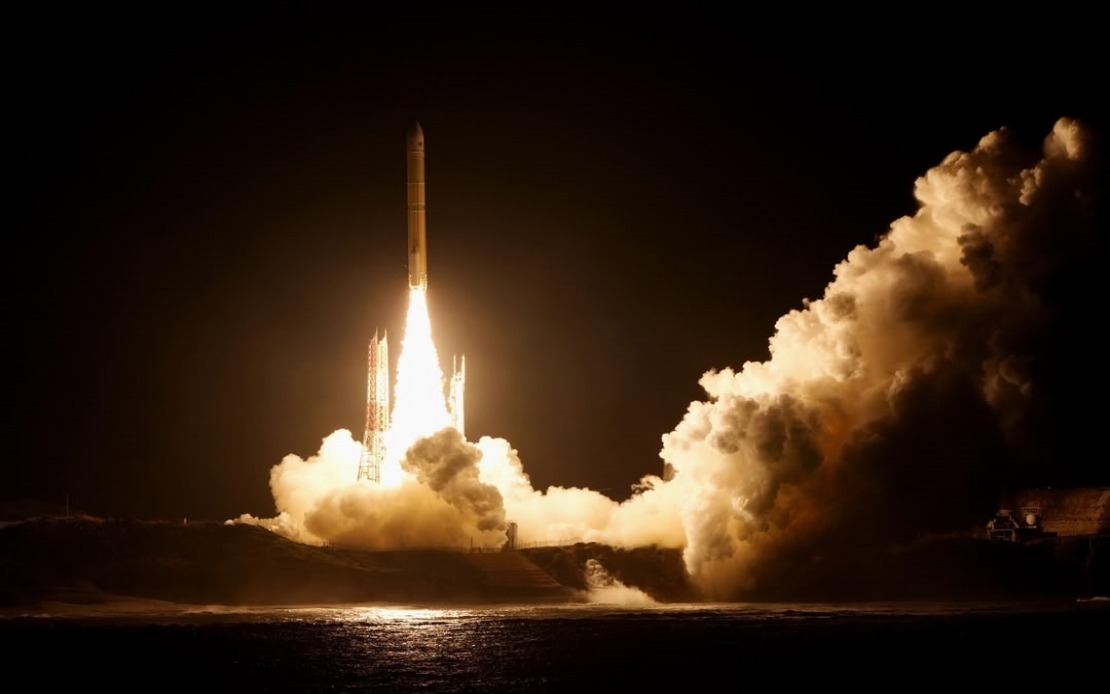
Japan's Aerospace Exploration Agency has achieved another significant milestone in its space programme by successfully launching the H3 rocket from Tanegashima Space Centre early on Tuesday, carrying the Michibiki No. 7 positioning satellite into orbit. The achievement represents a crucial recovery for Japan's flagship launch vehicle, which had suffered a setback only eight months earlier. The successful deployment marks the second consecutive triumph for the H3 system and demonstrates the agency's ability to resolve technical challenges that threatened the country's long-term space ambitions.
The H3 rocket lifted off from the Tanegashima Space Centre, situated on a small island in southwestern Japan, with the Michibiki No. 7 satellite aboard as part of Japan's Quasi-Zenith Satellite System. This constellation of positioning satellites functions as an independent alternative to global navigation infrastructure, providing precise location information for civilian applications ranging from smartphone mapping to vehicle navigation systems and emergency response coordination. The system is particularly valuable for Japan and the broader Asia-Pacific region, as it reduces reliance on foreign space infrastructure for critical positioning services.
The launch had required rescheduling twice before ultimately succeeding. Originally planned for the previous Friday, the mission was postponed to Monday due to an approaching typhoon, then delayed a further day as meteorological conditions near the launch facility remained unsuitable. These scheduling adjustments reflect the strict operational protocols that space agencies must observe, as unfavourable weather can create dangerous conditions during both the pre-launch preparation phase and the critical early moments following liftoff when the rocket is most vulnerable to environmental factors.
The December failure that preceded this success had created significant complications for Japan's space programme timeline. When the H3 rocket designated as No. 8 failed to successfully insert the Michibiki No. 5 satellite into its intended orbit, it triggered a cascade of delays throughout the deployment schedule. The Michibiki No. 7 satellite, originally expected to be launched in February, had to be rescheduled indefinitely while the space agency conducted root cause analysis and implemented corrective measures. This extended delay demonstrated the interconnected nature of modern space operations, where a single setback reverberates across multiple projects and fiscal years.
The successful June launch of an H3 rocket carrying multiple small satellites provided encouraging evidence that engineers had identified and resolved the underlying technical problems. That mission, while involving different payload objectives than the positioning satellite programme, allowed the agency to validate critical systems and operational procedures in actual flight conditions. The transition from that successful test flight to the Michibiki No. 7 deployment represented a meaningful step forward in establishing regular operational cadence for the new rocket system.
Japan's commitment to expanding its Quasi-Zenith Satellite System reflects strategic thinking about space independence and technological sovereignty. Five Michibiki satellites are presently delivering positioning services across the region, but the government has established an objective to field seven satellites capable of providing comprehensive coverage without requiring augmentation from other nations' navigation systems. This sevenfold constellation will enable Japan to offer continuous, reliable positioning services independent of the American Global Positioning System, the Russian GLONASS, the European Galileo system, or China's BeiDou Navigation Satellite System.
The significance of this constellation development extends beyond Japan's borders. The Quasi-Zenith Satellite System provides enhanced positioning accuracy and availability throughout East and Southeast Asia, benefiting countries across the region that have adopted compatible receivers. For Malaysian users and businesses, Japan's expansion of this system offers an additional layer of navigational redundancy and improved service reliability, particularly for applications requiring centimetre-level positioning accuracy in agriculture, construction, surveying, and autonomous transportation sectors.
The H3 rocket's trajectory represents a critical transition point in Japan's launch vehicle heritage. For more than two decades, the H2A rocket served as the dependable workhorse of Japanese space operations, establishing a proven track record of reliability that made it one of the world's most trusted launch systems. The H3 programme was conceived as the successor to this proven platform, incorporating technological improvements and enhanced cost-efficiency to maintain Japan's competitive position in the increasingly challenging commercial and institutional launch market. However, the transition from a proven system to a new design inevitably encounters technical surprises and operational learning curves.
The H3's mixed operational record thus far reflects the inherent risks of developing next-generation space hardware. Early setbacks need not signal fundamental design flaws but rather underscore the complexity of spaceflight engineering, where factors ranging from materials behaviour under extreme conditions to component interactions under launch stresses can produce unexpected results. The December failure, while disappointing, proved recoverable, and the demonstrated ability to diagnose problems and implement solutions positions the programme favourably for sustained operations ahead.
Looking forward, the consecutive successful launches represent a potential inflection point where the H3 transitions from a rocket system proving its capabilities to one establishing routine operational reliability. If this trajectory continues, Japan will have secured independent access to space for both government missions and commercial customers, strengthening its technological base and providing a stable platform for regional space activities. For Southeast Asian nations considering satellite launch options and space partnerships, Japan's H3 success becomes increasingly relevant as an alternative launch provider with demonstrated technical competence and growing operational confidence.

