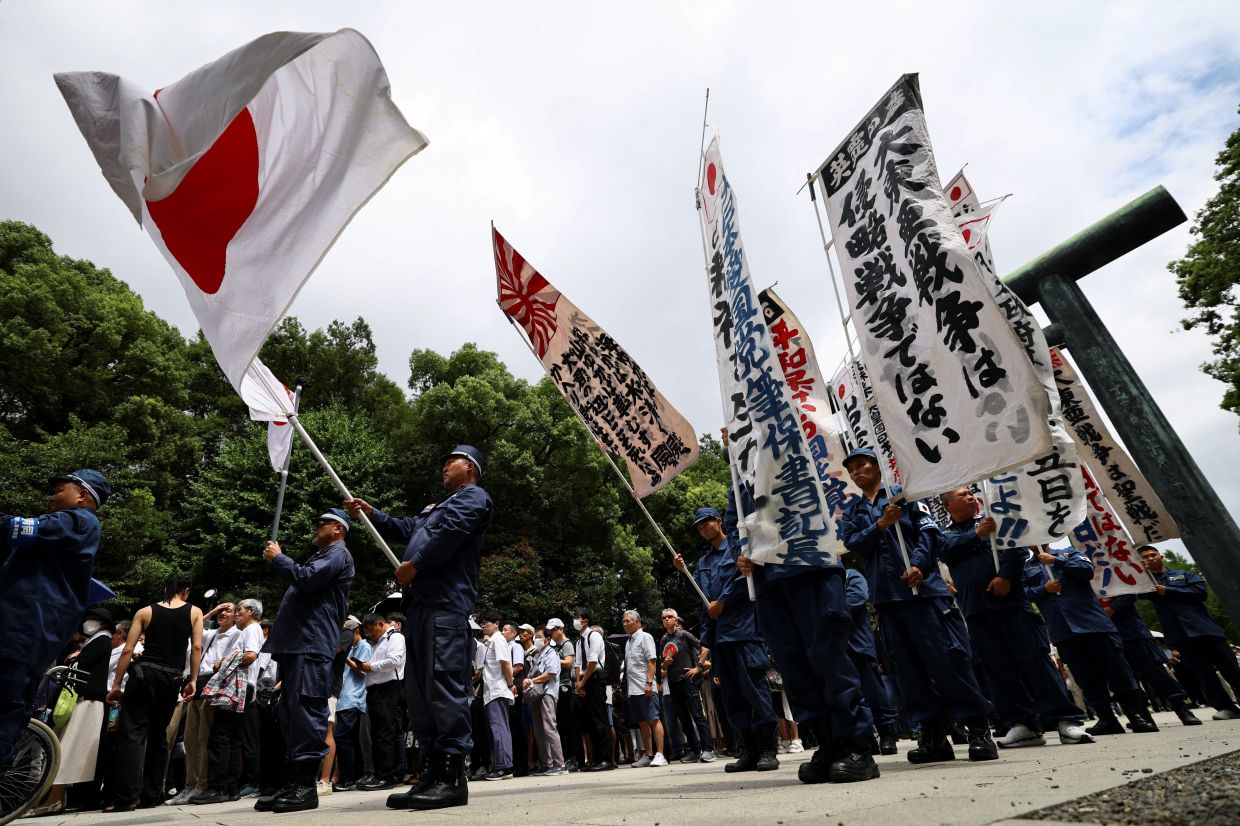
Japan's defence minister Shinjiro Koizumi paid respects at the Yasukuni shrine on Saturday, marking the 81st anniversary of the nation's surrender in World War II, though Prime Minister Sanae Takaichi conspicuously chose not to attend the controversial site. Koizumi's visit to the shrine, which honours 2.5 million Japanese war dead, represents his first pilgrimage in his current defence portfolio and arrives at a moment of considerable diplomatic sensitivity across the region. The annual August 15 observance typically draws crowds to the Tokyo site, including a contingent of visitors in military-style garments, creating visual imagery that continues to provoke strong reactions among Japan's neighbours.
The Yasukuni shrine remains one of East Asia's most fraught historical symbols, enshrining not only ordinary soldiers but also individuals convicted of war crimes during Imperial Japan's campaigns throughout the 1930s and 1940s. For China and South Korea, official visits by Japan's political leadership to the shrine represent a failure to adequately reckon with the nation's wartime aggression and the atrocities committed across the region. This perception has repeatedly strained diplomatic relations, transforming what might elsewhere be routine commemorative gestures into geopolitical flashpoints. The shrine's symbolic weight in regional consciousness cannot be overstated, functioning as a litmus test for how seriously Tokyo takes historical accountability in the eyes of neighbouring governments.
Takaichi's decision to remain absent from the shrine on Saturday carried significant meaning, though she maintained symbolic involvement by sending an offering, a practice followed by her predecessors. Before assuming the premiership in October, Takaichi had been a regular visitor to Yasukuni, suggesting a deliberate recalibration of approach upon taking office. Her restraint contrasts with the decision made by former Prime Minister Shinzo Abe, her political mentor, who visited the shrine in December 2013 following his election victory. That earlier visit triggered sharp protests from both Beijing and Seoul, and even drew an unusually critical response from Washington, Japan's closest security ally. The fact that Takaichi has chosen a different path indicates awareness of the political costs associated with such visits.
Koizumi's attendance as defence minister, while potentially less diplomatically charged than a prime ministerial visit, nonetheless carries implications for the trajectory of Japanese defence policy and regional perceptions of Tokyo's strategic intentions. The last defence minister to visit Yasukuni was Minoru Kihara in 2024, making such pilgrimages not unprecedented but sufficiently infrequent to draw notice. Koizumi himself has long maintained a pattern of regular Yasukuni visits throughout his political career, establishing consistency in his personal stance on war commemoration. His continued adherence to this practice despite occupying a senior security portfolio signals the complexity of managing domestic political expectations with international diplomatic considerations in contemporary Japanese governance.
Takaichi's broader policy direction has already generated considerable anxiety in Beijing and diplomatic friction across the Taiwan Strait. In November, the prime minister suggested that Japan would consider military intervention in any armed conflict over Taiwan, a statement that directly challenged China's sovereignty claims and represented a notable departure from Japan's more circumspect historical positioning. China's response has been swift and multi-faceted, including warnings discouraging Chinese citizens from travelling to Japan and implementing targeted trade restrictions. Beijing has simultaneously intensified military activities around disputed island territories, signalling its displeasure through coordinated pressure across multiple dimensions. This escalatory cycle demonstrates how individual policy statements can rapidly metastasise into broader strategic competition.
Chinese defence ministry spokesperson Senior Colonel Chen Xi issued a formal warning on the eve of the August 15 anniversary, explicitly cautioning against what Beijing characterises as Japanese neo-militarism. The statement urged Tokyo to engage in genuine historical reflection and atonement for wartime transgressions, demanding adherence to the post-war international order while ceasing remilitarisation initiatives. This language reflects Beijing's consistent framing of Japanese defence expansion as a threat to established regional stability. Russia's ambassador to Japan jointly issued a statement with China's diplomatic mission, emphasising their nations' sacrifices during World War II and implicitly critiquing Japanese historical narratives. These coordinated expressions of concern underscore the degree to which Japan's defence posture has become a focal point for great power competition in East Asia.
Takaichi has accelerated Japan's departure from its post-war pacifist constraints, overseeing substantial increases in military spending and capability development. This strategic recalibration reflects genuine security concerns regarding China's growing assertiveness and North Korea's continued nuclear weapons development, yet it simultaneously activates regional historical sensitivities that remain unresolved. The timing of defence investments, policy rhetoric, and visits to commemorative sites collectively communicate Japan's evolving security doctrine to both domestic audiences and international observers. Southeast Asian nations, including Malaysia, observe this trajectory with mixed sentiments, recognising legitimate Japanese security needs while remaining cautious about militarisation trajectories that could destabilise the broader region.
Russian President Vladimir Putin's visit to the Kuril Islands on August 14, the day preceding the Yasukuni shrine observations, injected additional complexity into the regional diplomatic environment. Tokyo maintains historical claims to these territories, and Putin's symbolic assertion of Russian control provoked sharp Japanese protests, demonstrating how geopolitical competitions simultaneously operate across multiple disputes and multiple timeframes. The convergence of these events within a 48-hour window illustrates the interconnected nature of contemporary great power tensions in the Asia-Pacific, where historical grievances, territorial disputes, and strategic competition operate in tandem.
Interestingly, Japanese relations with South Korea have experienced modest improvement in recent years, providing a potential counterweight to deteriorating China-Japan dynamics. In January of this year, Takaichi engaged in drumming activities with South Korean President Lee Jae Myung in a symbolic gesture of cultural and diplomatic engagement, while defence minister Koizumi participated in ping-pong exchanges with his South Korean counterpart. These lighter diplomatic moments suggest possibilities for managing tensions through sustained dialogue and people-to-people exchange, even amidst deep historical disagreements. However, such improvements remain fragile, and high-profile Yasukuni shrine visits risk undermining the careful consensus-building that has enabled modest warming of ties.
The Yasukuni shrine itself attempted to manage the August 15 observances by appealing to visitors to refrain from military-style uniforms, seeking to preserve a respectful atmosphere for general worshippers and reduce visual provocations. The sanctuary announced that staff would provide guidance to those unaware of the guidelines, framing the policy as advisory rather than prohibitive. This approach reflects institutional awareness that uniformed visitors generate international controversy and domestic discord, yet the shrine stopped short of implementing mandatory restrictions. An AFP reporter estimated approximately 20-30 individuals wore military-style garments despite the appeal, indicating ongoing contestation over appropriate commemorative practice and the boundaries of acceptable expression at such sites.
The divergence between Takaichi's cautious approach and Koizumi's continued Yasukuni practice illuminates ongoing tensions within Japanese political leadership regarding historical memory, strategic autonomy, and regional diplomacy. Takaichi's decision to abstain while maintaining symbolic involvement through offerings attempts to navigate competing pressures: satisfying domestic constituencies that view Yasukuni visits as essential patriotic observance, while simultaneously avoiding the international blowback that accompanies high-profile prime ministerial pilgrimages. This balancing act reflects the enduring salience of World War II history in shaping contemporary East Asian relations, nearly eight decades after Japan's surrender. For Malaysian observers and Southeast Asian policymakers, Japan's evolving approach to historical commemoration and defence posture carries implications for regional security architecture and the maintenance of the rules-based order that has facilitated decades of prosperity across the Indo-Pacific.

