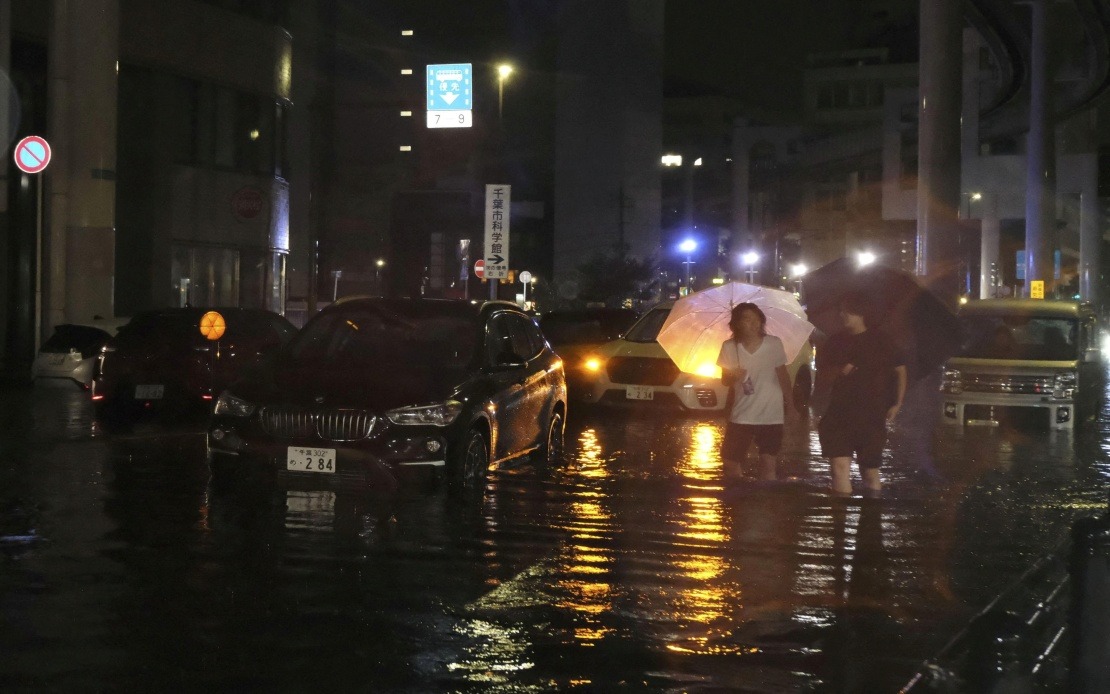
Eastern Japan's Chiba Prefecture descended into crisis on Thursday as an extraordinary deluge swept across the region, leaving four people dead and another unresponsive. The Japan Meteorological Agency responded to the unprecedented conditions by issuing a Level 5 alert—its most severe classification—for rainfall across more than one-third of municipalities in Chiba, which sits immediately east of Tokyo. The combination of warm, humid air masses colliding with frigid upper-atmosphere air created dangerously unstable atmospheric conditions, transforming the prefecture into a landscape of inundation and danger that would persist well into Friday morning.
The sheer intensity of the precipitation caught residents and infrastructure alike off guard. In Chiba's Chuo Ward, an hourly rainfall measurement of 115 millimetres on Thursday night represented roughly one month's worth of typical August precipitation compressed into a single night. Across the prefecture, roads rapidly disappeared beneath surging water as drainage systems proved inadequate for such extreme volumes. The metropolis of Chiba and the adjacent city of Ichikawa both issued urgent public advisories demanding residents implement immediate protective measures, while water violently erupted from underground service hatches in Chiba's streets. Citizens waded through knee-deep water in desperate attempts to reach their homes as the downpour intensified.
The scale of the evacuation underscored the genuine threat posed by such meteorological events in densely populated regions. At their peak, evacuation orders encompassed more than 400,000 individuals spread across both Chiba and neighbouring Ibaraki prefectures. By Friday morning, approximately 126,000 people remained under mandatory evacuation orders across the two prefectures as conditions gradually stabilised. The Fire and Disaster Management Agency coordinated the massive displacement of populations, establishing over 200 evacuation centres across Chiba, Ibaraki, Saitama, and Gunma prefectures to shelter those unable to remain in their homes. The prefectural government building in Chiba became an improvised shelter, housing roughly 1,800 stranded commuters unable to navigate the flooded transportation networks.
Extending beyond simple flooding, the Japan Meteorological Agency also issued a Level 5 landslide warning for multiple municipalities, including Chiba and the adjacent city of Ichihara, reflecting genuine concerns that saturated soil could trigger dangerous geological failures across the hilly and forested regions. These warnings were subsequently downgraded Friday morning as precipitation gradually diminished, though authorities cautioned that dangerous conditions could persist throughout the region into Friday evening.
For Malaysian and Southeast Asian readers, such extreme weather events carry particular relevance as monsoon and tropical rainfall systems regularly threaten the region. Japan's response mechanisms—multi-tiered colour-coded alert systems, coordinated evacuation protocols, and pre-positioned emergency shelters—represent institutional approaches that developing nations in Southeast Asia continue to refine. The efficiency and speed with which Japanese authorities mobilised resources and communicated warnings to hundreds of thousands of residents reflects decades of experience managing seasonal meteorological hazards in one of the world's most earthquake and flood-prone territories.
Infrastructure vulnerabilities became apparent as the deluge progressed. Tokyo Electric Power Company Holdings Inc. reported that approximately 45,000 households across Chiba Prefecture experienced electrical disconnection at the crisis's height, compounding difficulties for residents attempting to charge devices and maintain communication with emergency services. Water intrusion into electrical substations and damaged transmission lines created cascading failures across the power distribution network, a vulnerability that resonates throughout Asia's urban centres where similar infrastructure integration exists.
The meteorological explanation for such extreme events provides important context for understanding climate patterns affecting East Asia. The collision of tropical moisture-laden air flowing northward with descending arctic air masses created the precise atmospheric conditions that spawn supercell thunderstorms and mesoscale convective systems capable of producing precipitation rates exceeding 100 millimetres per hour. Such scenarios, once considered anomalies, increasingly represent the new normal as ocean temperatures warm and atmospheric circulation patterns shift, consequences that extend throughout the Western Pacific region.
Transportation paralysis accompanied the flooding, as stranded commuters sought shelter in public buildings. The Chiba prefectural government building transformed into a temporary refuge, accommodating nearly 2,000 individuals displaced from damaged rail lines and impassable roads. Such scenes reflect the vulnerability of metropolitan transport systems to extreme precipitation, a concern equally relevant across Southeast Asian megacities where similar population densities and infrastructure configurations create comparable risks.
As precipitation continued through Friday morning, authorities maintained vigilance despite downgrading the highest-level warnings. The meteorological agency cautioned that Chiba and adjacent prefectures could experience additional heavy rainfall throughout Friday, suggesting that the crisis remained in flux even as initial emergency responses stabilised the worst immediate dangers. Recovery operations would require assessing damage across residential areas, rebuilding compromised road networks, and restoring electrical service to isolated communities.

