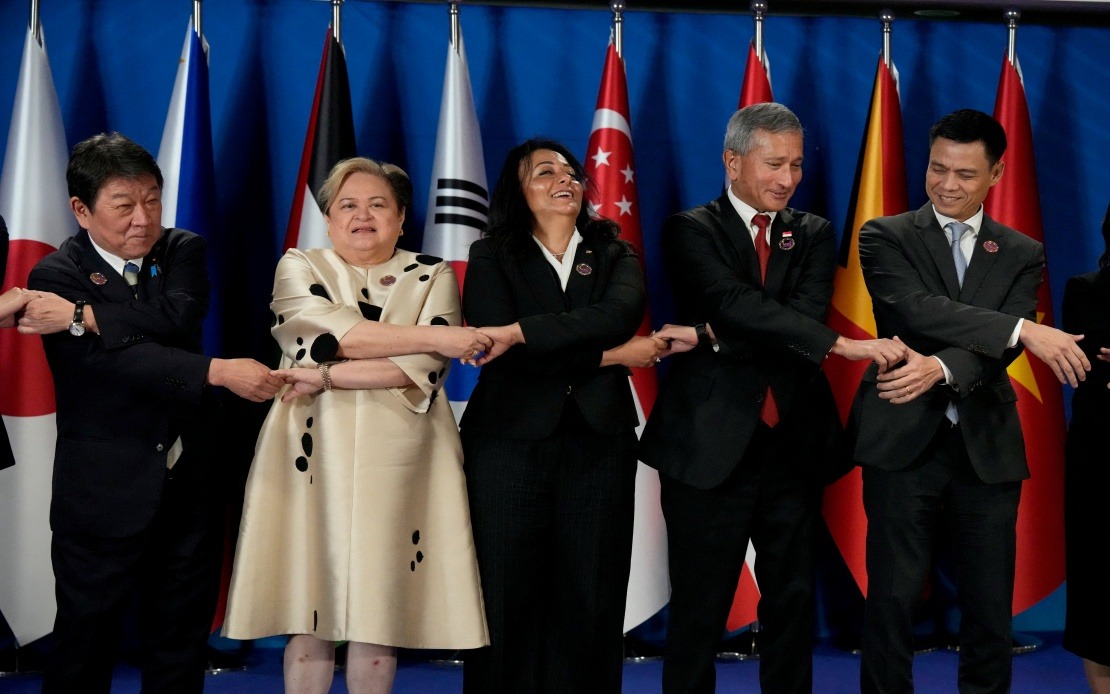
Four major Asia-Pacific economies have underscored their strategic commitment to ASEAN at Post-Ministerial Conferences in Manila, with foreign ministers from Japan, South Korea, Australia and New Zealand each emphasising the bloc's central role in navigating an increasingly volatile and interconnected world. The coordinated messaging reflects growing recognition among developed nations that ASEAN's unity and regional leadership are essential to managing both opportunities and risks that threaten stability across the wider Indo-Pacific.
Japanese Foreign Minister Toshimitsu Motegi articulated Tokyo's vision for closer ties centred on three transformative pillars: digital innovation, artificial intelligence development, and the transition to cleaner energy systems. Japan's framing reflects its own economic challenges and the need to secure partnerships that can drive competitiveness while addressing environmental pressures. For Malaysian policymakers, Japan's emphasis on these sectors signals potential avenues for bilateral collaboration and technology transfer, particularly as the country seeks to modernise its manufacturing base and energy infrastructure in alignment with regional sustainability goals.
Seoul's representative, Foreign Minister Cho Hyun, diagnosed the region's predicament with particular clarity, identifying three interconnected threats reshaping the strategic landscape: the fragmentation of global supply chains that underpins economic stability, the escalating instability in West Asia with its spillover effects on energy markets, and the disruptive pace of technological change. South Korea's framing is notably candid about the dual nature of transformation—creating both fresh possibilities and genuine dangers. This assessment resonates acutely with Southeast Asian economies dependent on stable trade flows and vulnerable to energy price shocks. Cho's emphasis on building solidarity and expanding strategic space reflects Seoul's own vulnerabilities as a technologically advanced nation operating within a volatile geopolitical environment.
Beyond rhetoric, South Korea is anchoring its partnership through concrete initiatives. An AI companionship programme and a cultural and creative industries initiative represent attempts to embed cooperation at both technological and human levels. These ventures offer templates for ASEAN members considering how to balance innovation adoption with cultural preservation—a tension increasingly relevant as artificial intelligence tools reshape workforces and creative sectors across Southeast Asia.
New Zealand's Foreign Minister Winston Peters articulated a complementary concern, casting current global circumstances as genuinely novel and multifaceted. His framing encompassed renewed great-power competition, the erosion of multilateral institutions that once provided predictable frameworks for international conduct, the advent of artificial intelligence with transformative potential, and accelerating climate disruption. Peters positioned partnership as the antidote to fragmentation, emphasising knowledge-sharing, trade relationships, and mutual prosperity as the foundations for collective resilience. This perspective carries particular weight for smaller economies like those in ASEAN that depend on rules-based frameworks to constrain the leverage of larger powers.
Australian Foreign Minister Penny Wong provided perhaps the most sombre assessment, characterising the preceding year as notably challenging and documenting how the strategic landscape has hardened through intensified competition and elevated risks of unintended escalation and miscalculation. She specifically cited shocks emanating from West Asia as having global ramifications still unfolding, with consequences for the reliability of food and energy supplies as well as critical inputs including fertiliser and industrial materials. For Malaysia and other ASEAN members with economies dependent on global supply chains and energy imports, Wong's diagnosis underscores why regional economic resilience has become strategically urgent.
Australia's commitment to supporting ASEAN-led economic initiatives provides a concrete dimension to regional partnership. The ASEAN Power Grid and Digital Economy Framework Agreement represent infrastructure and institutional projects designed to deepen integration and reduce systemic vulnerabilities. These initiatives offer Malaysian stakeholders opportunities to participate in region-building efforts that could reduce exposure to external shocks while generating economic opportunities through enhanced connectivity and digital commerce.
Wong's broader argument—that ASEAN holds the geographic, political, and institutional centre of a region where global futures are being determined—reflects a shift in how developed democracies conceptualise Southeast Asia. Rather than viewing the region as peripheral to great-power competition, Australia positions ASEAN as constitutive of regional order itself. This framing elevates the stakes for ASEAN unity and institutional efficacy, making the bloc's capacity to mediate tensions and coordinate responses to transnational challenges essential not merely for Southeast Asian prosperity but for broader Indo-Pacific stability.
The convergence of messaging across four developed nations suggests coordinated diplomatic positioning rather than isolated statements. All four emphasised ASEAN's centrality and their own commitment to partnership; all identified technological transformation and climate change as priority domains; and all couched their engagement in terms of supporting ASEAN-led initiatives rather than pursuing unilateral agendas. This rhetorical restraint and institutional deference likely reflects lessons learned from previous attempts by external powers to shape regional outcomes through direct coercion or dominance.
For Malaysia specifically, these developments carry multifaceted implications. The emphasis on digital transformation and AI development creates opportunities for Malaysian companies and researchers to participate in regional innovation ecosystems, potentially attracting investment and talent. The focus on supply chain resilience and economic integration aligns with Malaysia's own interests in manufacturing competitiveness and market access. Additionally, the strong positioning of ASEAN as a central geopolitical actor validates Malaysia's strategic hedging approach, which has historically sought to balance relationships with multiple powers rather than entering exclusive alignments.
The meeting outcomes also underscore the vulnerability of regionalism to external pressures. While all four nations praised ASEAN centrality, their engagement is ultimately driven by their own strategic interests in constraining competition, managing risks, and securing access to Southeast Asian markets and resources. The sustainability of these partnerships depends on whether developed economies can maintain commitment through periods of great-power tension or economic downturn—a test that previous regional architecture has not always withstood.
Looking forward, the challenge for ASEAN and its member states will be converting diplomatic support into concrete institutional capacity and economic outcomes. The initiatives mentioned—AI programmes, digital frameworks, power grids—require sustained funding, technical expertise, and political will across multiple constituencies. Malaysia, as a significant ASEAN member with substantial technological capacity and economic weight, will play a crucial role in determining whether regional initiatives translate into shared prosperity or become hollow institutional shells that mask persistent inequalities and vulnerabilities.

