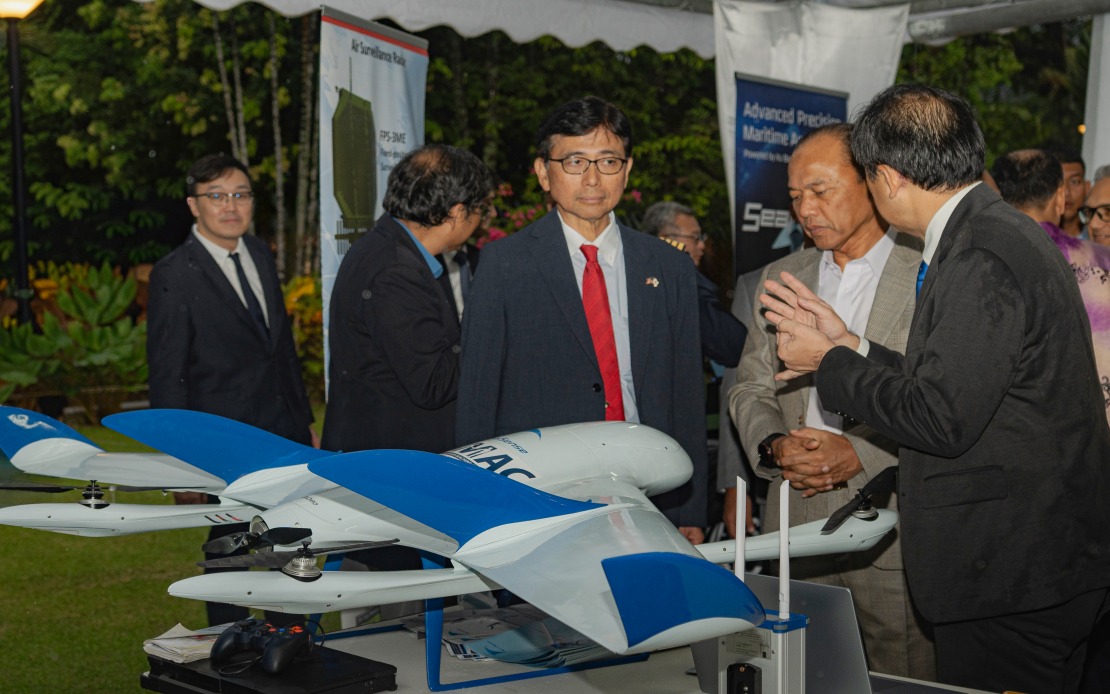
Japan is positioning itself for substantially deeper security engagement with Malaysia, according to remarks delivered by Ambassador Noriyuki Shikata at the Japan Self-Defence Forces Day Reception in Kuala Lumpur on Wednesday. The commitment comes at a moment when geopolitical tensions across the Indo-Pacific have prompted Japan and regional democracies to recalibrate their defence partnerships. Malaysia, as a nation straddling critical sea lanes and maintaining strategic autonomy in regional affairs, has become increasingly central to Japan's security architecture in Southeast Asia.
The foundation for this intensified cooperation was laid during Prime Minister Datuk Seri Anwar Ibrahim's recent visit to Japan, where he met with Prime Minister Sanae Takaichi. Both leaders reaffirmed a determination to strengthen strategic coordination, particularly in defence and security matters. This alignment reflects a broader pattern across Asia-Pacific capitals, where democracies are quietly but steadily building interlocking security relationships to manage uncertainties ranging from supply chain vulnerabilities to contested waterways.
Central to the Japan-Malaysia partnership is the alignment between Japan's Free and Open Indo-Pacific vision and ASEAN's own Outlook on the Indo-Pacific. These two frameworks, while emanating from different institutional sources, share core principles around freedom of navigation, rules-based maritime order, and economic openness. By synchronising these visions, Japan and Malaysia are helping to anchor Southeast Asian regionalism with like-minded security approaches rather than allowing strategic drift to occur in the absence of coherent alternatives.
The bilateral relationship achieved a significant institutional upgrade in 2023 when Japan and Malaysia elevated their connection to a Comprehensive Strategic Partnership, a designation that places the relationship among Japan's most consequential in the region. This elevation is not merely symbolic; it reflects the two governments' recognition that deepening ties serve mutual interests in an era of strategic competition. As Ambassador Shikata noted, the upcoming 70th anniversary of diplomatic relations in 2025 provides an opportunity to further institutionalise cooperation across multiple domains.
Maritime security forms the practical backbone of this partnership. The MALPAN exercise, conducted regularly between Japan's Maritime Self-Defence Force and the Royal Malaysian Navy in the South China Sea and Strait of Malacca, has evolved from a bilateral naval undertaking into something more ambitious. The inclusion of the Royal Malaysian Air Force in the April iteration demonstrates how security cooperation is expanding beyond traditional naval dimensions into integrated tri-service coordination. These exercises serve dual purposes: they build interoperability among allied forces while sending clear signals about commitment to maintaining open sea lanes in waters through which trillions of dollars in global trade flow annually.
Japan's Official Security Assistance programme, established in 2023 as an alternative mechanism to traditional military sales, reflects Tokyo's strategy of deepening defence relationships through equipment transfers and capacity-building rather than headline-grabbing arms deals. Malaysia ranks among the earliest recipients of this assistance. The provision of unmanned aerial vehicles and rescue boats in previous years has given way to more sophisticated contributions, including ceasefire monitoring equipment provided to ASEAN's observer missions and, notably, a diving support vessel destined for the Royal Malaysian Navy. These transfers, while individually modest, cumulatively demonstrate Japan's intention to strengthen Malaysia's operational capabilities in domains directly relevant to regional stability.
The diving support vessel acquisition deserves particular attention for Malaysian readers and policymakers. Such vessels are essential for submarine rescue operations, underwater infrastructure maintenance, and deep-water salvage operations. By providing this capability, Japan is essentially enabling Malaysia to operate more independently in the maritime domain while simultaneously fostering deeper naval integration with Japanese self-defence forces through training and operational experience. This reflects a sophisticated approach to security cooperation that builds capacity without creating dependency.
Defence industry collaboration represents an underexplored but potentially significant dimension of the deepening partnership. The participation of 10 Japanese companies in the Defence Services Asia 2026 exhibition in Kuala Lumpur signals corporate-level commitment to the Malaysian market. More substantially, the signing of Terms of Reference for a bilateral defence industry dialogue during the same event creates formal mechanisms through which technological transfer, joint production possibilities, and supply chain integration can be explored. For Malaysia, such arrangements offer pathways to acquire advanced systems while potentially developing local expertise and manufacturing capabilities.
The presence of General Tan Sri Malek Razak Sulaiman, the Armed Forces chief, at the ambassador's remarks underscores institutional buy-in from Malaysia's defence establishment. Military leadership endorsement is essential for translating diplomatic commitments into sustained operational cooperation. The Malaysian armed forces' evident enthusiasm for deepening ties with Japan reflects recognition that Japanese self-defence capabilities, technological sophistication, and commitment to rules-based order align with Malaysia's own security interests in an increasingly contested region.
For Malaysia specifically, this partnership carries several strategic implications. First, it provides diversified security partnerships at a time when regional nations are increasingly reluctant to align exclusively with any single external power. Second, Japanese technology and training can enhance Malaysian maritime capabilities at a time when protecting exclusive economic zones and maintaining freedom of navigation have become central to regional stability. Third, the partnership signals to other regional actors that Malaysia maintains serious relationships with technologically advanced democracies committed to international law and peaceful dispute resolution.
The broader Indo-Pacific context remains crucial for understanding why both countries are prioritising this relationship now. Rising strategic competition, contested maritime zones, and concerns about unilateral changes to the regional status quo have prompted established democracies and regional powers to strengthen their partnerships. Japan's approach differs from more confrontational postures by emphasising practical cooperation, capacity-building, and institutional frameworks rather than explicit balancing rhetoric. Malaysia's participation in these mechanisms reflects its pragmatic approach to navigating great power competition while preserving strategic autonomy.
Looking ahead to 2025 and beyond, the trajectory appears set for continued expansion. The explicit commitment to deepen cooperation in defence and security, coupled with concrete mechanisms through equipment transfers, joint exercises, and industry dialogue, suggests that Japan-Malaysia security ties will become progressively more integrated. For Southeast Asian observers, this partnership model offers a template for how regional nations can engage with external powers in ways that enhance security without sacrificing sovereignty or regional stability.

